
North Africa
Libya

Turkey prepares Libya intervention

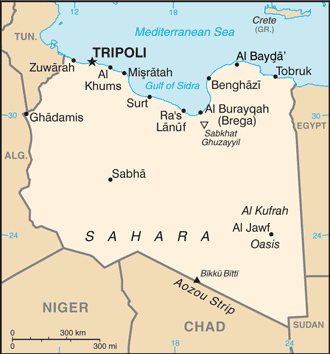
The Turkish parliament voted overwhelmingly to send troops to Libya, to back up the UN-recognized government in Tripoli, now under siege from an offensive by warlord Khalifa Haftar, who is loyal to the rival government in the country’s east. Lawmakers voted in an emergency session to give Ankara a one-year mandate to deploy forces to the North African country. US President Donald Trump responded to the vote by calling his Turkish counterpart Recep Tayyip Erdogan, warning him against intervening in the Libyan conflict. Weeks earlier, the US State Department issued a statement calling on Haftar to halt his offensive, and also warned against “Russia’s attempts to exploit the conflict.” Russia is believed to be backing Haftar. The Libya Observer reports that “random shelling continues to take civilian lives” as Haftar’s forces and “foreign mercenaries” mount an advance on Tripoli’s airport. (Map: CIA)
Iran

Trump sends more troops to Persian Gulf

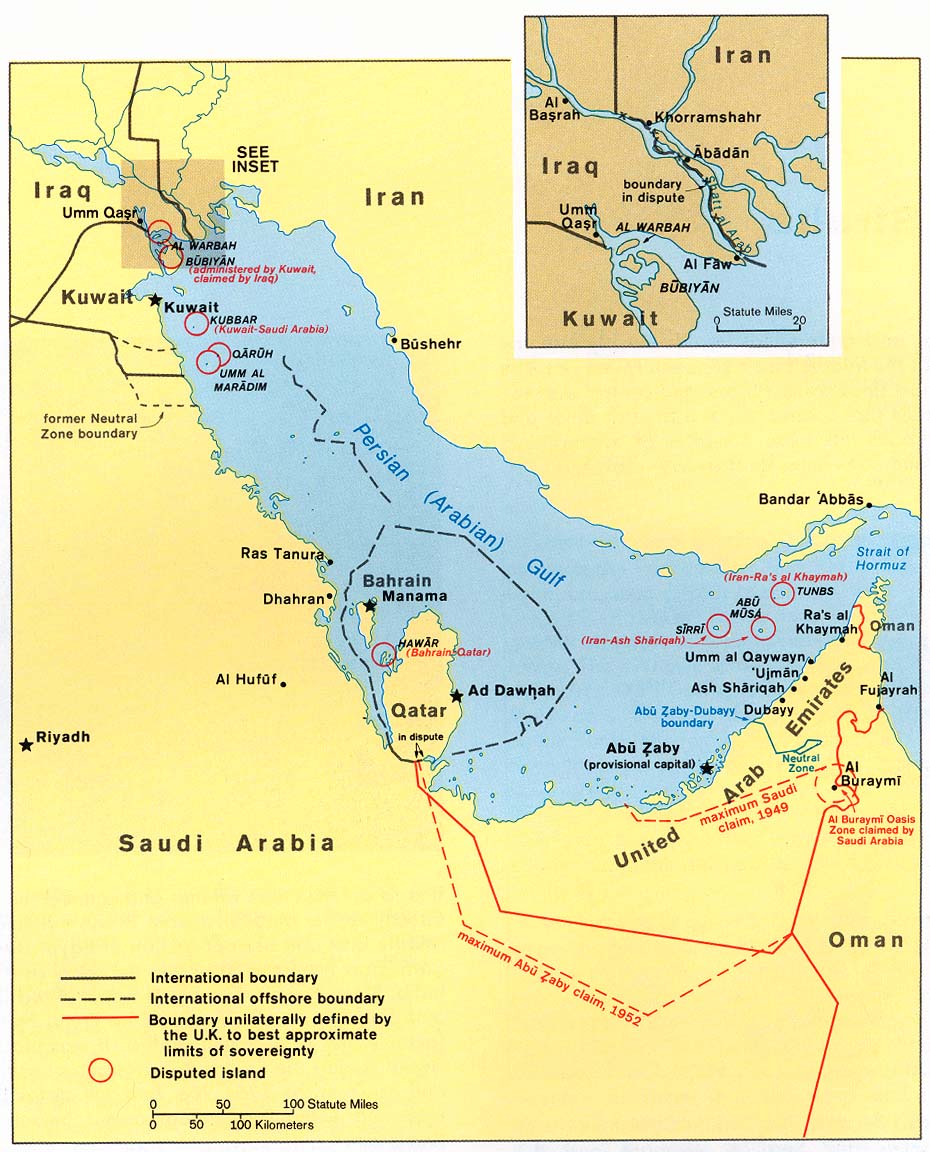
In response to the recent escalation in Iraq, President Trump has ordered thousands more US troops to neighboring Kuwait—and hudreds more Marines into Iraq itself. The US and Iran are playing a geo-strategic game for control of Iraq, and the greater region. Both sides are treating the Iraqi people as pawns. As long as ISIS and Sunni jihadists remain a threat, Washington and Tehran can only push things so far. But things could still escalate toward US war with Iran, even if neither side is seeking that outcome. (Map: Perry-Castañeda Library Map Collection)

Europe
berkut

Maidan martyrs betrayed in Ukraine prisoner swap

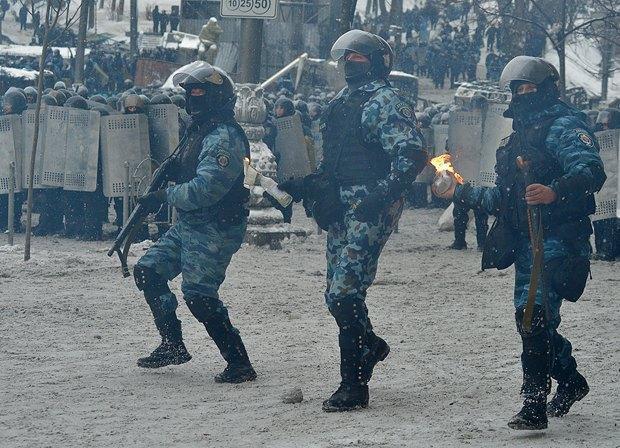
Activists in Ukraine are protesting a judicial ruling they say defers accountability in the massacre of scores of protesters during the Maidan Square occupation of 2014, popularly known as “Heaven’s Hundred.” Five ex-officers of the Berkut, the former regime’s now-disbanded political police, faced charges of killing 48 protesters and wounding 80 others during the February 2014 repression. Another 21 sought in the violence, also members of the Berkut’s elite Black Company, managed to escape to Russia after the fall of the Viktor Yanukovich regime later that month, and some are now believed to have been incorporated into paramilitary groups by the Vladimir Putin government. The five were ordered released from custody by the Kyiv Court of Appeals—among the 200 prisoners freed in a swap between the Ukrainian authorities and Russia-backed separatists. Their release was protested in an open letter to President Volodymyr Zelensky by the group Families of the Heaven’s Hundred Heores, who asserted that it violates international law.  (Photo: EuroMaidan)

Iran
Tabandeh

Iran on edge following death of Sufi leader

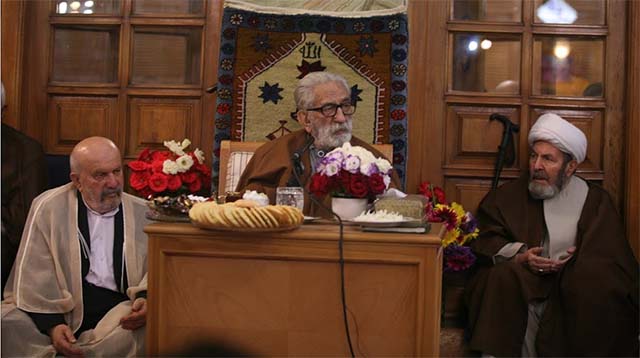
The death of 92-year-old Noor-Ali Tabandeh, also known as Majzoub Ali Shah, leader of Iran’s Gonabadi Sufi order, prompted the regime to take pre-emptive measures against a new outbreak of protests. Riot police took over all streets leading to the hospital where he was held. Tabandeh was a harsh critic of Velayat-e Faqih (Guardianship of Islamic Jurists), the system by which Iran’s orthodox Shi’ite establishment has final say over all laws. He had been under effective house arrest since February 2018, when a wave of protests by Gonabadi dervishes against persecution of their Order led to hundreds of arrests. Since Tabandeh’s death, his followers on social media have been speculating that he was poisoned by the authorities. His passing comes as Iranian authorities have restricted mobile internet use in response to a new call for mass demonstrations. (Photo: Center for Human Rights in Iran)

Southern Cone
lithium

Chile: indigenous win a round in lithium struggle

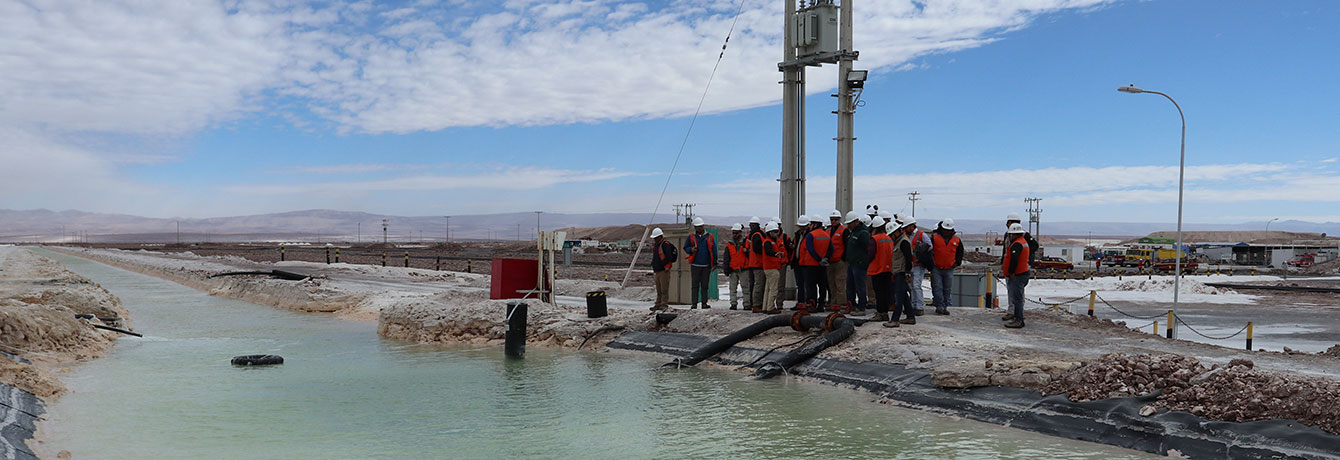
The First Environmental Tribunal in the Chile’s northern city of Antofagasta ruled in favor of indigenous communities that had brought suit against Sociedad Quimica y Minera (SQM), the world’s second-largest miner of lithium. The court found SQM’s compliance plan for water preservation submitted to Chile’s Environment Superintendency (SMA) was “insufficient,” citing the “particular fragility” of the lithium-rich but extremely arid salt-flats where the company hopes to expand operations, the Salar de Atacama. Under the ruling, SQM must submit a new compliance plan, pay multi-million fines to the SMA for being out of compliance, or suspend operations. “We must protect sensitive ecosystems even more when they constitute the ancestral habitat of our native peoples whom the State of Chile is obliged to protect,” the court’s chief justice, Mauricio Oviedo, said in a statement. The case was brought by the local Council of Atacameño Pueblos, representing the impacted indigenous communities of Peine and Camar. (Photo: First Environmental Tribunal of Antofagasta)

The Andes
Chapare

Bolivia: regime threatens autonomous Chapare

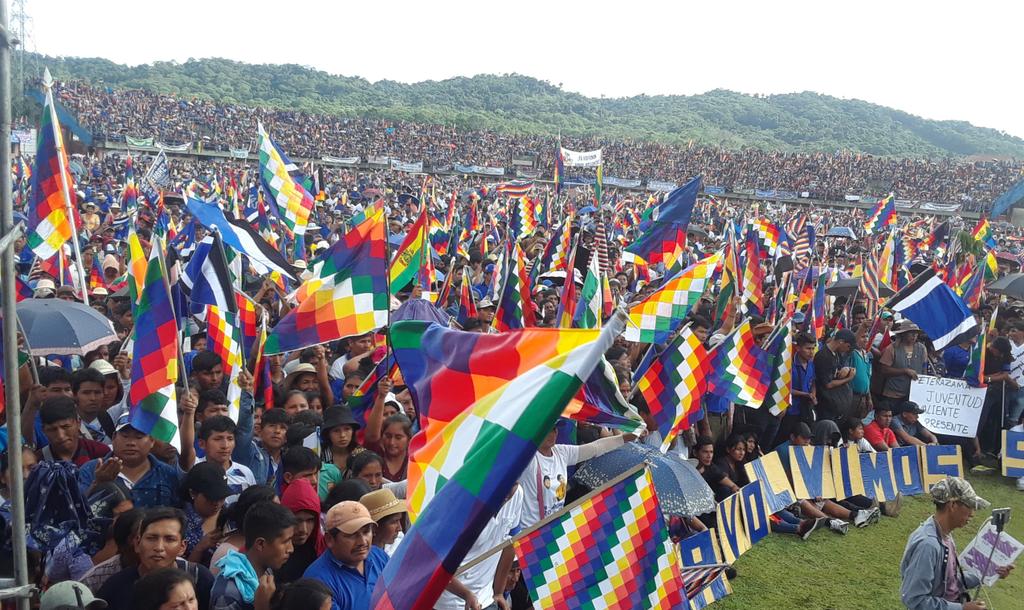
The new Bolivian regime’s Government Minister Arturo Murillo is threatening a military invasion of the eastern lowland region of Chapare, heartland of support for ousted president Evo Morales, which has become a de facto autonmous zone outside the control of La Paz. Murillo implied to reporters that planned new elections will not proceed until control over Chapare has been re-established. In the aftermath of the November coup, the Six Federations of the Tropic of Cochabamba, the cocalero alliance once led by Morales, mobilized to resist the new regime. The region was cut off by cocalero roadblocks, and several National Police statons burned. The roadblocks have since been relaxed, but large areas of the province are without any police presence and effectively independent. (Photo: Ollie Vargas via Twitter)

Syria
Idlib displaced

Syria: thousands flee intensified Idlib offensive

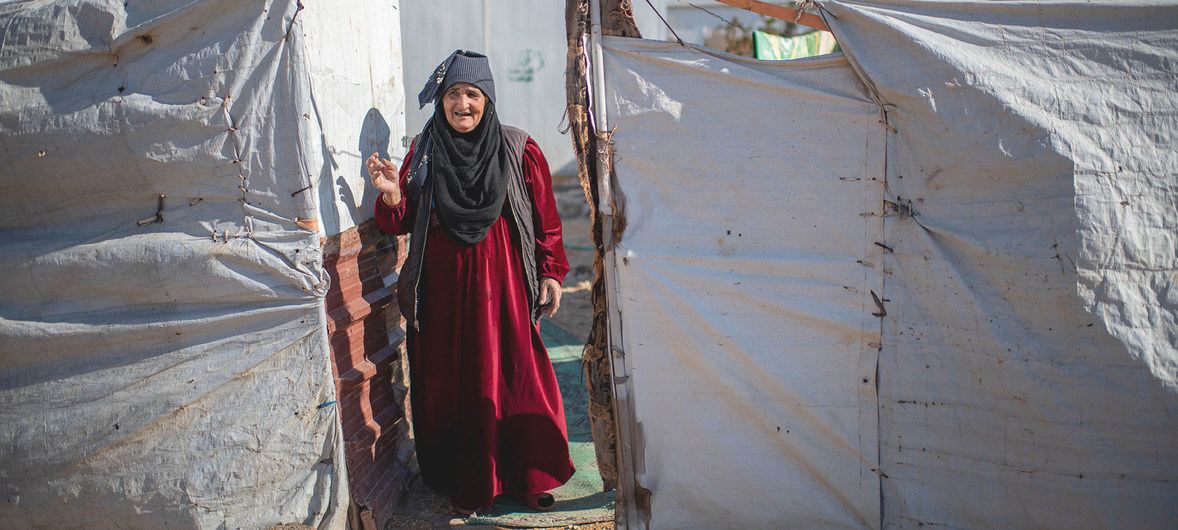
More than 235,000 people have fled from their homes in Syria’s rebel-held Idlib province over the past days, as the Assad regime and Russia escalate their campaign of aerial bombardment. A report from the UN Office for the Coordination of Humanitarian Affairs states that Ma’arrat An Nu’man and other towns in the province are now “almost empty,” while internally displaced persons (IDP) camps in the extreme northwest of the province are rapidly swelling. “Displacement during winter is further exacerbating the vulnerability of those affected,” the report states. Perversely, the renewed offensive comes days after Russia and China vetoed a UN Security Council resolution that would have extended cross-border aid convoys into Idlib from Turkey for another year—essentially condemning many of those not directly killed by the bombs to death by starvation and exposure. (Photo: UNHCR)

Watching the Shadows

Podcast: against the global detention state

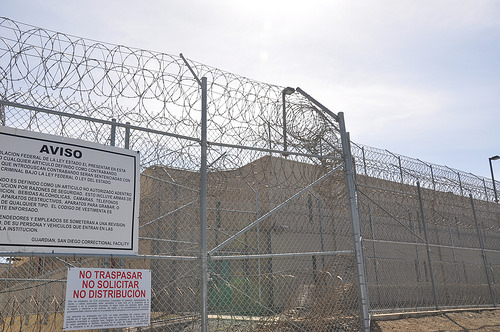
In Episode 45 of the CounterVortex podcast, Bill Weinberg notes with alarm the rapid consolidation of a global detention state, extending across borders and rival power blocs. In the United States, Trump moves toward indefinite detention of undocumented migrants, with horrific rights abuses widespread in the fast-expanding camp system. In China, up to a million Uighurs have been detained in “re-education camps,” and are facing such abuses as forced sterilization. As India hypocritically protests China’s treatment of the Uighurs, it is also preparing mass detention of its own Muslim population. Russia’s Vladimir Putin is similarly preparing mass detention of the Crimean Tatars. In Syria, the Bashar Assad regime has detained hundreds of thousands, and is carrying out a mass extermination of prisoners, almost certainly amounting to genocide. In Libya, countless thousands of desperate migrants have been detained, often by completely unaccountable militias, and an actual slave trade in captured Black African migrants has emerged. Yet Trump exploits the mass internment of the Uighurs to score propaganda points against imperial rival China—and some “leftists” (sic) in the US are so confused as to actually defend China’s detention state. International solidarity is urgently needed at this desperate moment to repudiate such divide-and-rule stratagems. Listen on SoundCloud, and support our podcast via Patreon. (Photo of Homeland Security’s Otay Mesa Detention Center from BBC World Service via Flickr)

Southeast Asia

Killings of ecological defenders rise in Philippines

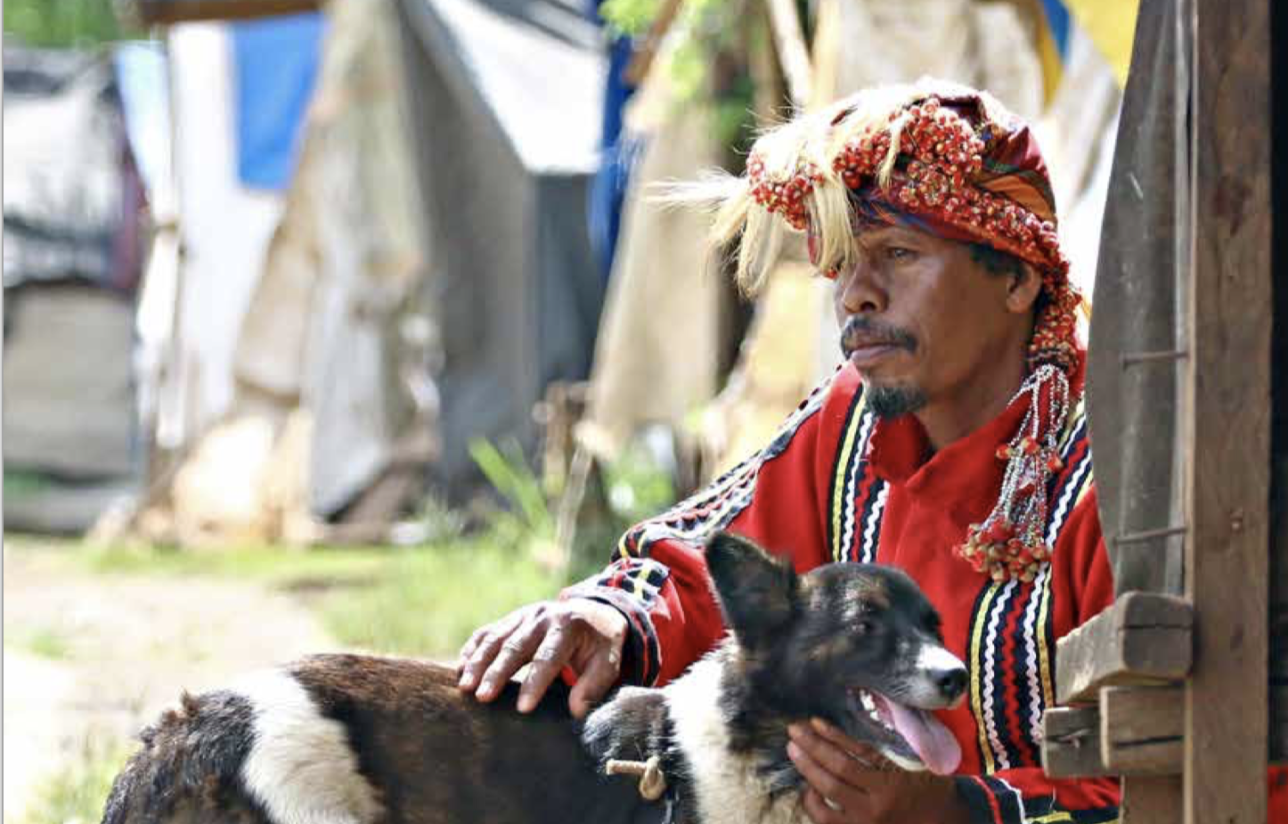
Named the most dangerous country in the world for land and environmental defenders, the Philippines has become an even deadlier place for activists in 2019, with 46 recorded deaths so far this year, according to the Kalikasan People’s Network for the Environment. The same organization recorded 28 killings of land and environmental defenders in 2018. Global Witness, an environmental watchdog, tallied 30 such killings in the Philippines that year and designated the country the most dangerous in the world for defenders based on sheer number of deaths. Small farmers and agricultural workers accounted for the majority of the deaths recorded by Kalikasan PNE this year with 29, or 63%. This was followed by forest rangers or government officials involved in environmental oversight, at 35%. Next were members of the Philippines’ indigenous peoples at 20%, and finally lawyers and church workers at four percent. (Image of man from the Manobo tribe of Mindanao via Mongabay)

Southeast Asia

Philippines: convictions in Maguindanao massacre

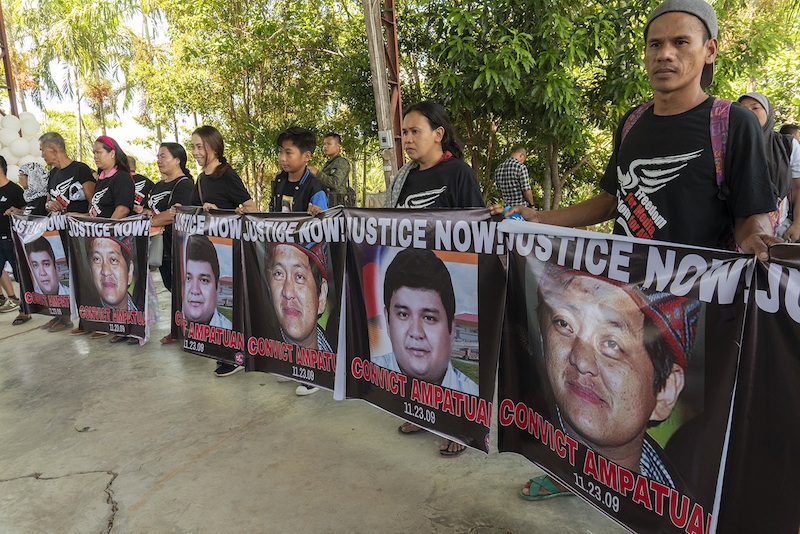
More than a decade after 58 people were killed in the worst case of election-related violence in Philippine history, a court in Quezon City found Datu Andal Ampatuan Jr. and his brother Zaldy Ampatuan guilty of overseeing the November 2009 massacre at Maguindanao. They were sentenced to 40 years without parole. The pair were convicted on 57 counts of murder in the attack on a convoy that included journalists covering an opposition candidate for the governorship of Maguindanao province. Police said 58 were killed in the massacre, but the body of one victim was never found. Their father, then-incumbent governor Andal Ampatuan Sr., was arrested in connection with the case and died in prison while awaiting trial in 2015. The court sentenced a further 15, including more Ampatuan family members and police officials, to between six and 10 years as accessories to the crime. (Photo: Relatives of victims burn portraits of Ampatuan clan members during visit to massacre site. Credit: MindaNews)

Planet Watch
Cumbre de los Pueblos

Madrid climate talks a total bust

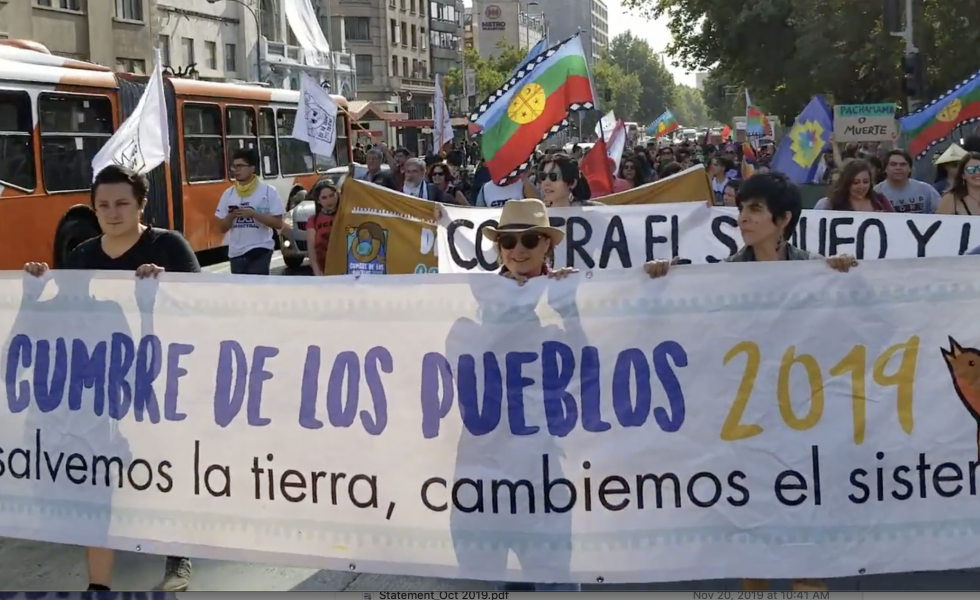
Nearly half a million demonstrators gathered in Madrid as the UN Climate Change Conference (COP25) opened more than two weeks ago, with young Swedish activist Greta Thunberg the star of the show at a mass rally. But despite being the longest climate summit yet, the affair ultimately amounted to little. Nearly 27,000 delegates came together with the supposed aim of finalizing the “rulebook” of the Paris Agreement, which is to officially take effect in 2020—settling mechanisms for international cooperation under Article 6 of the deal. But, unable to agree on terms, delegates finally invoked “Rule 16” of the climate process—allowing them to put off the critical decisions for another year. This means there will have been no progress when COP26 is convened in Glasgow in November 2020. UN Secretary General António Guterres tweeted that he was “disappointed” with the results of COP25, and that “the international community lost an important opportunity.” (Photo: Global Justice Ecology Project)

Africa
Gambia

Gambia: protesters demand president step down

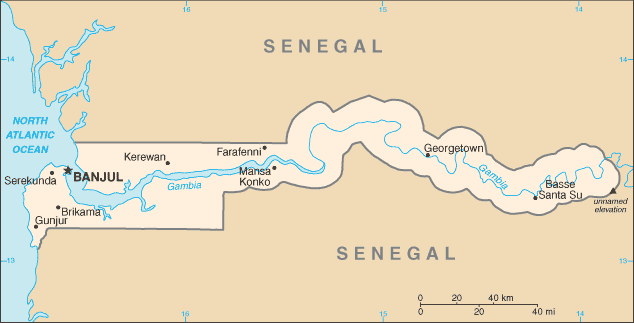
Thousands of Gambians took to the streets in the capital Banjul, demanding that President Adama Barrow honor the agreement he signed with the opposition to step down after three years in office. Barrow, a relative unknown at the time, defeated long-ruling Yahya Jammeh in elections in the small West African state in 2016. He promised to rule for three years before stepping down, but he has since said he will govern until 2021, serving a full presidential term. The protests were organized by the movement “Operation Three Years Jotna,” which means “three years enough” in a mix of English and the Wolof language. (Map: CIA)