


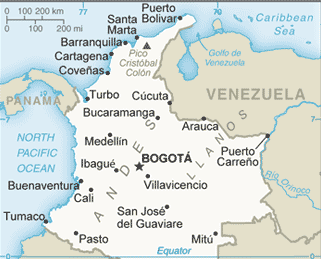
In its latest annual report released May 12, the International Committee of the Red Cross (ICRC) found that the armed conflict in Colombia saw the “worst humanitarian consequences” of the past decade in 2025. The number of people killed or injured by explosive devices rose by 34% to 965, overwhelmingly non-combatants. The number of individual disappearances doubled to 308. Violations of international humanitarian law documented by the ICRC reached 845 cases, while figures for displacement and “confinement” doubled. According to the Comprehensive Victim Support & Reparation Unit (UARIV), at least 235,619 people were displaced individually in 2025, while 87,069 were displaced in mass displacement events, and 176,730 remained “confined” in communities under siege by armed actors. (TNH, ReliefWeb)
Map: PCL


Deadly clashes in Colombia’s Guaviare
More than 50 people have been killed in clashes between two factions of the “dissident” Revolutionary Armed Forces of Colombia (FARC) that has remained in arms despite the peace process. They are evidently fighting for control over strategic drug trafficking routes in the southern region of Guaviare. The government said that casualties include minors who are being increasingly recruited by armed groups. Colombia is holding presidential elections on May 31, following an extremely polarized race. (TNH)
Stakes high in Colombia election
More than 41 million Colombians are eligible to vote in this weekend’s monumental first-round presidential election. The stakes are high: will one of the region’s last major progressive bastions extend its political project, or will it succumb to the right-wing surge that has recently taken power back from the left in Argentina, Chile, Honduras and Bolivia? Early signs suggest the left’s candidate Senator Iván Cepeda is well-positioned to finish first, but it remains unclear whether he will clear the 50% threshold needed to avoid a runoff.
A senator, philosopher and human rights activist whose father was assassinated in 1994, Cepeda catapulted to the top of the left’s field in part because of his role in the case that led to the conviction of former right-wing president Álvaro Uribe on charges related to paramilitary ties last August. Confident that he will finish the day in first place, Cepeda has spent the waning days of his campaign focused on mobilizing enough voters to win outright in the first round. He closed his campaign in the coastal city of Barranquilla, where more than 80,000 supporters packed a rally that reflected the broad enthusiasm his campaign has generated across the country.
In his closing address, Cepeda reiterated the key themes of his campaign, including his vow to crack down on corruption and continue much of the agenda of his predecessor, Gustavo Petro. He also returned to his vision of social change, asserting that his government’s “main commitment will be to the poor” and arguing that “when inequality is reduced, when historical injustice is repaired, and when the state protects those who were never protected, all of society is better and advances.”
Cepeda’s rally, staged in a popular barrio in which he laid out a progressive vision of society, contrasted starkly with that of his leading challenger, far-right lawyer Abelardo de la Espriella. Fittingly for a man whose policies are more spectacle than substance, de la Espriella closed his campaign with an over-the-top rally in Medellín. Encased in a bullet-proof box, he waved his fists around, vowed to “die” defending Colombia’s honor, and urged his supporters—whom he calls “defenders of the homeland”—to join him in doing so “by reason or by force.”
The rhetoric is consistent with a candidate who is seen by many as a “Colombian Bukele.” De la Espriella has promised to abandon peace talks and double down on military force to confront the country’s armed conflict. Like other leaders of the global far right, he has cast himself as an anti-establishment outsider. Yet nothing could be further from the truth: he has spent much of his career as a lawyer representing powerful political and business interests. His history of defending controversial figures, alleged ties to right-wing paramilitary groups, and hardline proposals have led critics to dub him a “narcolawyer.” The first-time candidate, who calls himself “The Tiger,” was living in Italy before launching his presidential bid.
Recent polling suggests that de la Espriella has overtaken Paloma Valencia, the candidate of the traditional right and a protegée of former President Uribe. After dominating the March primary of a coalition of right-wing parties, Valencia was widely expected to emerge as the strongest conservative contender. While some analysts still believe she could outperform expectations, Colombian voters appear to be tiring of the traditional right. Even so, her primary victory and a sizable pool of undecided voters make the outcome far from certain.
The left’s current strength cannot be separated from Petro’s successful presidency. Though Cepeda trails both de la Espriella and Valencia in hypothetical runoff scenarios, early polling for the 2026 election took a right-wing victory as a foregone conclusion. Petro’s recent surge in popularity has complicated that narrative. Despite governing amid immense constraints, Colombia’s first left-wing president has presided over historic gains for the country’s popular classes. While Colombia continues to grapple with serious challenges—not least an ongoing armed conflict that has been politically damaging for Cepeda—the left’s time in power has shown that improving the material conditions of the working classes is a popular project. Petro is set to leave office with an approval rating near 50 percent—more than double that of his last two predecessors. (NACLA Update)
Colombia’s presidential election goes to run-off
Colombia’s presidential election will go to a runoff June 21 between a leftist and right-wing candidate on opposite ends of the political spectrum, after the May 31 vote produced no overall winner.
The right-wing Abelardo de la Espriella, an admirer of Donald Trump, came top in the vote, followed closely by the left-wing senator Iván Cepeda, an ally of the current president Gustavo Petro. (BBC News)
Colombia’s hard right turn
Abelardo de la Espriella, a 47-year-old far-right lawyer and political newcomer, was officially declared the winner of Colombia’s presidential election on June 25, bringing to an end days of uncertainty following the June 21 razor-thin result. Leftist candidate Iván Cepeda, President Gustavo Petro, and their allies had initially refrained from conceding defeat until the official recount was complete. On June 24, Cepeda accepted the outcome while denouncing foreign intervention in the election and promising peaceful resistance to de la Espriella’s agenda. Petro has been more reluctant to officially recognize the result, though he has continued preparations for the transfer of power on Aug. 7.
De la Espriella’s victory marks a milestone for Colombia’s far-right. While the country has long had a deeply conservative political establishment, his explicitly “populist” appeal—however phony it may be—represents a departure from the traditional Colombian right, even as it ultimately supported him. Perhaps seeking to consolidate that alliance, de la Espriella cast a more “moderate” tone in his acceptance speech, calling upon Colombians to “leave behind divisions” and promising to govern on behalf of “all Colombians” while respecting the constitutional rights of the opposition. Given his historically narrow mandate—he beat Cepeda by less than one percentage point—a play for moderation may prove politically necessary.
Yet his ongoing attacks on Petro, dark rhetoric about the state of the nation, and early policy moves signal that a more confrontational political climate lies ahead. He has repeatedly referred to Petro’s administration as a “regime” and accused the outgoing president of “degrading” the office of the presidency. He has also painted a dystopian picture of Colombia as a “battered nation” that will require “sacrifice, discipline, and work” to “save.” On the policy front, he has vowed to end all negotiations with the country’s armed groups, giving them one month to surrender, or else, and pledged to strengthen tieswith Israel while joining the Trump administration’s growing “Shield of the Americas” coalition.
Given his own ties to organized crime, de la Espriella would fit well within the Shield of the Americas, a coalition ostensibly dedicated to combatting “narcoterrorism” but increasingly composed of regional leaders who themselves face serious allegations of corruption or criminality. (NACLA Update)
Post-electoral tensions in Colombia
Weeks after left-wing presidential runner-up Iván Cepeda officially recognized the victory of far-right narcolawyer Abelardo de la Espriella, tensions over Colombia’s Aug. 7 transfer of power continued to escalate. Last week, Cepeda placed conditions on his acceptance of the new government, including that de la Espriella renounce his US citizenship and clarify as to whether he has acted as a US “agent,” an accusation linked to his ties to businessman Alex Saab and a Colombian paramilitary who served as a DEA informant. He has also demanded assurances that outgoing President Gustavo Petro would not face extradition to the United States—a real fear given the ongoing US investigations into Petro’s alleged ties to drug traffickers and public declarations from Carlos Alonso Lucio, a key member the incoming government, to prosecute and potentially extradite him. Petro, for his part, has continued to argue the election was fraudulent, while his government launched legal proceedingsagainst Lucio. De la Espriella responded by accusing Petro of leading a “coup” to stay in power and suspended the formal process through which representatives from both sides meet to transfer power. (NACLA Update)
Colombia’s tense transition
During his final two public speeches marking Colombia’s Independence Day celebrations on July 20, outgoing President Gustavo Petro sharply ratcheted up political tensions. Speaking first to supporters in southern Bogotá and then to Congress during the inauguration of its new session, Petro doubled down on his claim that far-right narco-lawyer Abelardo de la Espriella had won the election as a result of fraud. “The Colombian people elected Iván Cepeda,” he declared during his morning speech, promising to provide evidence for his contentious claim. He later announced a “nullity lawsuit” challenging the election on X.Petro also called on his supporters to prepare to mobilize “by the millions” to defend his government’s social reforms, which he argued before Congress had contributed to unprecedented economic growth. He also took aim at incoming president de la Espriella’s foreign policy choices, critiquing his move to restore relations with Israel and arguing that he would be merely a “servant” to the Trump administration. De la Espriella, meanwhile, has focused on bolstering his image as a security hardliner, breaking with tradition by seeking to be sworn in at a military garrison and announcing that Medellín will host a regional office of the US-led anti-cartel alliance known as the “Shield of the Americas.” (NACLA Update)
Espriella moves inauguration to Cali in play to populism
Abelardo de la Espriella Abelardo opted to move his inauguration out of the country’s capital of Bogotá to the city of Santiago de Cali—ostensibly to get the ceremony away from the seat of power and closer to the people.
Even with his promise to be a president for all, it was clear some were not happy with the political change. Security forces establish a heightened presence before the inauguration. Police seized a bus loaded with explosives in southern Colombia which they believe was headed toward the inauguration site.
And across the country, hundreds gathered to protest, disavowing the incoming president. (NewsHour)