Watching the Shadows
Orwell

Podcast: Trump for War-is-Peace Prize

In Donald Trump’s perverse ambition to win the Nobel Peace Prize, he is citing his supposed diplomatic victories in ending six conflicts: Armenia-Azerbaijan, Congo-Rwanda, Israel-Iran, India-Pakistan, Thailand-Cambodia and Egypt-Ethiopia. In Episode 292 of the CounterVortex podcast, Bill Weinberg examines each of these examples, and breaks down how claims to have won “peace” are either extremely overstated or (more often) total Orwellian jive. The implication that Russia-Ukraine will be next, as Putin escalates his aggression, puts a hideous crown on the irony. (Image via Twitter)
The Caucasus
Armenia-Azerbaijan

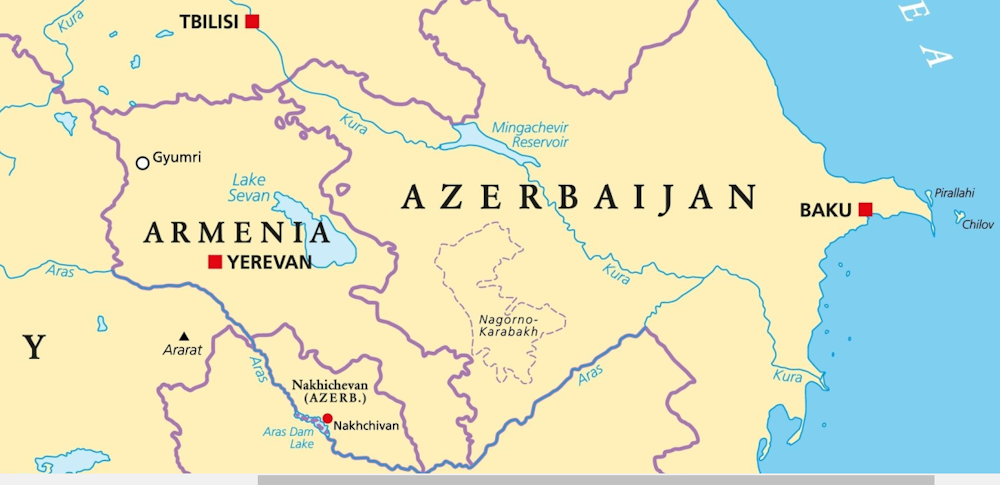
‘Trump Corridor’ through Armenia under ‘peace’ deal

Prime Minister Nikol Pashinyan of Armenia and President Ilham Aliyev of Azerbaijan signed a joint declaration at the White House, with Donald Trump boasting that the US-brokered deal ends decades of conflict between the Caucasus neighbors. Critically, the agreement calls for a new transport corridor across Armenian territory, linking Azerbaijan to its exclave of Nakhchivan, which lies between Armenia and the borders with Turkey and Iran. The corridor is to be named the “Trump Route for International Peace & Prosperity,” and Armenia has granted the United States the right to manage it for 99 years. US companies will have exclusive development rights on the corridor throughout this period. (Map: Peter Hermes Furian/Shutterstock via The Conversation)

Planet Watch
Tbilisi

Podcast: nullify the election! IV

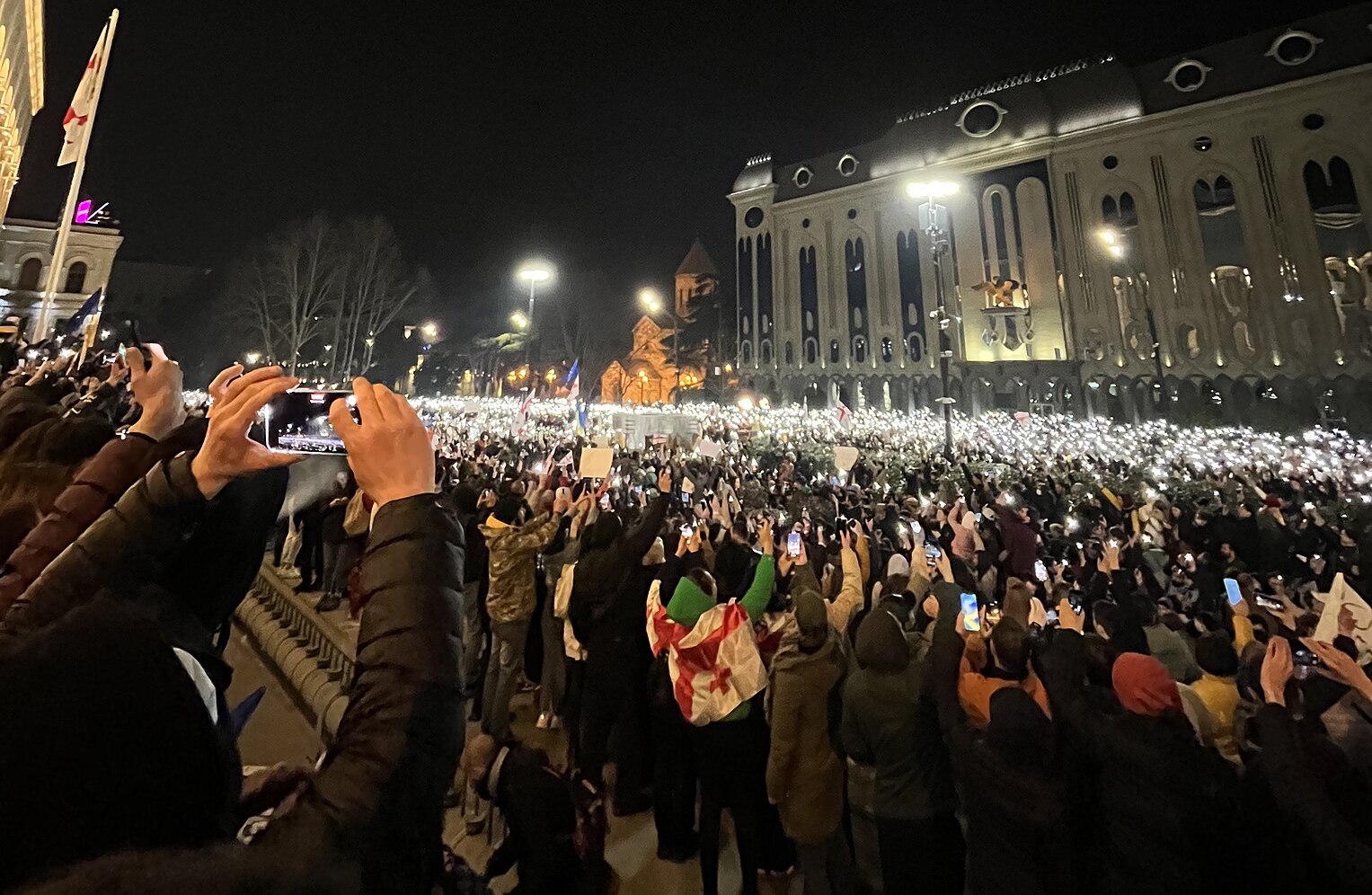
Around the world, with inspiring heroism and courage, people are putting everything on the line to defend democracy and prevent the consolidation of dictatorships. In the Republic of Georgia, protests continue in the wake of contested elections that consolidated the rule of an authoritarian pro-Russia party, and the incumbent opposition-backed president is refusing to step down until new polls are held. In Romania, where a Putin-favored right-wing populist won the first-round vote for the presidency, that round has now been annulled by the country’s high court in response to a public outcry over Russian meddling. In South Korea, President Yoon Suk Yeol’s declaration of martial law was met with defiant protests, prompting an overturn of the declaration by the National Assembly, followed by a vote to impeach Yoon, and the opening of a criminal investigation on charges of “insurrection.” Mozambique has seen months of angry protests since contested elections that saw yet another victory for the entrenched machine FRELIMO—despite a deadly police crackdown. And in Brazil, ex-president Jair Bolsonaro, indicted for leading a Trump-style attempted auto-golpe in 2022, has been barred from office. In Episode 257 of the CounterVortex podcast, Bill Weinberg again asks: Why is everyone so quiet here in the United States, the seat of the empire, where the stakes are the highest? (Photo of protest in Tbilisi, Georgia: DerFuchs via Wikimedia Commons)

Oceania
new caledonia

Podcast: New Caledonia in the Great Game

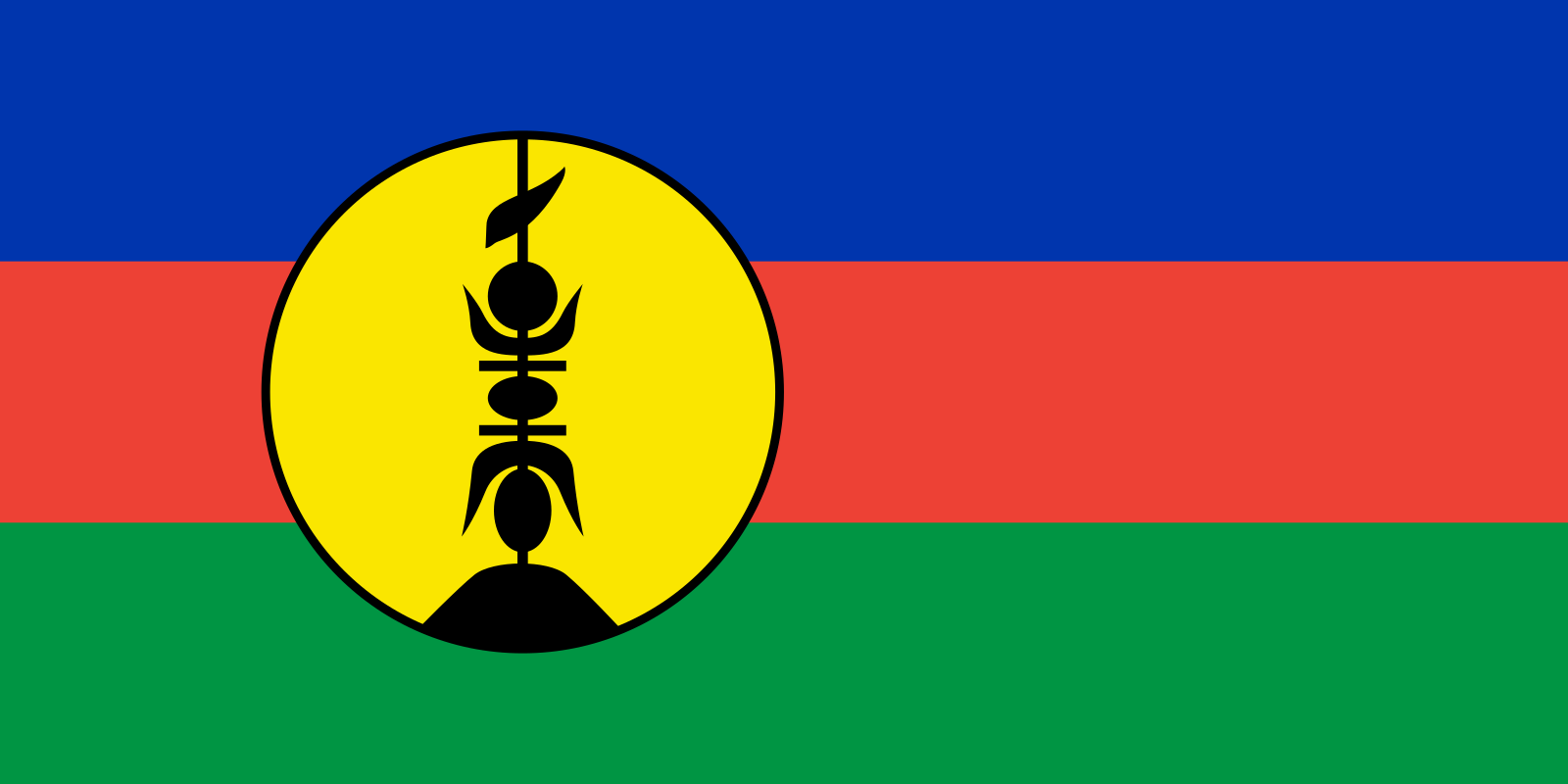
Azerbaijan, now facing accusations of genocide against Armenians, suddenly rallies to the defense of the Kanak indigenous people in the French overseas territory of New Caledonia, and accuses France of a legacy of “crimes against humanity” in its colonial holdings. This appears to be blatant retaliation for French support of Armenia in the conflict between the two Caucasus nations. The repression of the Kanak uprising in their colonized homeland and the cleansing of the Armenians from their usurped ancestral lands both demand our protest—but the propaganda game makes everything more complicated. Yet another example of how a global divide-and-rule racket is the essence of the state system. Bill Weinberg discusses in Episode 227 of the CounterVortex podcast. Listen on SoundCloud or via Patreon. (Flag image via Wikipedia)

The Caucasus
Nagorno-Karabakh

ICC petitioned to investigate new Armenian genocide

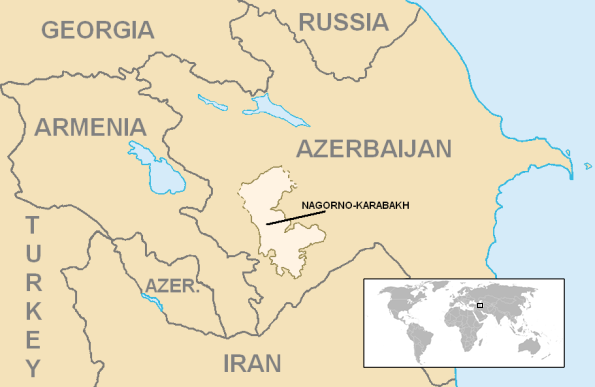
The California-based Center for Truth & Justice (CFTJ) published a report purporting that acts of genocide have been committed in the contested Nagorno-Karabakh region and Armenian border provinces, and calling upon the International Court of Justice to open an investigation. The CFTJ claims that Azerbaijani security forces have evicted ethnic Armenians from their native lands in these areas since the war of 2020, documenting instances of torture, arbitrary detentions and extrajudicial killings. (Map: Wikipedia)

The Caucasus
Caucasus

Anti-Semitic riots, attacks in Russian Caucasus

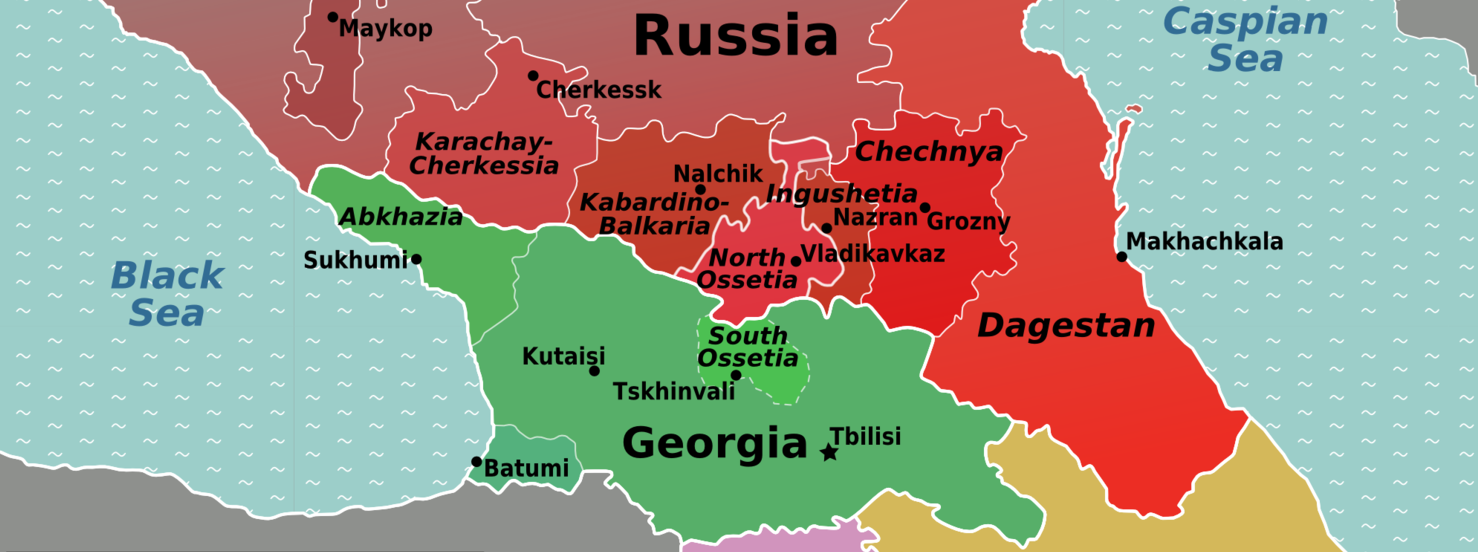
An angry mob in Russia’s Caucasus republic of Dagestan stormed the airport of regional capital Makhachkala, seking to confront passengers arriving on a flight from Israel. Some held signs reading “Child killers have no place in Dagestan” and “We are against Jewish refugees.” The National Guard only showed up hours after rioters had overrun all areas of the airport, including the runway. Clashes then ensued, with several arrested. There was a similar scene in the Dagestani city of Khasavyurt, after reports on social media claimed that “refugees from Israel” were being accommodated at a local hotel. Another such rally was reported from Cherkessk, capital of Karachay-Cherkessia republic. And in Nalchik, capital of Kabardino-Balkaria, an under-construction Jewish cultural center was set ablaze, with “Death to the Yahudi” written in Russian on one wall. (Map: Perry-Castañeda Library Map Collection)

The Caucasus
Nagorno-Karabakh

Podcast: the fall of Artsakh & the fate of the Armenians

With a mass exodus of ethnic Armenians underway from the enclave of Nagorno-Karabakh following its fall to Azerbaijani forces, the threat of “ethnic cleansing” looms. The enclave had maintained a de facto independence as the Republic of Artsakh since 1991, but the war in Ukraine has pushed the stand-off out of the headlines, and ironically given Azerbaijan a free hand to finally re-take the territory. In Episode 193 of the CounterVortex podcast, Bill Weinberg explores the historical roots of the conflict, and demonstrates how the Armenians of Artsakh have been betrayed by all the Great Powers—including both Russia and the United States. Listen on SoundCloud or via Patreon. (Map: Wikipedia)

The Caucasus
Nagorno-Karabakh

Republic of Artsakh falls to Azerbaijan

Azerbaijan launched an assault on the breakaway enclave of Nagorno-Karabakh, taking the territory that had been held by ethnic Armenian separatists since 1991. Through the mediation of the Russian peacekeeping contingent stationed in the enclave, Azerbaijan and leaders of the self-declared Republic of Artsakh reached a ceasefire agreement that calls for the disbanding of the Artsakh Defense Army, and the removal of Armenian military forces from the peacekeeping zone that has linked the enclave to Armenia. The military operation claimed some 30 lives, including at least seven ethnic Armenian civilians. The EU said it will monitor implementation of the ceasefire and warned that forced displacement of the Karabakh Armenians will be met with a “strong response.” (Map: Wikipedia)

Europe
Darya Polyudova

Solitary confinement for Russian anti-war dissident

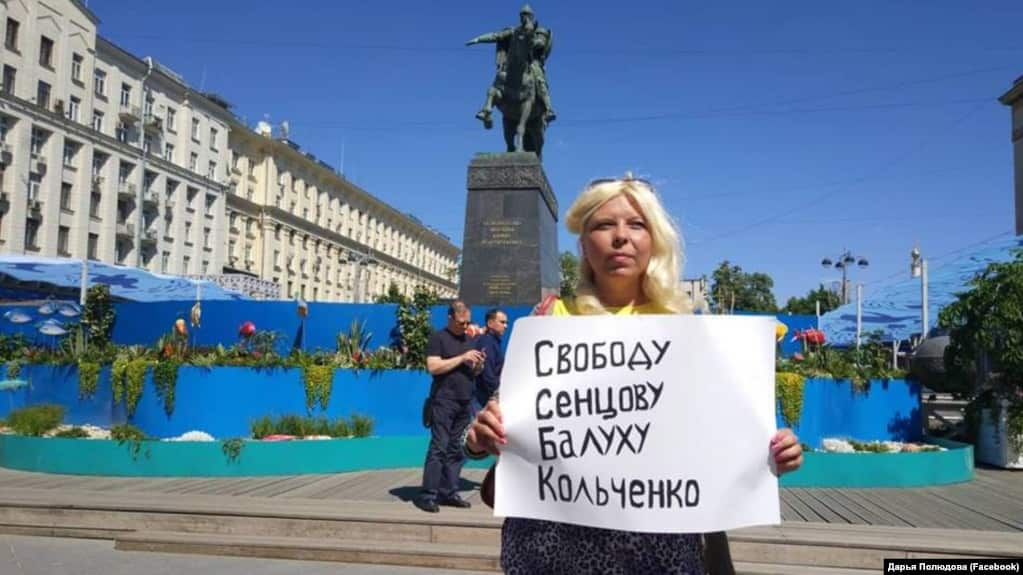
Imprisoned Russian anti-war activist Darya Polyudova has been placed in punitive solitary confinement after guards said they found a razor-blade in her belongings, which is considered a major violation at the penal colony in the North Caucasus region of Kabardino-Balkaria where she is incarcerated. Polyudova’s mother told Radio Free Europe/Radio Liberty  that her daughter said guards had planted the blade in her belongings to frame her, adding that the activist is starting a hunger strike to protest the move. Polyudova, affiliated with the Left Resistance dissident network, was sentenced to nine years in prison in December on “extremism” charges related to her nonviolent opposition to the Russian war in Ukraine. (Photo: Polyudova with sign calling for release of Ukrainians detained by Russia, including filmmaker Oleg Sentsov and Crimean anarchist Oleksandr Kolchenko. Via RFE/RL)

The Caucasus
Lachin

Armenia detains anti-Russia protesters amid Lachin Corridor stand-off

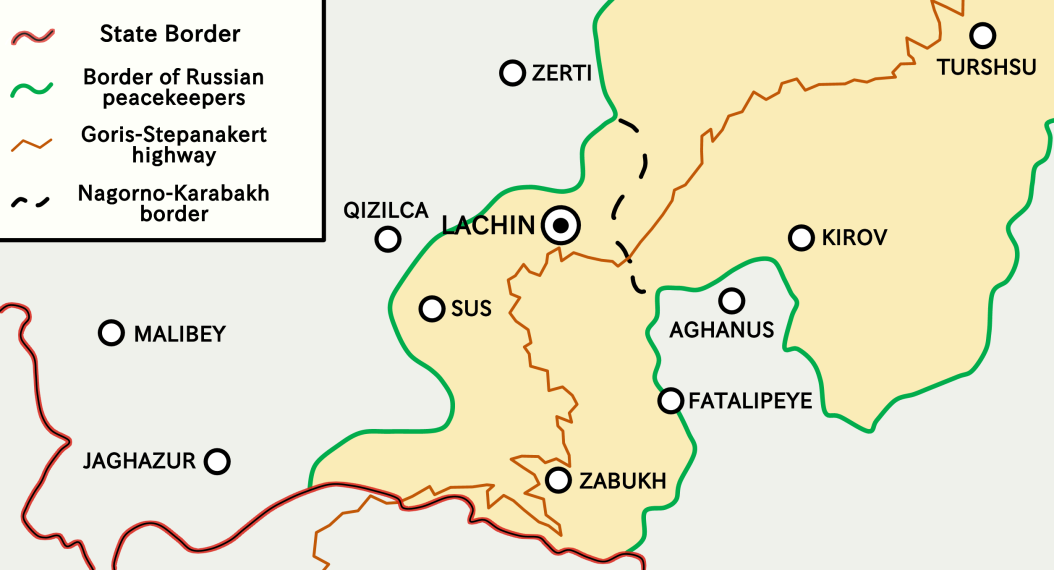
At least 65 were arrested in Armenia’s second city of Gyumri as authorities dispersed a rally outside a Russian military base. Activists were demanding that Yerevan cut ties with Moscow amid a deepening stand-off with Azerbaijan over the disputed enclave of Nagorno-Karabakh. Russian “peacekeepers” have failed to re-open the Lachin Corridor, the only access in or out of Nagorno-Karabakh, which has been closed by Azerbaijan for almost a month—leaving 100,000 ethnic Armenians trapped, with supplies of food and medicine running low. The corridor was supposed to remain open under terms of the November 2020 ceasefire deal between Armenia and Azerbaijan. But the corridor has for nearly a month been blocked by Azeri activists, who charge that unregulated mining operations in Nagorno-Karabakh are causing environmental damage to the territory. (Map via Wikimedia Commons)

Europe
Stratofortress

Massive military drills from North Sea to Caucasus

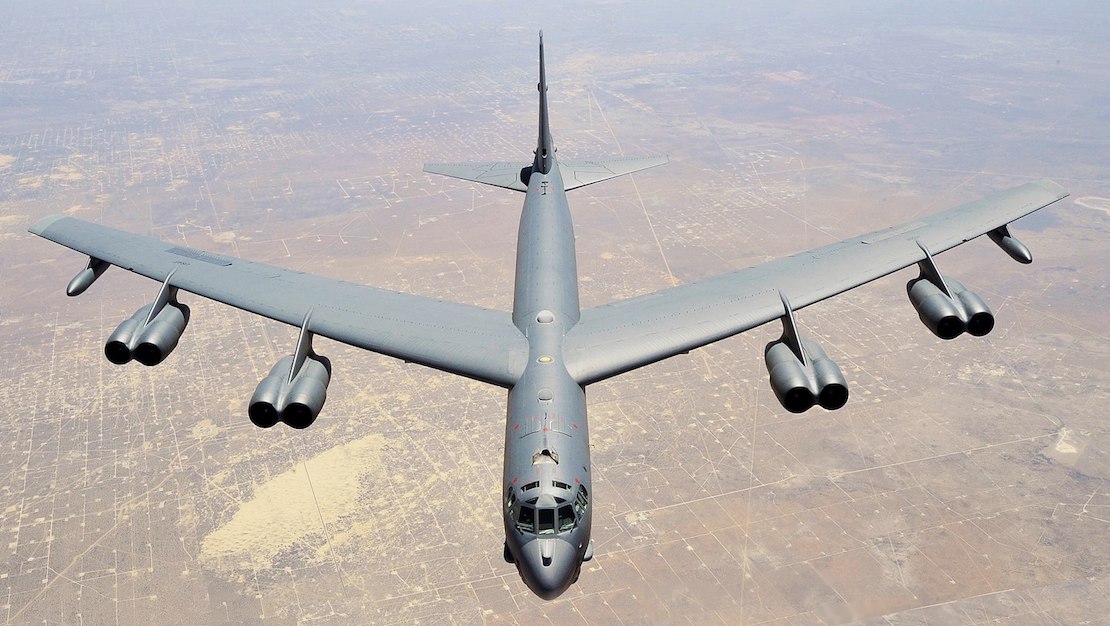
NATO opened an annual exercise to test nuclear deterrence capabilities in Europe, with the participation of 14 of the 30 member countries. The drill, this year dubbed “Steadfast Noon,” will run two weeks and involve 60 aircraft, mostly over the North Sea. Russia’s own nuclear deterrence drills, known as GROM, are expected to begin later this month—which means they will overlap with the NATO exercise. Iran’s Islamic Revolutionary Guards Corps meanwhile launched a large-scale military drill along the borders of Armenia and Azerbaijan. The exercise has seen construction of a temporary pontoon bridge, allowing passage of tanks and armored vehicles, over portions of the Araz River that separates Iran from the Caucasus republics. Last month, Tehran warned that it would not tolerate any seizure of territory from Armenia by Azerbaijan after border clashes broke out between its two northern neighbors. (Photo of B-52 Stratofortress via Wikimedia Commons)

Europe
mariupol ruins

Podcast: Grozny, Aleppo, Mariupol

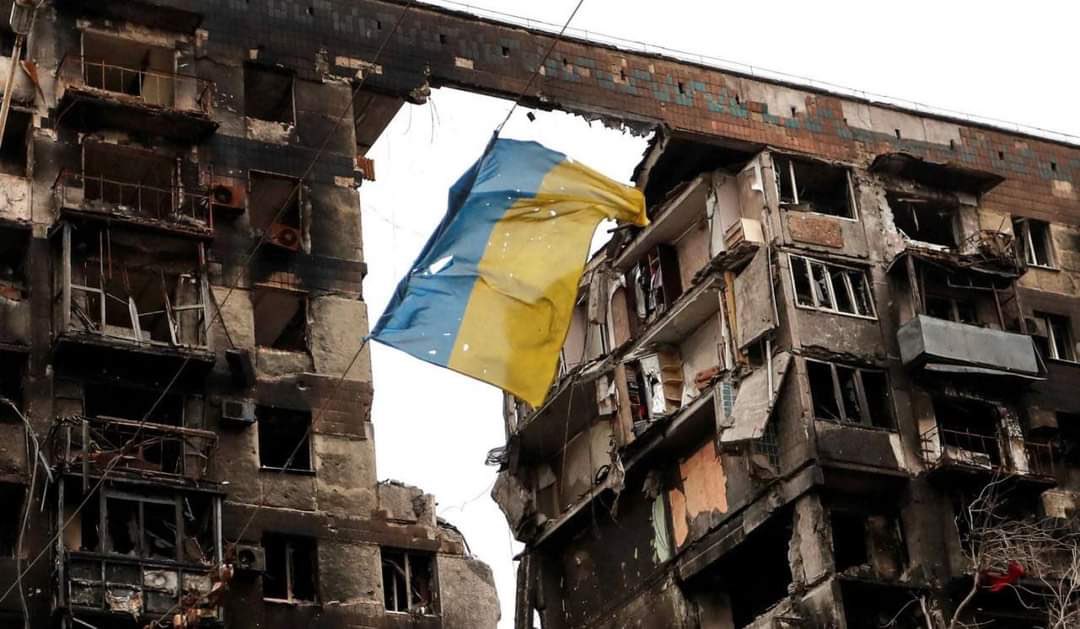
In Episode 144 of the CounterVortex podcast, Bill Weinberg notes Putin’s annexation of Ukraine’s Donbas region not only came on exactly the same day as the 1938 Munich Agreement, which approved Hitler’s annexation of Czechoslovakia’s Sudetenland—it was also the same day that Putin launched two of his previous criminal military adventures. On Sept. 30, 1999, Russian tanks rolled into Chechnya, marking the start of the Second Chechen War, with massive aerial bombardment of the region’s capital city of Groazny. On Sept. 30, 2015, Russian began air-strikes in Syria, marking the start of a massive military intervention on behalf of the Bashar Assad dictatorship, in which the city of Aleppo would be virtually destroyed by bombardment. And in Putin’s new war of aggression in Ukraine, the Azov seaport of Mariupol has been similarly nearly obliterated. A review of this history reveals Vladimir Putin as a serial city-destroyer, who must be deposed and put on trial for his crimes against humanity. Listen on SoundCloud or via Patreon. (Photo via Twitter)