
Southeast Asia
Affan Kurniawan

Police automotive terror sparks Indonesia uprising

Days of popular protest in Indonesia exploded into violence after Affan Kurniawan, a motorbike delivery worker, was fatally struck by a police vehicle in Jakarta. The worker had not even been participating in the protest when armored vehicles ploughed into the crowd, mowing him down. Kurniawan’s helmet, lying in the rainy street after he was struck, has become an online viral image that fueled further demonstrations across the country. Six were killed and the army called to the streets before the protests were called off when the government agreed to revoke controversial perks for lawmakers, including lavish housing allowances. But the underlying grievances of unemployment and inflation remain. (Image via Twitter)

Watching the Shadows
Orwell

Podcast: Trump for War-is-Peace Prize

In Donald Trump’s perverse ambition to win the Nobel Peace Prize, he is citing his supposed diplomatic victories in ending six conflicts: Armenia-Azerbaijan, Congo-Rwanda, Israel-Iran, India-Pakistan, Thailand-Cambodia and Egypt-Ethiopia. In Episode 292 of the CounterVortex podcast, Bill Weinberg examines each of these examples, and breaks down how claims to have won “peace” are either extremely overstated or (more often) total Orwellian jive. The implication that Russia-Ukraine will be next, as Putin escalates his aggression, puts a hideous crown on the irony. (Image via Twitter)

Southeast Asia
Preah Vihear

Orwell and the Thai-Cambodia conflict

Cambodia’s prime minister, Hun Manet, nominated Donald Trump for the Nobel Peace Prize on Aug. 7, citing his “crucial role” in restoring peace after bloody border fighting with Thailand. The gushy statement praised Trump’s “extraordinary statesmanship” and “innovative diplomacy.” (NYT) Cambodia now… Read moreOrwell and the Thai-Cambodia conflict

Southeast Asia
warplane

Burma: dictator thanks Russia for military support

Following his visit to Moscow for the Victory Day celebrations earlier this month, Burmese junta leader Min Aung Hlaing thanked Russia for the fighter jets and helicopters it has provided his military government. The junta, which came to power in the February 2021 coup, is currently facing an insurgency by a number of armed ethnic and opposition groups across Burma. Rights groups accuse the Tatmadaw, as the Burmese military is known, of routinely targeting civilian populations and infrastructure in its aerial attacks. While in Moscow, Min Aung Hlaing also met for the first time with Chinese leader Xi Jinping, another key patron of his regime. (Photo: Russia MoD via The Irrawaddy)

Southeast Asia
Burma

Burma: junta continues air-strikes after earthquake

Burma’s military junta has continued to bomb rebel-held areas following the major earthquake in the country, which has killed more than 1,600 people. The UN official for human rights in the country described the attacks as “completely outrageous and unacceptable.” Special Rapporteur Tom Andrews told the BBC that it was “nothing short of incredible” that the military is continuing to “drop bombs when you are trying to rescue people” after the quake. “I’m calling upon the junta to just stop, stop any of its military operations.” Strikes have been reported since the disaster in Shan state and in Sagaing region—the epicenter of the quake. (Photo of IDP camp in Rakhine state: DFID via Wikimedia Commons)

Southeast Asia
Regime Airstrikes

Burma: deadly junta air-strikes escalate

Junta air-strikes killed over 170 people across Burma in January, a fourfold increase over the previous month, according to an analysis by The Irrawaddy, an independent exile-based newspaper that maintains a network of reporters on the ground. The strikes hit villages, health facilities, a prison and a gold mine in various areas held by the resistance, although most of those killed were civilians. More than 1,800 people have been killed in air-strikes since the February 2021 coup. (Image: The Irrawaddy)

Greater Middle East
ARSA

Rojava and the Rohingya: fearful symmetry

Three weeks after the fall of the Bashar Assad dictatorship, the only fighting in Syria remains between Arab and Kurdish militias—holding grim potential for destabilization of the democratic revolution. Kurds had been persecuted and even denied citizenship under the Assad regime, but the invasion of their autonomous territory of Rojava by the Turkish-backed rebels of the Syrian National Army (SNA) drove them into a paradoxical tactical alliance with the dictatorship. The tragic situation in Burma’s Rakhine state mirrors this disturbing reality. The Muslim Rohingya people had been persecuted, denied citizenship and finally targeted in a campaign of genocide by the military, but are now facing attacks by the Buddhist-supremacist rebels of the Arakan Army—driving some Rohingya into a paradoxical tactical alliance with the military junta. In Episode 258 of the CounterVortex podcast, Bill Weinberg offers this analogy in the hope that the peoples of Burma can unite across religious lines to defeat the junta, and that Syrians can find a way toward co-existence in the new revolutionary order and avoid ethnic war. Listen on SoundCloud or via Patreon. (Photo of Arakan Rohingya Salvation Army-ARSA rebels: Burma News International)

Southeast Asia
Burma

Burma: Arakan Army seizes border zone

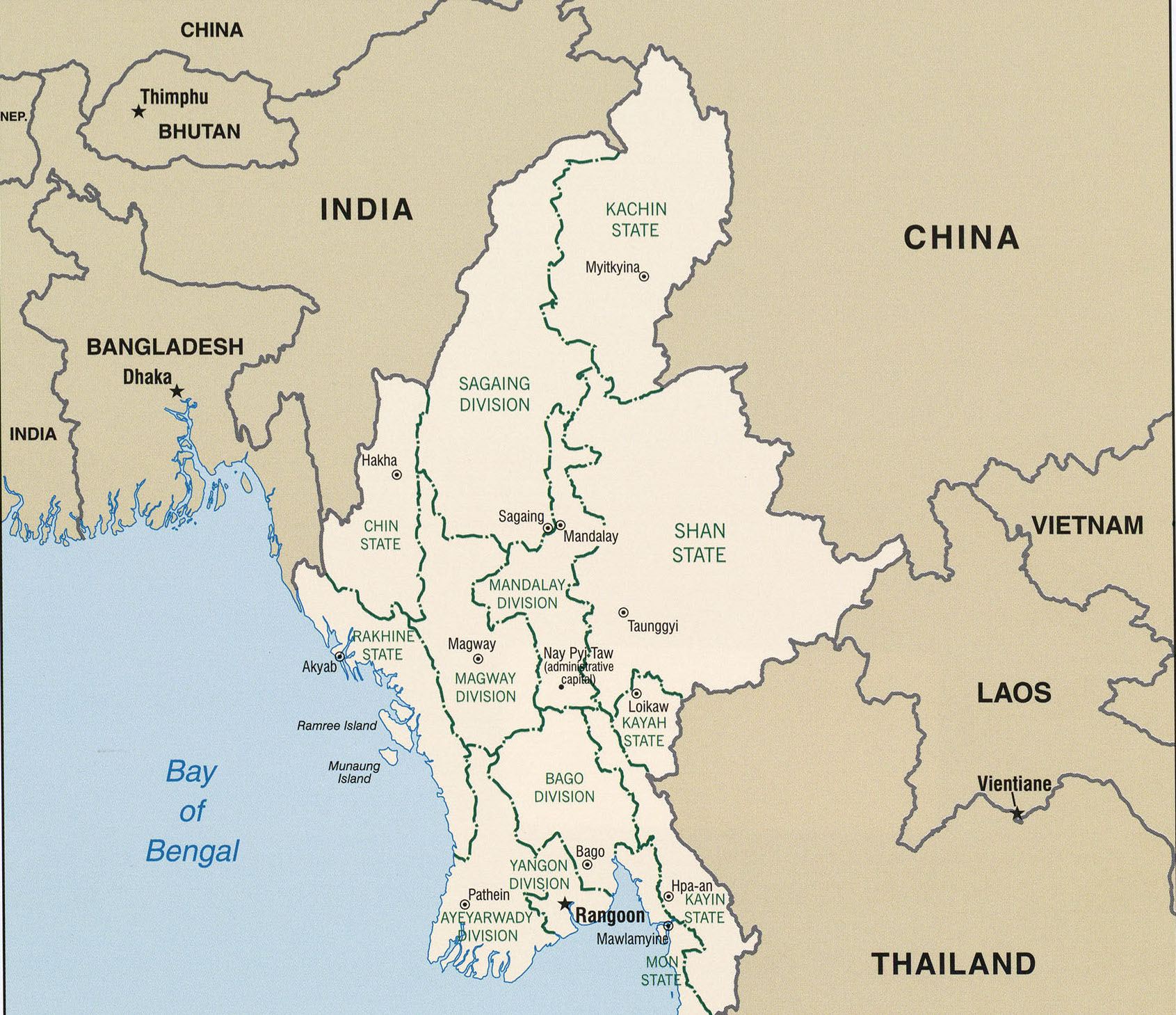
The rebel Arakan Army announced its full control of Burma’s border with Bangladesh after the seizure of the last junta base in Maungdaw township. The rebel army said it had taken captive a general and dozens of other soldiers, including around 80 Rohingya fighters—raising fears of further reprisals against the Muslim minority. The Arakan Army seeks autonomy for the ethnic Rakhine people and is part of an alliance of armed groups that has also seized key towns in eastern Burma. The Rohingya, having long faced massive ethnically targetted attacks by the military, are now facing such attacks by the ethno-nationalist Arakan Army. In addition to Rohingya youth being press-ganged into the military to fight the rebels, some Rohingya militias are now collaborating with the junta against the Arakan Army. (Map: PCL)

Southeast Asia
South China Sea

Maritime collision escalates South China Sea tensions

Manila accused Chinese military vessles of engaging in “dangerous manoeuvres, including ramming and towing” a Philippine ship in an effort to disrupt a “routine” resupply mission to an outpost on Second Thomas Shoal (known to the Philippines as Ayungin Shoal) in the the disputed Spratly Islands (known to the Philippines as the Kalayaan Islands). By Philippine media accounts, the craft was fired upon with water cannon and boarded by Chinese troops, with several Filipino soldiers injured in the ensuing confrontation. The skirmish came amid escalating tensions over the South China Sea—much of which Manila calls the West Philippine Sea, but nearly all of which is claimed by Beijing. The chief of staff of the Armed Forces of the Philippines, Romeo Brawner Jr., stated that the military and other maritime law enforcement agencies are prepared to defend Filipino fishermen from China’s newly announced “anti-trespassing policy.” (Map via IDSA)

Southeast Asia
Burma

Burma: army accused in village massacre

Burmese junta soldiers reportedly killed at least 75 civilians in an attack on a village in Rakhine state, where the regime is facing a fierce insurgency by the rebel Arakan Army (AA). The AA said in a statement that it has a list of 53 victims, including two teenagers and five women. Over 100 soldiers entered Byian Phyu, near state capital Sittwe, forcing residents into a communal area in the center of the village, where scores of were summarily gunned down, survivors said. Burma’s military government has denied the accusation. (Map: PCL)

Southeast Asia
Burma

Burma: new warnings of Rohingya ‘genocide’

Twenty-eight non-governmental organizations representing Burma’s Rohingya Muslim minority issued a joint statement warning of the risk of a new “genocide” and urging the international community to take action. The NGOs, including the Free Rohingya Coalition and Burmese Rohingya Organization UK (BROUK), said that this time the threat comes from the Arakan Army, a predominantly Buddhist ethnic armed group that is waging an insurgency against the ruling junta. According to the statement, the Arakan Army has ordered Rohingya residents to evacuate the town of Buthidaung, Rakhine state, where many internally displaced during the 2017 genocide carried out by the Burmese armed forces have taken refuge. The evacuation order is being backed up by a campaign of threats, violence, and arson. (Map: PCL)

Southeast Asia
Burma

Burma: Karen rebels seize strategic border town

The Karen National Union (KNU) said that it will establish its own administrative mechanism in territory recently captured from Burma’s military in and around the critical trade hub of Myawaddy, on the border with Thailand. The KNU has several departments in its governance structure, including those for health, education, foreign affairs and defense, in territories it controls in seven districts across southeastern Burma, including in Karen (Kayin) and Mon states and Bago and Tanintharyi regions. The junta has lost control of several towns on the border with China to other rebel armies in recent months, but the loss of Myawaddy is a special blow, as it is the transfer point for most of Burma’s overland trade with Thailand. (Map: PCL)