


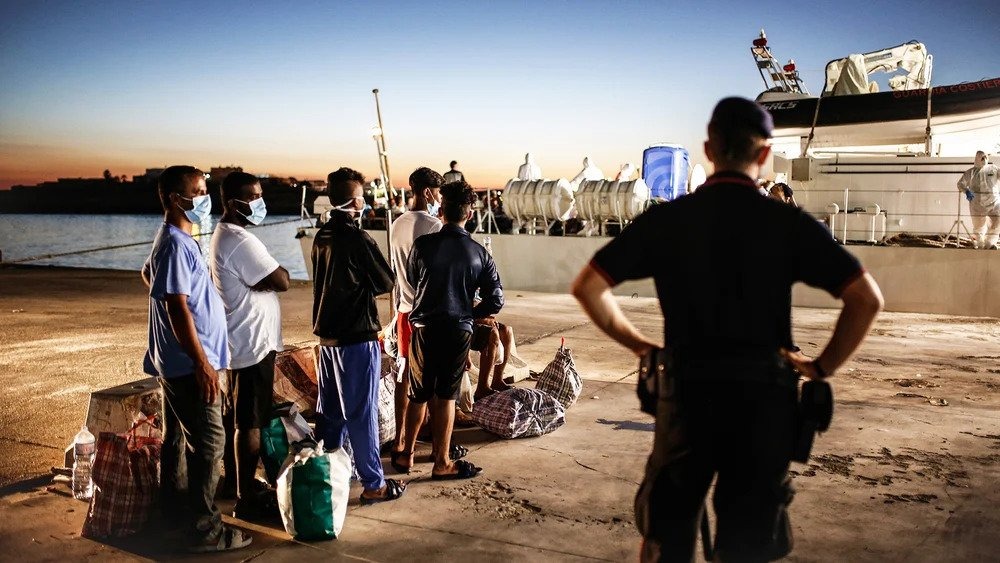
The European Union took a significant step toward adopting a Trump-like approach to migration when the EuroParliament approved a new law March 26 expanding the power of security agencies to track, detain and deport migrants. Amnesty International criticized the revised "Return Regulation" as "punitive" and a threat to fundamental rights. The law also allows for people to be deported to countries other than their country of origin—a controversial policy used by the Trump administration. Greece, an EU member, is even working directly with US officials to ramp up deportations.
In related news, German Chancellor Friedrich Merz said last week that he and Syrian President Ahmed al-Sharaa hope to see 80% of Syrian refugees in Germany return to Syria in the coming three years. Merz's call for Syrians to "go back to their homeland," which came after his meeting with al-Sharaa in Berlin, drew condemnation from human rights monitors who pointed to continued violence and insecurity in Syria. (TNH, Jurist)


European push for stronger deportation powers delayed
Negotiators for European Union member states and members of the European Parliament temporarily ended three rounds of talks May 21, failing to reach agreement over a implementation of a controversial law aimed at increasing the power to deport rejected asylum seekers. The bill paves the way for what critics call "ICE-style" raids on private residences and "other relevant premises," longer detention periods, and the establishment of so-called "return hubs" in third countries.
Despite coming under heavy criticism by rights groups, the European push for greater deportation powers appears to be a question of when, not if: The negotiations stalled over when the provisional law would come into force, rather than questions of substance. Negotiations are set to resume on June 1. Meanwhile, on May 15, all 46 member states of the Council of Europe—which includes all EU member states—signed on to a political declaration that critics fear will weaken legal protections for migrants, and make it easier for states to carry out deportations. (TNH)
EU adopts Pact on Migration & Asylum —to protest
The Council of the European Union announced the formal adoption of the EU Pact on Migration & Asylum on June 9, despite opposition from Hungary and Poland. The reform seeks to streamline procedures and ensure equitable burden sharing between member states.
The pact introduces new key principles, including stricter regulations aimed at broadening applicant screening, health and security checks, expediting examination procedures and providing free counseling services. The main innovation of the pact is the mandatory "solidarity mechanism," which gives governments three options to manage asylum seekers: aid in relocation, payment of €20,000 for each person rejected, or contributions of in-kind operational support.
Human Rights Watch criticized the pact as undermining the right to asylum. (Jurist)
As the pact advanced in the EuroParliament, it was met with similar criticisms.
EU adopts ‘Return of Migrants’ law —to protest
Right-wing members of the European Parliament erupted into cheers of "send them back" after the body passed a law on June 17 giving member states new powers to deport people whose asylum claims have been rejected. Critics warn that the legislation gives EU countries the ability to carry out Trump-style deportation campaigns. The law allows for the creation of deportation centres outside the EU, paves the way for raids on homes and other premises, and extends detention periods to up to 30 months. (TNH)
UN rights chief concerned over new EU migration law
UN High Commissioner for Human Rights Volker Türk on June 20 expressed deep concern about the adoption of the new European Union regulation facilitating detention and deportation of migrants and asylum seekers. The so-called "Returns Regulation" was provisionally approved in March of this year, and the EU parliament voted for its legal adoption on June 17.
The new regulation expands the use of pre-removal detention and enables EU countries to create "return hubs" in third countries so long as those third countries uphold human rights and international law. The regulations are aimed at standardizing the removal process of undocumented migrants across the EU.
Speaking in a press release, Volker Türk stated:
The high commissioner stressed that robust monitoring and accountability mechanisms are needed to ensure that people’s human rights are protected during the removal process. Further, he encouraged the public discussion on migration to avoid conflating migration with security concerns.
The EU has also adopted other measures, creating a stricter and more uniform migration process. On June 12, the EU's Migration & Asylum Pact came into force, introducing stricter regulations aimed at broadening applicant screening, increasing health and security checks, expediting examination procedures, and providing free counseling services. HRW critiqued this pact, warning that it denies migrants the ability to have a fair hearing. The pact enables EU member states to designate non-EU states as "safe third countries," allowing the EU state to refuse to examine an asylum claim. (Jurist)
Flashpoint Ceuta
An estimated 60,000 people entered the Spanish North African enclave of Ceuta between July 29 and 31, and at least 34 people died attempting to cross. Ceuta's border is heavily fortified to prevent migration between Morocco and Spain. Previous mass crossing attempts have been met by violence from Moroccan and Spanish security forces. European officials have said they will not allow people who crossed to move on to the European continent. Spain is sending troops to the enclave, as local authorities demand Madrid declare a state of emergency. (TNH, CNN, DW)
The aftermath of Ceuta
A lot is still unclear about what prompted up to 80,000 people to cross the border between Morocco and the Spanish North African exclave of Ceuta between July 29 and 31. The movement was spurred by online rumours, and it exposed a sense of economic despair among Moroccan youth, who made up the vast majority of those who rushed to cross, often by swimming. As many as 141 people died–by far the highest death toll of any migration-related incident at the borders of Spain's two North African exclaves in recent years. Most of the people who crossed have since returned to Morocco, but some 3,000 to 5,000 reportedly remain in Ceuta. Far-right politicians across Europe and in the United States were quick to use what happened to drum up fears of "migrant invasions" and to push for even more intense border security measures. As always, the rhetoric ignored the conditions that push people to take tremendous risks to migrate, not to mention the fact that Europe desperately needs immigration–to the tune of one million people per year, according to the EU Commission. (TNH)
Migrant boat disaster off Canary Islands
More than 80 people are feared dead after Spanish authorities found a boat carrying people floating close to the Canary Islands on Sept. 2. The boat had departed from the Gambia and had spent 27 days at sea. Forty-four people were found alive, and five corpses were recovered. The maritime migration route between West Africa and the Canary Islands in the Atlantic Ocean is believed to be the deadliest in the world, although many deaths are never confirmed. (TNH)