


A new report from the UN Commission of Inquiry on the Occupied Palestinian Territories finds that Israel has continued to commit “genocidal acts” in the Gaza Strip since the signing of a ceasefire with Hamas last October, and continues to carry out war crimes and crimes against humanity throughout the occupied territories.
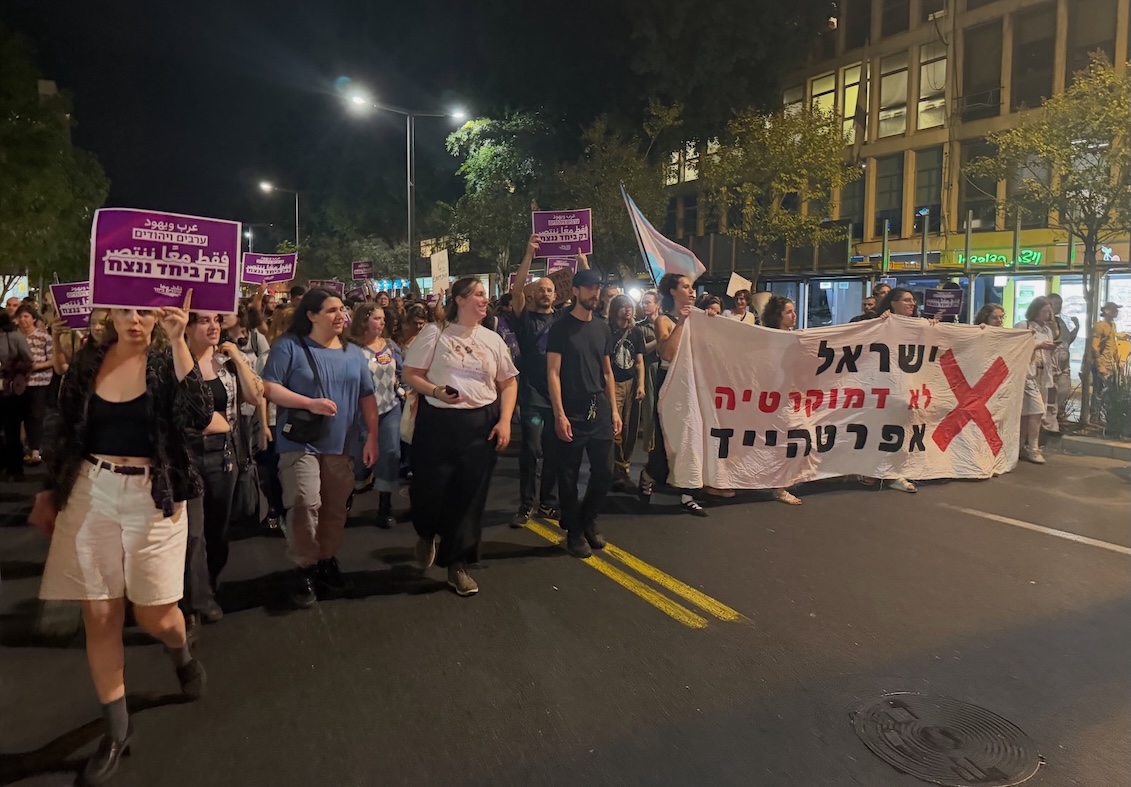
The situation, alas, seems unlikely to fundamentally change regardless of the eventual outcome of the Israeli elections that took place Oct. 27. Prime Minister Benjamin Netanyahu’s Likud party received the most seats, but does not have enough support to form a government with its far-right allies. The anti-Netanyahu bloc led by former IDF commander Gadi Eisenkot also fell short of a majority. This puts Palestinian Arab citizens of Israel—who constitute some 20% of the population, and who voted in record numbers—in the position of potential kingmakers. However, most parties in Eisenkot’s bloc are refusing to enter into a coalition with the Arab parties—principally, the Joint List and United Arab List (Ra’am). Pro-coexistence activists have marched in Tel Aviv to demand such a coalition, including in an Oct. 29 mobilization outside Eisenkot’s home in the suburb of Herzliya, chanting “There is no change without partnership.”
Netanyahu is meanwhile seeking to invalidate the election results, claiming (without evidence) that Qatar interfered in the race in league with the Arab-led parties. A Likud statement charged a conspiracy for a “foreign takeover of the Knesset, the Islamization of Israel, and the overthrow of right-wing rule.” The internal intelligence agency Shin Bet has been ordered to investigate the supposed plot.
The choice for Eisenkot’s bloc is clear: form a coalition with the Arab parties or allow Netanyahu to continue to rule—in a more aggressively reactionary posture than ever. The fact that they may choose the latter reveals much about the consensus on Zionist precepts among the Jewish-led parties—and is related to the fact that opposition to the Gaza genocide and Israel’s multiple wars and military interventions was not a plank for the Eisenkot bloc. Although mired in corruption scandal and facing an arrest warrant from the International Criminal Court, the tenacious Netanyahu may yet retain power. (TNH, ToI, ToI, JP, PRI, CNN, DW, Haaretz)
Photo: Shane Burley via Facebook. Banner reads: “Israel is not a democracy. It’s apartheid”


Netanyahu on his way out?
Has Benjamin Netanyahu, the great survivor of Israeli politics, finally run out of road after Israel’s election? After years of clinging to power, Israel’s longest-serving prime minister faces mounting political pressure, as well as corruption charges and allegations of war crimes that could leave him exposed to further legal scrutiny when he leaves office. A coalition of Arab-led political parties has backed Israeli opposition leader Gadi Eisenkot in his bid to replace Netanyahu, giving him the support of a majority of lawmakers. President Isaac Herzog is expected to announce whether Eisenkot or Netanyahu will get the first chance to form a government, following consultations with the parties. There is a major catch, however: Eisenkot has so far ruled out forming a coalition with the Arab-led parties. Netanyahu will remain prime minister of a caretaker government until a new administration is formed. Eisenkot opposes the creation of a Palestinian state, supports Israeli settlements in the occupied West Bank, developed Israel’s so-called Dahiyeh doctrine (named for the repeatedly bombarded Beirut suburb), and served as a minister in Netanyahu’s government during the first eight months of the Gaza war. Even if Eisenkot changes course, it remainsunclear how long Arab-led parties could remain part of a coalition that otherwise promises broad continuity in Israel’s dehumanizing policies toward Palestinians. (TNH)
US to cut aid to Israel?
On Nov. 3, as people across the US voted in the midterm elections, President Trump announced that the US would stop providing Israel with $3.8 billion in annual military aid at the beginning of next year. The move appeared to be motivated by the significant shift in US public opinion towards Israel that has occurred over the course of Israel’s US-backed war in Gaza. The move is likely more showmanship than substance, as Trump said Israel would still be able to buy weapons and military equipment from the US. (TNH)
UN chief urges Israel to allow supplies for flood-stricken Gaza
UN humanitarian chief Tom Fletcher said Nov. 11 that waiting for a new Israeli government to form is not an acceptable reason to delay winter supplies for Gaza. His statement came days after heavy rain flooded displacement sites across the Strip. Fletcher urged Israel to open all crossings and let aid groups operate.
The UN says more than 150,000 tents are outside Gaza ready to be dispatched, donated by groups such as the from the Egyptian Relief Committee. However, UN spokesperson Farhan Haq said the UN needs permission from Israeli authorities to bring more supplies through the crossings.
The rain began on the evening of Nov. 6 and continued through the weekend, according to the United Nations Office for the Coordination of Humanitarian Affairs (OCHA). The Site Management Cluster (SMC), a coalition of aid groups that support displacement sites in the occupied Palestinian territories, recorded 268 site alerts as of Nov. 8. Of those, 264 were related to heavy rain and flooding, affecting more than 26,000 households. The SMC reported that 6,136 shelters were destroyed and 17,400 damaged, and that 3,938 households were sleeping outside with no shelter. The SMC cautioned that its figures only reflect alerts from participating partners, and that the overall scale of damage is likely significantly higher.
Many of those in the sites were forced from their homes during the war. UN humanitarian chief Martin Griffiths told the Security Council in January 2024 that 85 percent of Gaza’s population, about 1.9 million people, had been forcibly displaced. A June assessment by the Palestine Shelter Cluster found that 54 percent of 1,951 surveyed households in accessible areas of Gaza lived in tents and another 11 percent in makeshift shelters. OCHA currently estimates that about 65% of Gaza’s population, roughly 1.4 million people, live in tents or makeshift shelters.
The rain follows a severely dry 2024-25 season, when Iraq, Jordan, Lebanon and Syria each received less than halftheir average rainfall, according to the UN Economic and Social Commission for Western Asia. The World Meteorological Organization (WMO) said Nov. 9 that “unusually” high precipitation totals were recorded in the Middle East this year, though water shortages persist in the region.
Fletcher’s remarks followed a statement from the Board of Peace, which called Israel’s response to the flooding “insufficient.” The Israeli Prime Minister’s Office said it has facilitated a winterization plan in coordination with the Board of Peace and the UN. OCHA, however, said that humanitarian partners urgently need more Israeli approvals to bring in shelter items, engine oil, spare parts and heavy machinery, along with more funding.
It is the fourth consecutive winter since the war began. (Jurist)
Exposed by design: Gaza’s winter
An Israeli air-strike on Gaza’s Nasser Hospital killed six people, including surgeon Rezik Abushira and a 13-year-old boy, on Nov. 12. Elsewhere in the Strip, a nine-month-old baby died from the cold in a tent on the same day. Earlier in the week, three children—aged four, five, and eight—were killed when a sand dune collapsed during a torrential rainstorm. The rains and winds destroyed tents, flooded latrines, and soaked the belongings of over 100,000 people.
Israel has squeezed Gaza’s population of around 2.1 million people into largely low-lying areas of the enclave. Nearly one million are living in flood-prone areas. Israel has also not allowed shelter materials into Gaza in anything resembling adequate numbers ahead of winter. Around 65% of Gaza’s population is living in tents, with the vast majority of others living in war-damaged or destroyed buildings. (TNH)