Europe

Russian anarchists call for anti-war resistance

As Putin finally ordered his forces across the Ukrainian border into the breakaway Donbas region, the Russian anarchist group Autonomous Action issued a statement to the world, entitled “Against annexations and imperial aggression.” It reads: “We urge you to counter the Kremlin’s aggression by any means you see fit. Against the seizure of territories under any pretext, against sending the Russian army to the Donbas, against militarization. And ultimately against the war. Take to the streets, spread the word… Do not be silent. Take action. Even a small screw can jam the gears of a death machine.” (Banner reads: “No war between peoples, no peace between classes.” Via Autonomous Action)

Greater Middle East
Marib

Yemen: Biden warned against Houthi ‘terrorist’ tag

President Joe Biden is said to be considering re-designating Yemen’s Houthi rebels as a terrorist organization following the group’s missile attacks on the United Arab Emirates, which leads the anti-Houthi military coalition with Saudi Arabia. Aid groups—part of a successful lobbying campaign that saw Biden remove the label shortly after he took office last January—warn that a redesignation would have “catastrophic consequences for Yemeni civilians.” Not only would it hit the economy hard, making it even more difficult to import food, fuel, and medicine, but it would also decrease the flow of much-needed aid to Houthi-controlled territory. Violence is meanwhile escalating, and not just around the battlefields of the contested province and city of Marib. Between early October and early February, 1,535 civilians were reportedly killed or injured, more than double the figure for the previous four months. (Photo of displaced persons camp in Marib by Mohamed Ghazi/TNH)

Watching the Shadows
pegida

Podcast: Russia and the new fascism

In Episode 111 of the CounterVortex podcast, Bill Weinberg explores the legacy of Francis Parker Yockey and other exponents of the fast-growing current in the Western fascist tradition that looks to Russia as a patron and ally. Under the leadership of Alexander Dugin, “Putin’s Rasputin” and the theorist of a “Eurasian” bloc against Western democracy, resurgent far-right Russo-nationalism is building ties to neo-fascist organizations across Europe—as well as to supposed “anti-war” leftists in the United States. The Putin propaganda machine’s Nazi-baiting of the Ukrainians is yet another example of the sinister trend of fascist pseudo-anti-fascism. It is imperative that progressives in the West do not take the toxic bait of this “Red-Brown Alliance.” Any genuine anti-war position must begin with repudiating Putin’s threats and aggression against Ukraine. Listen on SoundCloud or via Patreon. (Photo: Far-right protesters in Germany with sign reading “Putin, save us!” Via PRISM)

Africa
DRC

ICJ: Uganda must pay conflict reparations to DRC

The International Court of Justice (ICJ) ruled that Uganda must pay $325 million in reparations to the Democratic Republic of Congo (DRC) for its involvement in the Ituri conflict two decades ago. The ruling is based on a 2005 ICJ finding that Uganda violated international law by engaging in military activities in the DRC after occupying the latter’s northeastern Ituri province. Uganda was held responsible for the killing and torture of civilians, destruction of entire villages, conscripting child soldiers, inciting ethnic conflict, and plundering of natural resources. The ICJ moved to determine the quantum of reparations after the two parties failed to come to terms. (Photo: MONUSCO via Defense Post)

North Africa
libya

Libya’s two prime ministers

Libya’s eastern-based parliament chose a new prime minister for the country, former interior minister Fathi Bashagha. The only problem… Libya already has an interim prime minister: Abdul Hamid Dbeibah, chosen by a UN-led process to head the Tripoli-based Government of National Accord. Dbeibah was supposed to guide the fractured country through presidential elections in December, but they were postponed after contestation over the rules governing the process. Dbeibah had promised not to run for president but put his hat in the ring anyway, with the rules apparently mandating that he step down as prime minister three months before the polls—which he did not do. The Tobruk-based parliament says the deadline means Dbeibah’s time is up, but he says he won’t hand over power until elections take place. He reportedly survived an assassination attempt shortly before the parliament’s move to replace him. None of this bodes well for Libyans’ long quest for a united country. (Map: Perry-Castañeda Library)

The Andes
Lima

Peru: police pop presidential palace in petro-corruption probe

Special anti-corruption prosecutors backed up by National Police troops raided 15 properties around Peru’s capital Lima—including the presidential palace. The raids came as part of Megaoperation Resplandor 2022, an investigation into alleged irregularities in tenders for the purchase of biodiesel between parastatal PetroPerú and private firm Heaven Petroleum Operators. Also raided were the homes of PetroPerú director Hugo Ángel Cháves Arévalo, HPO manager Samir Abudayeh, and prominent entrepreneur Karelim López. The administration of President Pedro Castillo, a populist political outsider, has been wracked by repeated crises and scandals since he took office last July. (Photo: Wikipedia)

Mexico
Pemex

Control of oil behind Mexico-Spain tensions

Mexico’s President Andrés Manuel López Obrador called for a “pause” in relations with Spain, in a speech that explicitly invoked the legacy of colonialism going back to the Conquest. But the speech was aimed principally at Spanish oil company Repsol, which had been favored during the presidential term of Felipe Calderón. Specifically, López Obrador questioned the granting of gas contracts in the Burgos Basin, in Mexico’s northeast. He charged that Repsol operated the fields less productively than the state company Pemex had. “In the end, less gas was extracted than Pemex extracted” before the contracts, he charged. Repsol is meanwhile under investigation by Spanish prosecutors on charges of graft related to the company’s efforts to fend off a take-over bid by Pemex. (Photo via Digital Journal)

Europe
Donbass

Ukraine’s already existing humanitarian crisis

Amid the ongoing Russian military build-up and apparently faltering diplomatic efforts to prevent an invasion of Ukraine, one thing is clear: any incursion will worsen the dire humanitarian situation in the country. The latest overview from the UN’s emergency aid coordination body, OCHA, makes for sobering reading: 2.9 million in need, 13% children. This includes almost 300,000 people still displaced by an eight-year war that has claimed more than 13,000 lives. Particularly affected are the elderly in the separatist-occupied east. Since March 2020, when COVID-19 effectively rendered the so-called “contact line” impassable, they’ve been unable to cross to access their pensions and social services. Last week, eight trucks delivered the latest crossline international aid—COVID-19 prevention equipment, medicines, and construction materials. But how long these humanitarian convoys will be able to continue remains to be seen. (Photo: The New Humanitarian)

East Asia
kurils

Submarine incident in flashpoint Kuril Islands

Amid quickly escalating tensions over Ukraine, Russia lodged a diplomatic protest with the US embassy in Moscow, claiming that a US nuclear submarine penetrated Russian territorial waters near the Kuril Islands. According to Moscow’s Defense Ministry, a Virginia-class US Navy submarine was detected off Urup Island, where Russia’s Pacific Fleet was conducting exercises. The Defense Ministry said the submarine was chased off by Russian vessels, and retreated at “maximum speed.” The statement accused the US of a “violation of Russia’s state border.” Media accounts did not emphasize that whether this purported incident indeed took place in Russian waters is questionable, as the Kurils are in part claimed by Japan—a dispute which has prevented Moscow and Tokyo from entering a treaty to formally end their World War II hostilities. Russia over the past weeks has conducted naval maneuvers in the Mediterranean, the North Sea, and northeast Atlantic Ocean, as well as the Pacific and Sea of Okhotsk, where the Kurils are located.  (Map: International Kuril Island Project)

Planet Watch
nuclear power

Podcast: Nuclear power? No thanks!

In Episode 110 of the CounterVortex podcast, Bill Weinberg rants against the current greenwashing of nuclear power, and hype about a supposedly “safe” new generation of reactors. Every stage of the nuclear cycle is ecocidal and genocidal. Uranium mining has poisoned the lands of indigenous peoples from Navajo Country to Saskatchewan to West Africa. The ongoing functioning of nuclear plants entails routine emissions of radioactive gases, factored in by the bureaucrats in determining “acceptable” levels of cancer. Disposal of the waste, and the retired reactor sites themselves, is a problem that inherently defies solution. They will be deadly for exponentially longer into the future than biblical times stretch into the past. The Waste Isolation Pilot Project (WIPP) in New Mexico, hyped as secure for hundreds of millennia, leaked plutonium after only 13 years. And finally there is the “sexiest” issue, the one that actually gets some media play, at least—the risk of accident. It is a mark of capitalism’s depravity that even after the nightmares of Fukushima and Chernobyl, we periodically get media campaigns about an imminent “nuclear renaissance.” Nuclear versus fossil fuels is the false choice offered us by industry. The imperative is to get off the extraction economy and on to one based on sustainability and resource conservation. Listen on SoundCloud or via Patreon. (Photo: Wikimedia Commons)

Europe
Turów

Polish-Czech agreement on border coal mine

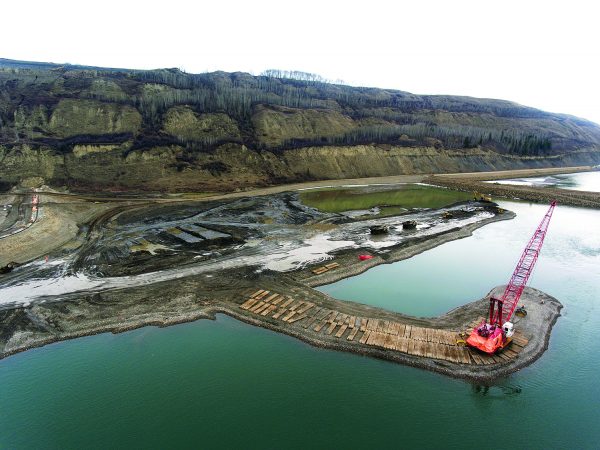
The government of Poland announced that it has agreed to pay compensation in a dispute over the Turów open-pit lignite mine that lies close to the border with the Czech Republic. In return, Prague has withdrawn its complaint at the Court of Justice of the European Union. The dispute concerns the complaints of local farmers on the Czech side of the border that their water sources are going dry due to the mine’s operations. The Turów Brown Coal Mine, owned by Poland’s parastatal power company PGE, must pump water from the pit into the Lusatian Neisse River, draining the local aquifer. The mine has been expanding closer to the border, further enflaming the fears of the Czech farmers. The deal was protested by Greenpeace for failing to provide sufficient guarantees for protection of the watershed. (Photo: Wikipedia)

Europe
suriname

Dutch citizen detained in Suriname war crimes case

A Netherlands court set aside a bid for amnesty and ruled to continue the pre-trial detention of a Dutch ex-army member suspected of war crimes, including the murder of civilians, during Suriname’s internal war. The 55-year-old Suriname-born Dutchman was arrested in Amsterdam on the basis of an investigation indicating that he murdered several Surinamese civilians in 1987. The Surinamese Interior War was a conflict waged in the inland rainforest of the South American nation and former Dutch colony between 1986 and 1992. During the war, the Surinamese National Army fought the Jungle Commando guerillas, killing hundreds of civilians and displacing thousands. The Jungle Commando won a base of support among the interior’s Maroon population, giving an ethnic cast to the conflict. (Map: University of Texas)