


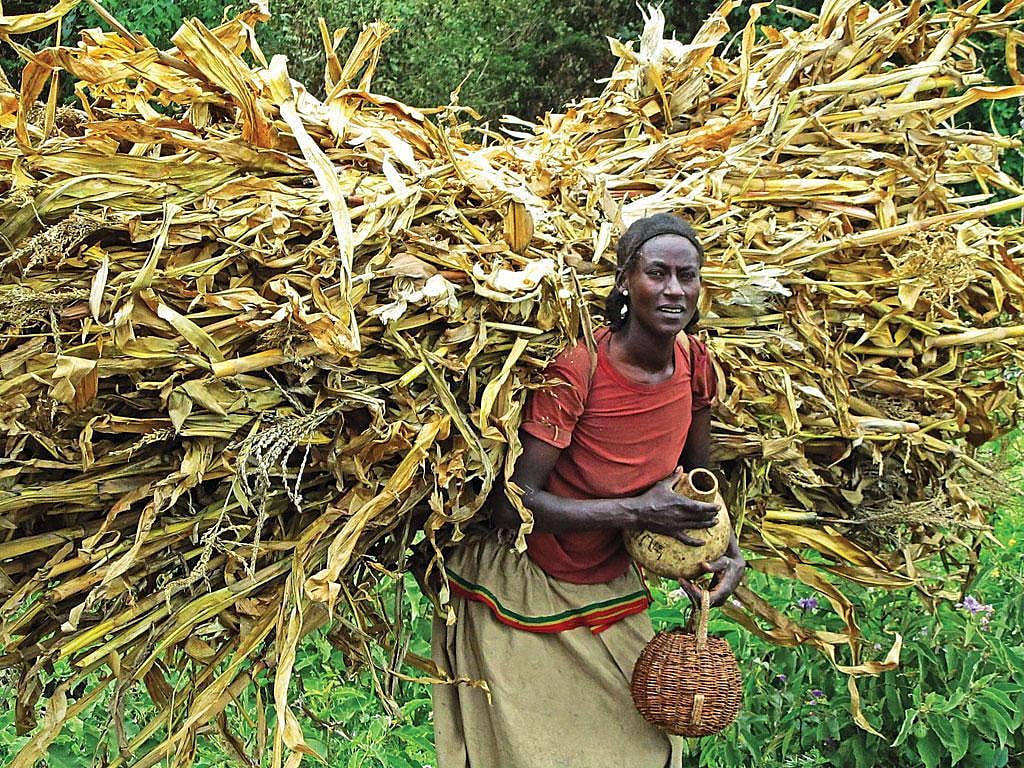
Some of the world’s poorest countries, including nations grappling with protracted humanitarian crises, are among those most affected by US President Donald Trump’s new trade tariffs regime, which has compounded pre-existing economic strains and debt woes. Asian markets will be particularly hard hit, including imports to the US from Myanmar to be charged at 45%, and Bangladesh at 37%. Big charges were also imposed on fragile economies in the Middle East and North Africa, with Syria at 41%, Libya at 31%, and Iraq at 39%. But among the worst effects will likely be felt in Africa, where Trump’s decision has created an “inexplicably cruel situation,” according to the Center for Global Development (CGD). “It is hard to fathom that the administration set out to destabilize poor African countries and unclear what they hope to gain,” wrote CGD researchers. The tariffs have effectively tanked the African Growth & Opportunity Act (AGOA), which allowed duty-free imports to the US for 32 countries and was credited with helping economic growth. Lesotho and Madagascar could be among the Trump tariffs’ biggest losers, CGD predicted. Amid existential financial worries in the international aid sector—triggered by Trump’s closure of USAID—economists have also raised the possibility of a global trade war, with far-reaching ramifications for inflation and the cost of living worldwide.
From The New Humanitarian, April 4
Note: Fluctuations in the price of oil and grain since the start of the Ukraine war in 2022 have contributed to popular privation and unrest worldwide.
Photo: Down To Earth


Trump to pause tariff hikes for 90 days —but not for China
President Trump abruptly announced April 9 that he will pause big hikes on tariffs for most countries for 90 days—except for China. Most countries will be left with 10% tariffs on their exports to the United States, while China—which had retaliated against Trump’s moves—will now face tariffs of 125%. (CNN)
Refugees in Kenya protest aid cuts
Food distribution has been suspended and aid workers have left Kenya’s northeastern Dadaab refugee complex following a clash close by May 8 between Kenyan security forces and the insurgent group al-Shabab. The suspension comes as refugees staged a peaceful protest earlier in the week over USAID funding cuts, which have sharply reduced food rations and access to water, healthcare, and education. The World Food Program has snipped the basic minimum ration by 40%, providing just three kilograms of sorghum and rice per person per month—without beans and oil. A lack of fuel now means that boreholes in the three-camp complex of roughly 500,000 refugees pump water for only an hour a day: The protesting refugees also cited the lack of drugs in clinics and the inability of the cash-strapped UN refugee agency to register secondary school students. Refugees that had been employed by NGOs are also facing widespread layoffs. (TNH)
Human costs of dismantling US humanitarian assistance
USAID funding cuts could kill 14 million people by 2030—including 4.5 million infants—as health programmes are pulled, according to a study in the Lancet. The cuts “threaten to abruptly halt and reverse one of the most important periods of progress in human development… [T]he resulting shock [for poor countries] would be similar in scale to a global pandemic or a major armed conflict,” said the study. The report’s findings (disputed by some) came as US Secretary of State Marco Rubio authored a Substack article deriding USAID, the former US development agency, which has now been officially folded into the State Department. Rubio declared that aid should be used “in furtherance of an America First foreign policy” and said future assistance would be “targeted and time limited.” (TNH)
USAID cuts may lead to more than 14 million deaths globally
A study co-authored by a UCLA Fielding School of Public Health researcher finds that recent cuts to the United States Agency for International Development, or USAID, may lead to more than 14 million additional deaths globally by 2030, including more than 4.5 million children under the age of five. (Center for Global Development, UCLA Newsroom)
US unveils new humanitarian aid plan after pausing contributions
The US has pledged $2 billion in humanitarian aid to the United Nations, as part of a deal that will also overhaul how the US funds foreign aid work. The move comes after the US paused nearly all of its contributions earlier this year, leaving the UN and other aid organizations scrambling. That $2 billion is still just a fraction of the $8 billion to $10 billion the US has provided to support global humanitarian work in recent years. In 2024, the final year of the Biden administration, the US provided $14 billion of global humanitarian assistance.
All of the $2 billion must now be funneled through one UN agency, the Office for Coordination of Humanitarian Affairs (OCHA). The US has also excluded Yemen, Afghanistan and Gaza from receiving any of the assistance. (NewsHour)
Millions in Nigeria face extreme hunger without urgent funding
The UN World Food Programme (WFP) said in a report on Jan. 22 that it urgently needs USD $128 million to sustain its operations in Nigeria through June, warning that more than a million people in the country’s northeast could lose access to emergency food and nutrition aid within weeks as violence surges across the nation.
The WFP will face food and cash shortfalls immediately, placing emergency food and nutrition activities at risk. The program will be forced to suspend operations in late February if funding is not urgently raised, which would leave millions of people without food and basic life necessities. (Jurist)
Have aid cuts led to more conflict deaths?
Analysts think hundreds of thousands of people may already have died as a result of the Trump administration’s sudden detonation of US foreign aid last year, and 22 million could die as a result of wider aid cuts from all donors.
Many of the projections floated over the last year are based on historical data. But a blog post from the Center for Global Development points to a new paper by Australian economists that uses real-time conflict data. The numbers suggest aid cuts have caused a 5% jump in armed conflict in 50 analyzed countries (all in Africa). More aid-dependent countries showed a rise in conflict compared to less aid-dependent ones, the analysts said. The CGD analysis crunched the numbers further using the same methodology to suggest a similar pattern in sub-national data: basically, comparing more- and less-dependent regions within countries. It also suggested a 5% rise in conflict deaths—adding up to 1,000 people.
Number crunchers will continue to sift the data and debate the causality count. But these and other studies add more flesh to scenarios humanitarians have been sketching out for months: malnutrition cases rise, child marriage rates jump, services for HIV and AIDS are disrupted, and government services aren’t yet able to step in to spaces that aid has dominated for years. That’s why humanitarians, privately and publicly, are again warning of famine risks in Somalia as drought conditions deteriorate—while injections of aid funding, which helped to avert famine in previous years, are seemingly unlikely. (TNH)
Trump imposes 10% global tariff after Supreme Court ruling
President Donald Trump announced a 10% global tariff after the US Supreme Court’s landmark decision Feb. 20 ruling against his tariff imposition under the International Emergency Economic Powers Act (IEEPA) of 1977.
Trump called the Supreme Court’s decision “deeply disappointing” and said he was “ashamed” of some Supreme Court justices. He said the 10% global tariff will be signed under Section 122 of the Trade Act of 1974. Trump also said he would initiate several investigations of unfair trade practices under Section 301 of the Trade Act, pointing to more prohibitive tariffs still.
The invalidated tariff regime included Trump’s “Liberation Day” tariffs, which imposed country-specific duties between 10% and 50% on most imports.
In a 6-3 decision, the Supreme Court held that the IEEPA does not authorize the president to impose tariffs. The court emphasized the principle of separation of powers, with tariffs falling under the power of Congress to impose taxes power under Article I, meaning the president has no inherent authority to impose tariffs. (Jurist)
Zambia, Zimbabwe pause US health deals
Zambia and Zimbabwe are pushing back on US health aid agreements that include preferential access to epidemic data and, in the case of Zambia, a side deal on access tocopper and cobalt. Lusaka said it was rethinking its $1.5 billion agreement, which offers $500 million less in aid over five years. Under the deal, Zambia was supposed to provide the US with information about pathogens with pandemic potential for 25 years and data-sharing for a decade.
Meanwhile, Zimbabwe has been more forthright in rejecting its $367 million bilateral agreement, describing it as “clearly lopsided.” The US had reportedly insisted on instant access to information about pathogens, while refusing to agree to benefit-sharing of any products developed as a result.
The US has signed health deals with at least 17 African countries—designed to see US support fall as governments ramp up their health spending. However, they tie health spending to US commercial interests, and reflect Washington’s current ideological battles, politicising—and potentially undermining—lifesaving programs. (TNH)
Mass starvation looms in Somalia
Nearly 6.5 million people—more than a third of the population—are facing acute hunger due to drought and insecurity, the government and the UN have warned. The crisis is compounded by a significant drop in food aid, with WFP acknowledging that food assistance could grind to a halt by April without new funding. The drought is having a devastating effect on agriculture, with widespread crop and livestock losses in addition to the large-scale displacement of people. (TNH)
Catastrophic aid shortfalls in East Africa
Chronic crises along Africa’s eastern coast are affecting more than 10 million people across three countries, according to humanitarian agencies. A coalition of local and international aid groups is appealing for $185 million to assist at least 3.3 million people in Kenya’s arid and semi-arid counties who face acute hunger following the failure of last year’s rains.
In Mozambique, flooding from heavy rains in December and Tropical Cyclone Gezani in February has impacted more than 720,000 people, according to Save the Children, with a quarter of a million children cut off from school.
A severe malnutrition crisis in Somalia resulting from overlapping crises—including recurrent droughts and floods, ongoing conflict, disease outbreaks, and soaring living costs—has imperilled 6.5 million people. International humanitarian funding for Somalia has plummeted by over two thirds, according to the International Rescue Committee. The World Food Program’s country director said the funding shortfall means food aid is reaching less than 15% of those who need it. (TNH)
States sue over Trump’s Section 122 tariffs
A coalition of 24 US states on March 5 filed a lawsuit challenging President Donald Trump’s implementation of new global tariffs following the Supreme Court’s February decision striking down his earlier tariffs under the International Emergency Economic Powers Act (IEEPA).
The complaint, filed in the US Court of International Trade, argues that President Trump unlawfully applied Section 122 of the Trade Act of 1974 in his Feb. 20 imposition of an ad valorem import duty on products imported into the United States. The case, Oregon et al. v. Trump et al., names the president, the Department of Homeland Security, and US Customs & Border Protection as defendants, and requests a three-judge panel under 28 U.S.C. § 255 given the constitutional scope of the issues raised.
The lawsuit’s core argument is that Section 122, which has never been invoked by any president, does not authorize the tariffs as currently applied.
The states also argue that Section 122 is inapplicable in today’s economy, as it was created in 1974 in response to the Nixon Shock economic policies—meaning it was designed for a type of currency crisis that cannot occur under the current system, wherein a currency’s value is determined primarily through foreign exchange market supply and demand and without direct government intervention.
This is the latest legal development in an uncertain landscape surrounding the US tariff policy, following thousands of companies that are currently suing to recover previously paid tariffs. (Jurist)