


Nicolás Maduro, the former president of Venezuela, appeared alongside his wife before a federal judge in New York on Jan. 5—with dueling demonstrations by his supporters and opponents outside the Manhattan courthouse. Separated by police lines, the rival protests nonetheless repeatedly escalated to physical confrontations. Inside, Maduro told US District Judge Alvin Hellerstein: “I’m innocent. I am not guilty. I am a decent man, the president of my country.” Maduro also told the judge he was “kidnapped from” his home in Caracas. His attorneys are expected to argue he was illegally arrested and is immune from prosecution.
Did Delcy capitulate?
Meanwhile in Washington, White House officials were briefing members of Congress, who were not notified beforehand of the Jan. 3 military operation in which Maduro was captured.
And in Venezuela, Maduro’s groomed successor, newly inaugurated acting president Delcy Rodríguez, showed signs of capitulating to the pressure from Washington. After the Pentagon raid in which Maduro was taken (which also claimed the lives of at least 60 people, including civilians and several members of a Cuban security detail), Rodriguez defiantly stated in a televised address: “There is only one president in Venezuela, and his name is Nicolás Maduro Moros.”
But the next day, she struck a conciliatory tone, writing on social media: “We invite the US government to collaborate with us on an agenda of cooperation oriented towards shared development within the framework of international law to strengthen lasting community coexistence.”
Bellicose mid-flight press conference
Rodríguez is under explicit threat from Trump, who told reporters on a Dec. 4 flight from Florida to DC that if she doesn’t cooperate “she will face a situation probably worse than Maduro.” When asked about his boast that he will “run” Venezuela, Trump responded: “We’re dealing with the people. We’re dealing with the people that just got sworn in. And don’t ask me who’s in charge, because I will give you an answer and it’ll be very controversial.” When the reporter took this bait and asked him what that meant, he replied: “It means we’re in charge.”
Trump was similarly lacking subtlety in his claim to Venezuela’s oil: “The oil companies are ready to go. They’re going to go in. They’re going to rebuild the infrastructure. You know, we built it to start off with many years ago. They took it away. You can’t do that.”
Apparently refering to Venezuelan efforts to extend state control over the country’s oil resources following US investment in the sector over a century ago, he added: “It was the greatest theft in the history of America. Nobody has ever stolen our property like they have. They took our oil away from us. They took the infrastructure away and all that infrastructure is rotted and decayed, and the oil companies are going to go in and rebuild it.”
And indeed, shares of Chevron, the last US oil company that was authorized to operate in Venezuela, soared as much as 10% in pre-market trading after Trump’s comment. Exxon Mobil and ConocoPhillips shares also rose around 4%.
Queried about his supposed isolationism and antipathy to “nation-building,” Trump explicitly invoked the notion of Latin America as a US influence sphere, which was articulated in his recent National Security Strategy. He said of Venezuela: “This isn’t a country that’s on the other side of the world. This isn’t a country like we have to travel 24 hours in an airplane. This is Venezuela. It’s in our area, the Donroe Doctrine.”
Colombia, Mexico, Cuba, Greenland
He went on to directly threaten Colombia’s President Gustavo Petro: “He has cocaine mills, cocaine factories. He’s not going to be doing it very long.” So there will be another military operation?, the reporter asked. Trump: “It sounds good to me.”
Mexico was next. Invoking the flow of migrants across the US southern border, Trump reiterated his recent threat of military intervention: “Mexico has to get their act together, because they’re pouring through Mexico, and we’re going to have to do something.”
And even Greenland: “We need Greenland from the standpoint of national security. And Denmark is not going to be able to do it, I can tell you. You know what Denmark did recently to boost up security in Greenland? They added one more dogsled. It’s true.”
Greenland’s Prime Minister Jens-Frederik Nielsen prompty responded: “This is enough. No more pressure. No more innuendo. No more fantasies about annexation.”
And Mexican President Claudia Sheinbaum said in a statement: “It is necessary to reaffirm that in Mexico the people are in charge and that we are a free, independent and sovereign country. Cooperation, yes. Subordination and intervention, no.”
But Secretary of State Marco Rubio meanwhile warned that Cuba could be next, responding to a reporter’s question at a DC press conference: “Yeah, look, if I lived in Havana and I was in the government, I’d be concerned.” (PBS NewsHour, FreedomNews.tv, CNN, The Hill, Politico, NDTV, NBC News)
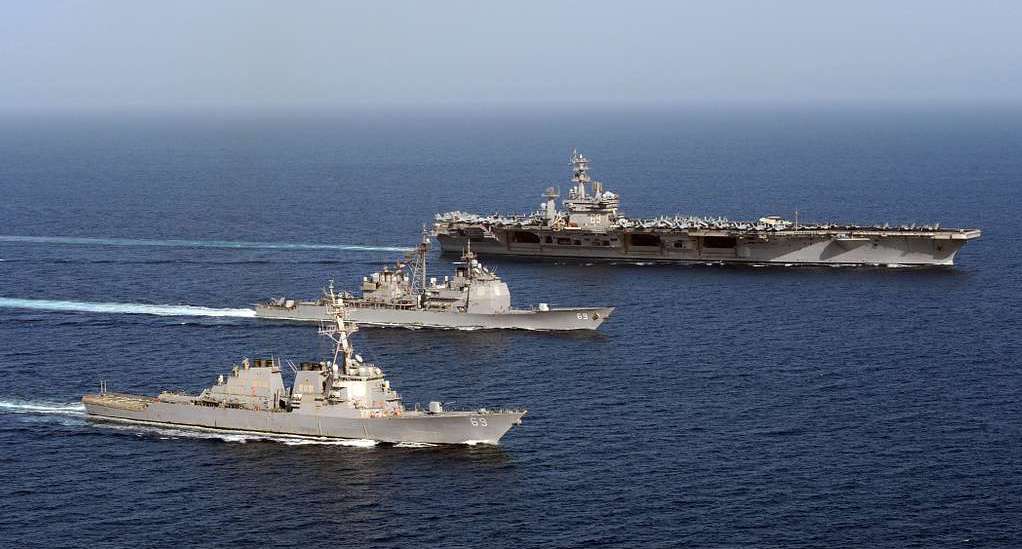
Photo: US Navy via Latin America Reports


Breakdown of charges against Maduro and co-defendants
Nicolás Maduro and his wife Cilia Flores, respectively the former president and first lady of Venezuela, made brief statements during their arraignment in the US District Court for the Southern District of New York on Jan. 5.
The couple pleaded not guilty to all charges levied against them in a new indictment, which alleges narco-terrorism conspiracy, cocaine importation conspiracy, and two weapons charges. Maduro is charged with all four crimes. Flores is accused of cocaine importation and the weapons charges, but not narco-terrorism, the charge that carries the longest sentence. The indictment names four others, who were not arraigned that day.
“I am president of the Republic of Venezuela… I was captured at my home in Caracas, Venezuela. I am a kidnapped president, prisoner of war. I am innocent. I am not guilty. I am a decent man,” said Maduro.
US District Judge Alvin Hellerstein interrupted Maduro, saying that the court will discuss “the legal sufficiency of what was done” later. The next hearing is scheduled for March 17.
Maduro’s attorney, Barry Pollack, also said that there are “issues about the legality of his military abduction.”
Flores said, “I am First Lady of the Republic of Venezuela.” When asked for her plea on the three charges that she faces, she replied, “Not guilty—completely innocent.” (Jurist)
Six defendants, four still at large
Maduro’s legal status is itself contested. The United States has not recognized him as Venezuela’s legitimate president since 2019, when the Trump administration backed opposition leader Juan Guaidó following a disputed election. The indictment describes Maduro as Venezuela’s “de facto but illegitimate ruler.” However, many countries—including China, Russia, and several Latin American and Caribbean states—continue to recognize Maduro as president. This division is likely to feature prominently in defense arguments regarding head-of-state immunity.
Maduro faces four counts, three of which he shares with all five co-defendants. The narco-terrorism count—the most serious charge—applies only to Maduro and two other defendants: current interior minister Diosdado Cabello Rondón and Ramón Rodríguez Chacín, a former interior minister. The relevant statute, 21 U.S.C. § 960a, targets drug trafficking conducted to benefit terrorist groups and carries a mandatory minimum sentence of 20 years.
The indictment names several such organizations: the Revolutionary Armed Forces of Colombia (FARC) as well as its successor factions such as the Segunda Marquetalia, the National Liberation Army (ELN), Tren de Aragua, the Sinaloa Cartel, and the Cartel del Noreste (CDN, formerly known as the Zetas).
The remaining three defendants face cocaine importation, weapons possession and weapons conspiracy charges only. They are Maduro’s wife (“first combatant”) Cilia Adela Flores de Maduro, Maduro’s son from a previous marriage Nicolás Ernesto Maduro Guerra, and Héctor Rusthenford Guerrero Flores AKA “Niño Guerrero,” the supposed head of the Tren de Aragua.
All defendants except Maduro and Cilia Flores remain at large.
Central to the government’s theory is the concept of the “Cartel de Los Soles” —the Cartel of the Suns, named for the sun insignia worn by high-ranking Venezuelan military officers. The indictment describes this as a “patronage system” in which “powerful Venezuelan elites enrich themselves through drug trafficking and the protection of their partner drug traffickers.” (Jurist)
Maria Corina Machado continues to debase herself
We’ve noted before how Venezuelan opposition leader María Corina Machado has obsequiously ingratiated herself to Trump, only to be met with his condescending dismissal. Now she has debased herself yet further, saying that she could “share” her Nobel Peace Prize with Trump—prompting a retort from the Nobel Institute, which said that its prizes cannot be shared or transfered. (El Diario)
Although Trump has explicitly rejected the idea of putting Machado in power (and has said not a word about Edmundo González, her surrogate candidate widely believed to have won the 2024 presidential election), she is celebrating the removal of Maduro—and in dishonest terms. She tweeted Jan. 5: “The brave people of Venezuela took to the streets in 30 countries and 130 cities around the world to celebrate a huge step that marks the inevitability and imminence of the transition in Venezuela.” This with widely circulated video footage of crowds celebrating in Caracas. Yet when a video of the same rally was tweeted by conspiracy theorist Alex Jones, PolitiFact rated the tweet as “false.” The footage is actually of an electoral rally in July 2024.
Apart from a pro-Maduro rally on Jan. 5 (presumably organized by the ruling party), by all accounts Caracas has been (for whatever reason) silent since the Pentagon raid two days earlier.
Maria Corina Machado continues to debase herself
Maria Corina Machado met with President Trump at the White House Jan. 15, and said that she presented him with her Nobel Peace Prize. It came a day after Trump spoke with Venezuela’s acting president Delcy Rodriguez, a woman who in the past disparaged Machado but is now empowered by the US to lead the country. (NewsHour, NBC)
US hosts hawkish conferences on hemispheric policing
Key military officials and political leaders from across Latin America gathered in Florida this week for two conferences focused on regional security. On March 6, at the inaugural “Americas Counter Cartel Conference,” Secretary of “War” Pete Hegseth and White House Security Adviser Stephen Miller pushed regional leaders to intensify their campaigns against criminal organizations. Likening drug cartels to groups like ISIS, Miller argued that organized crime can “only be defeated with military power” and vowed to continue using “hard power, military power, lethal force, to protect and defend the American homeland.” Hegseth agreed and added that the United States was “prepared to go on the offense alone, if necessary.” Both officials cast the battle against organized crime in civilizational terms, describing the representatives from more than a dozen allied conservative governments as “Christian nations under God” under threat from foreign “incursions.”
This message is sure to be repeated this bweekend at the “Shield of the Americas Summit,” a meeting of right-wing Latin American leaders hosted by Trump and dedicated to regional security. (NACLA Update)