Planet Watch
EZLN

Zapatistas: ‘nation-state under attack’

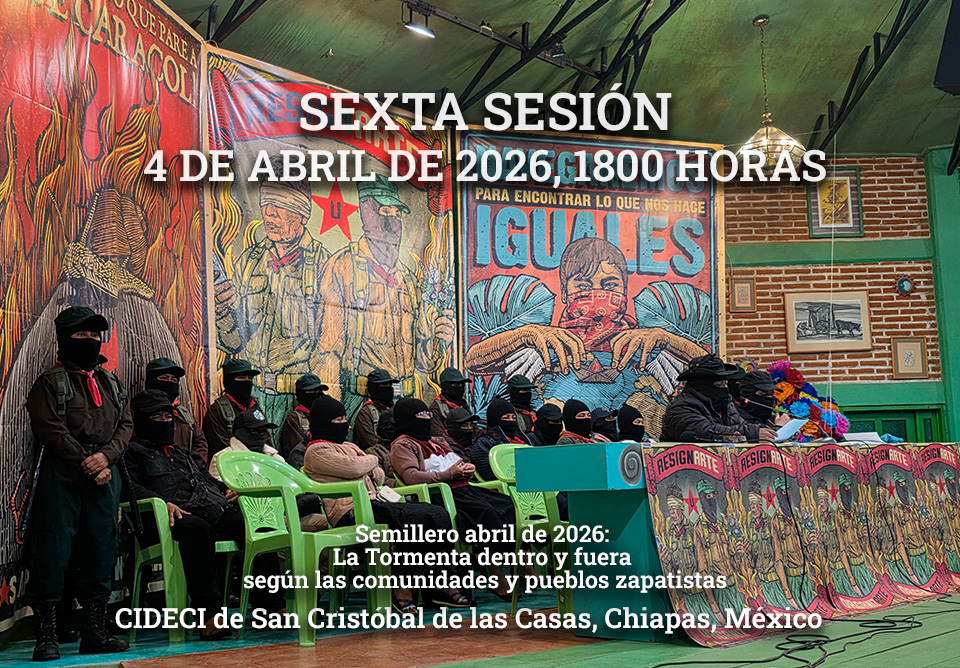
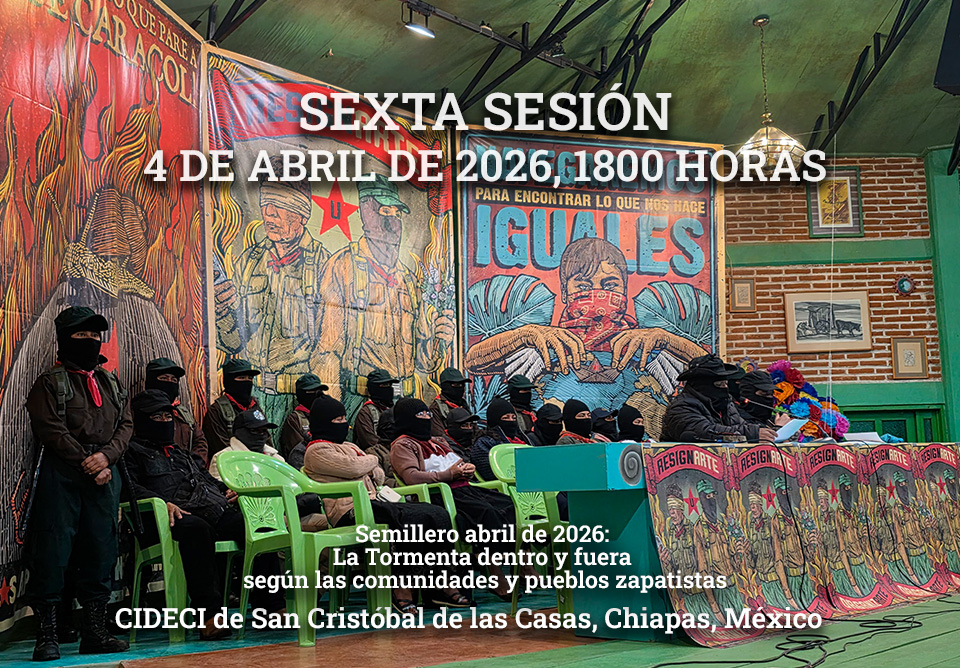
Mexico’s Zapatista rebels—who have observed a long ceasefire but still have a zone of control in the back-country of Chiapas state—held an international gathering in the highland city of San Cristóbal de Las Casas. Featured speaker was a ski-masked “Captain Marcos,” presumably the same charismatic spokesman once known as “Subcommander Marcos.” He delivered an exegesis entitled “A Peephole into the Storm in the World: Nation-States Under Attack” (Una mirilla a la Tormenta en el Mundo: Los Estados-Nación bajo ataque). Marcos portrayed a supra-national imperialism under Donald Trump, in which “the nation-state has no decision-making power.” Marcos decried the “kidnapping” of Nicolás Maduro from Venezuela, and the US oil blockade on Cuba, noting that Mexico has been effectively barred from shipping oil to the Caribbean island nation. He also asserted that in the US-Israeli war against Iran, the big oil companies are the ones who benefit, as the price of oil rises. “That’s what needs to be discussed: who is profiting from these wars?” (Image: Enlace Zapatista)

Planet Watch
Ukraine-Venezuela solidarity

Venezuela and Ukraine: forbidden symmetry

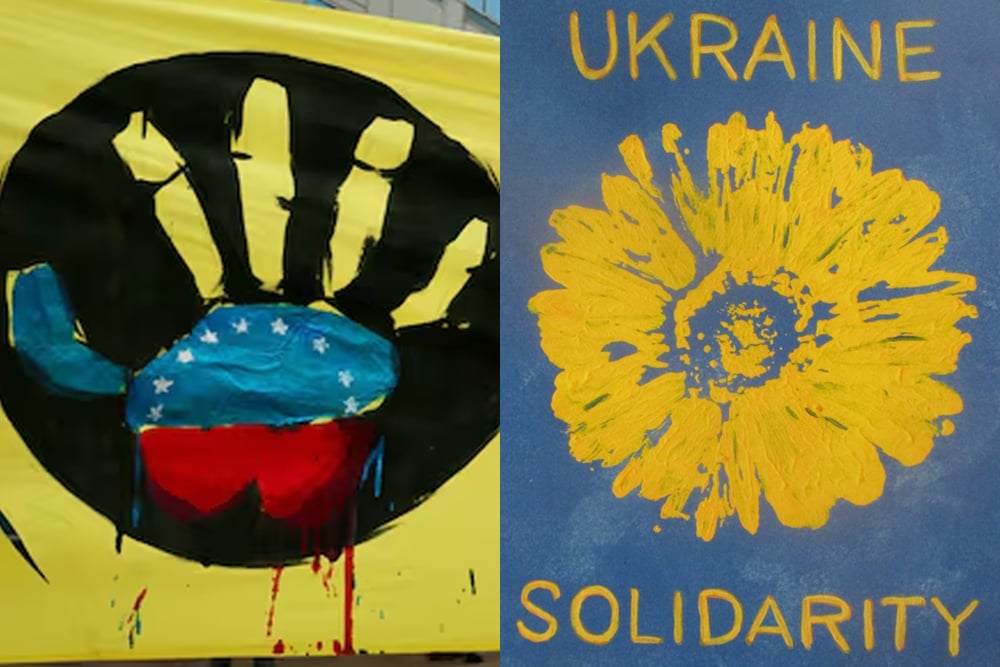
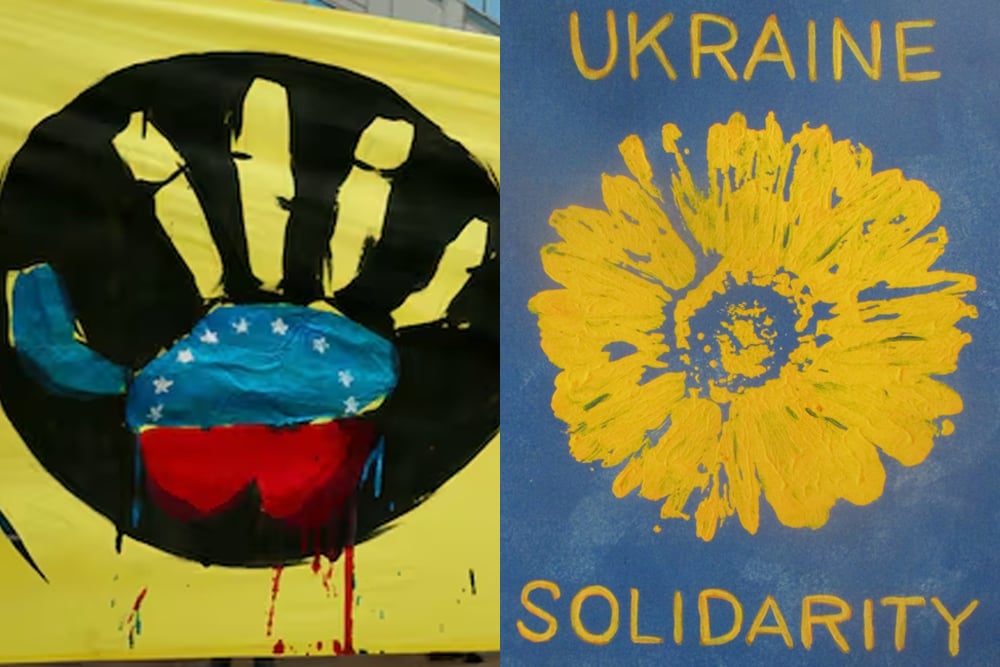
A close reading of the facts indicates that Putin and Trump worked out a global carve-up in which Russia gets Ukraine and the US gets Venezuela. This was implicitly acknowledged in the “Trump Corollary” to the Monroe Doctrine enshrined in the National Security Strategy released by the White House weeks before the illegal Venezuela attack was launched. In this light, Russian protests of the US aggression at the UN Security Council seem strictly pro forma. Both dissident left voices in Venezuela and democratic socialists in Ukraine have made the point that to betray one country is to betray the other. In Episode 312 of the CounterVortex podcast, Bill Weinberg demonstrates how the global divide-and-rule racket that is campism has never made less sense. (Image mash-up by Chris Rywalt, with material from Tamara Wyndham  and CBC)

Watching the Shadows
Aegis

‘Donroe Doctrine’ threatens hemisphere

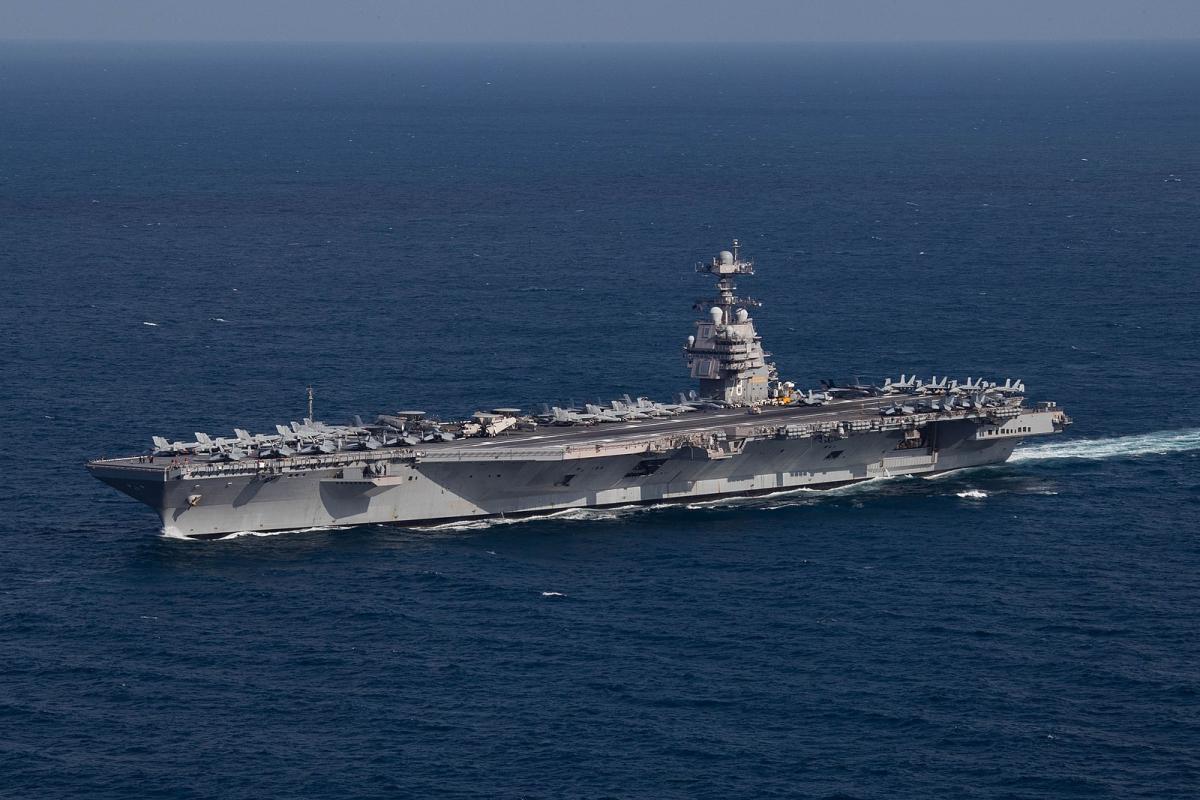
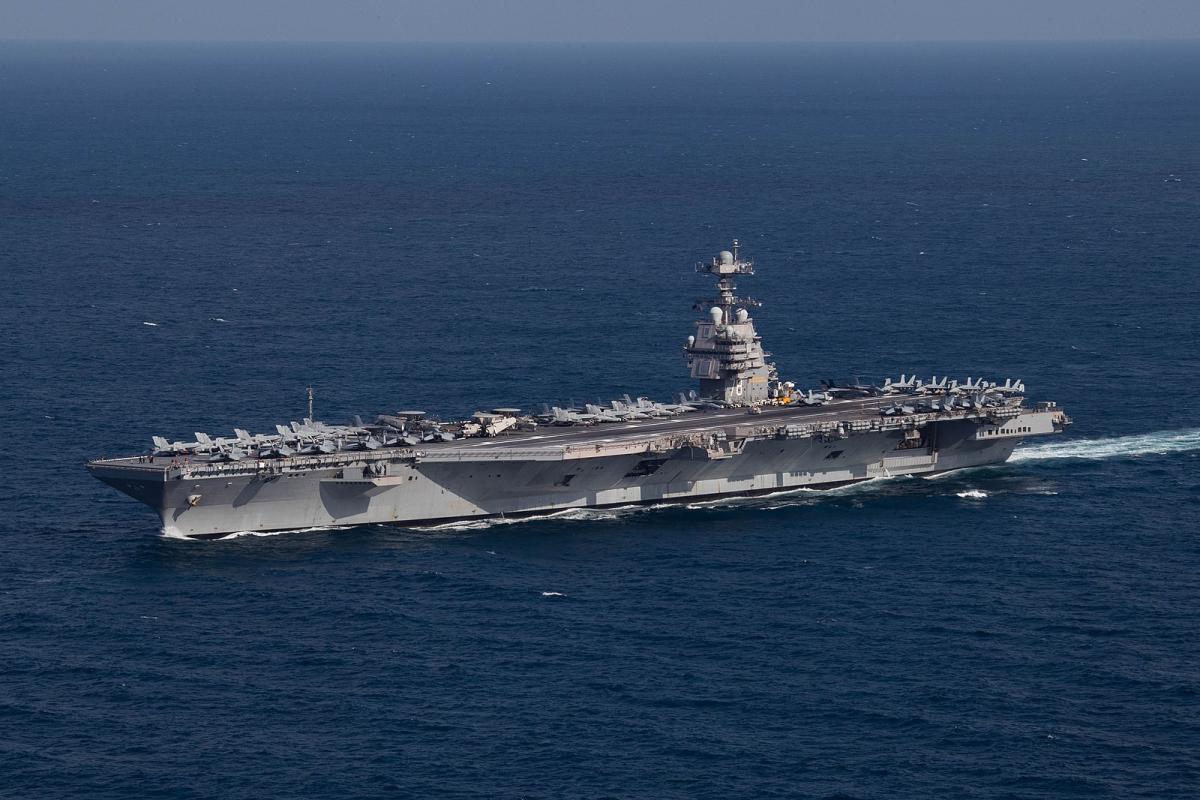
As Nicolás Maduro appeared in federal court in New York, Trump made explicit military threats against Colombia, Mexico, Cuba and Greenland—prompting protests from those countries’ leaders. In defense of his bellicosity, Trump invoked the notion of Latin America as a US influence sphere that was articulated in his recent National Security Strategy, calling it the “Donroe Doctrine.” (Photo: US Navy via Latin America Reports)

Southern Cone
Chile

Chile’s turn to the hard right

The rising wave of far-right populism has arrived in Chile with the victory in the presidential race of José Antonio Kast, an ultra-conservative who campaigned on fighting crime and carrying out mass deportations. Emulating Donald Trump, Kast exploited a backlash against migrants—especially Venezuelans—and pledged to build a separation wall on the border with Peru. His victory marks the country’s sharpest shift to the right since the restoration of democracy after the brutal dictatorship of Augusto Pinochet 30 years ago—an era and figure that Kast has openly admired. (Image: Nicolas Raymond via Flickr)

Watching the Shadows
NSS

Trump Corollary: spheres of influence, white supremacy

Donald Trump’s new National Security Strategy instates a “Trump Corollary” to the Monroe Doctrine. Like the Roosevelt Corollary of 1904, which was used to justify the “gunboat diplomacy” of that era, this new corollary openly calls for dividing the world into spheres of influence—with the Western Hemisphere assigned to the US. Russia is obviously pleased as punch over this, as it implicitly gives Moscow a free hand in Ukraine—and Putin will likely consider this an acceptable pay-off for his betrayal of Venezuela. However, China is less likely to surrender its massive investments and mega-projects in Latin America in exchange for a free hand to take over Taiwan. The document’s text on Europe is even more sinister, revealing a white supremacist agenda that looks not to Washington’s traditional allies to counter Russia, but to the continent’s Russian-backed far-right movements to counter Washington’s traditional allies. In Episode 308 of the CounterVortex podcast, Bill Weinberg exposes the NSS as a further step toward consolidation of a Fascist World Order. (Image: White House)

Watching the Shadows
Orwell

Podcast: Trump for War-is-Peace Prize III

Trump’s perverse ambition to win the Nobel Peace Prize was given a boost by his “winning” of the first “FIFA Peace Prize“—just as he is carrying out illegal deadly air-strikes in the Caribbean, and threatening Venezuela with war. “Secretary of War” Pete Hegseth is denying claims that he gave orders to “kill them all” in the strikes, but Congress is preparing an investigation. Regardless of whether this order was given, the strikes are clearly illegal under the international laws of war. Nonetheless, the Pentagon has opened an investigation into Sen. Mark Kelly for his video calling for troops to refuse illegal orders. Trump—who pardoned soldiers convicted of war crimes in his first term—has called for Kelly to be hanged for sedition. In Episode 307 of the CounterVortex podcast, Bill Weinberg continues to be flabbergasted by the Orwellian war-is-peace propaganda. (Image via Twitter)

Watching the Shadows
Orwell

Podcast: Trump for War-is-Peace Prize II

Trump continues to pursue his perverse ambition to win the Nobel Peace Prize—now proffering “peace” plans for Ukraine and Gaza that would actually reward war crimes, and therefore portend wider war. In both cases these new “peace” plans are merely sanitized recapitulations of earlier proposals—for the surrender of the Donbas and Crimea to Russia, and for Israeli annexation of the Occupied Palestinian Territories and “transfer” of their indigenous inhabitants. Meanwhile, the actual winner of this year’s Peace Prize, Venezuelan opposition leader María Corina Machado, is obsequiously pandering to Trump, and playing along with his bellicose designs on her country. In Episode 306 of the CounterVortex podcast, Bill Weinberg cuts through the Orwellian war-is-peace propaganda. (Image via Twitter)

Mexico
Manzo

Mexico: specter of US strikes amid cartel terror

Mayor Carlos Alberto Manzo Rodríguez was assassinated during a Day of the Dead celebration in the main square of Uruapan, in the violence-torn Mexican state of Michoacán. He had been an outspoken opponent of the drug cartels and their reign of terror in the state, and his death sparked protests across Michoacán. The US State Department said in response to the killing that the United States is ready to “deepen security cooperation with Mexico to wipe out organized crime on both sides of the border.” But this comes as the specter of unilateral US intervention has been raised. NBC News reports that the White House has started planning a “potential mission” involving US troops and intelligence officers to target the cartels on Mexican soil. (Photo: Juan José Estrada Serafín/Cuartoscuro.com via Mexico News Daily)

The Andes
Bolivia

Bolivia: far-right candidate defeated —at least

Rodrigo Paz, a center-right senator and son of a former president, won Bolivia’s run-off election—defeating former far-right president Jorge “Tuto” Quiroga, who ran on a platform that pledged an IMF bailout for the troubled economy and widespread privatization of state industries and natural resources. For the first time since 1997, there was no candidate on the ballot from the Movement toward Socialism (MAS), the party of former president Evo Morales. A candidate from MAS, which had ruled all but one year since 2006, was eliminated in the first round in August. However, some of the social policies put in place by the MAS have now been adopted by Paz. (Photo: Dan Lundberg/Flickr)

The Andes
Venezuela

Trump officials push Venezuela regime change

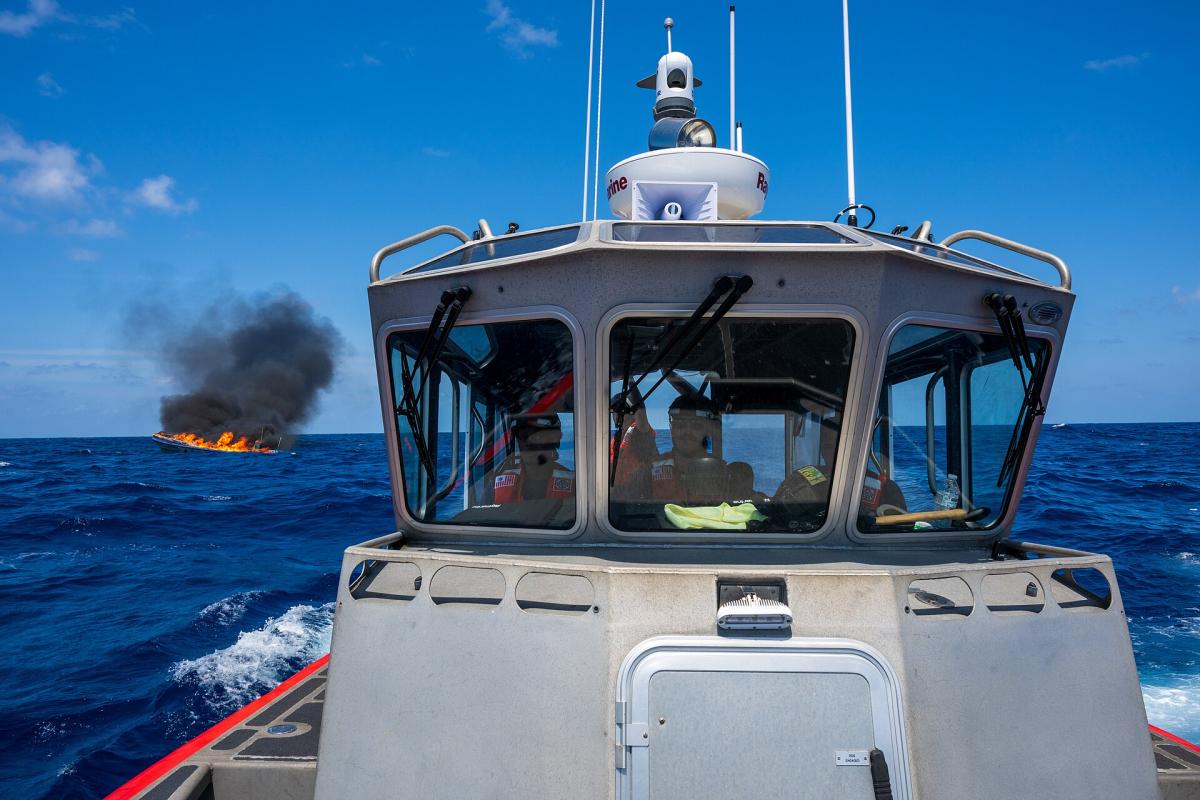
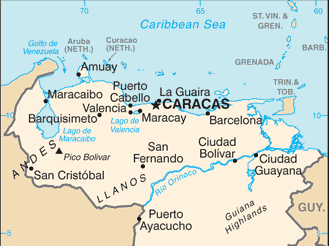
Venezuelan President Nicolás Maduro announced that he is ready to declare a state of emergency in response to aggression by the United States. Such a declaration would give the army control over public services and the country’s oil industry, which Venezuelan leaders say the US is preparing to grab. US officials, led by Secretary of State Marco Rubio and CIA director John Ratcliffe, are reported to be pushing plans to overthrow Maduro. The US has increased its naval presence in the Caribbean and launched repeated deadly strikes on civilian vessels in international waters off Venezuela. President Trump has claimed, without evidence, that the vessels were carrying drug traffickers. Rubio recently described Maduro as a “fugitive from American justice” who leads a terrorist and criminal organization bringing narcotics into the US, posing an “imminent, immediate threat.” (Image: Grunge Love via Flickr)

The Andes
CONAIE

Popular protests turn deadly in Ecuador

Widespread protests in Ecuador, sparked by cuts to fuel subsidies, reached a boiling point, as an indigenous land defender was killed by the armed forces, a government aid convoy was reportedly attacked by protesters, and 12 soldiers went missing. Meanwhile, the government continued to advance its plan to rewrite the constitution—an initiative that has further intensified public anger. Undeterred, the powerful Confederation of Indigenous Nationalities (CONAIE), which initiated the nationwide strike, announced that it would extend the action. (Photo: CONAIE via Peoples Dispatch)

The Andes
Colombia

US ‘decertifies’ Colombia as drug war partner

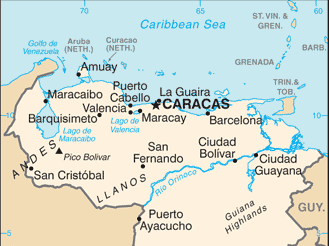
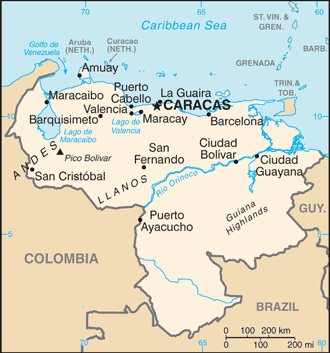
The United States decertified Colombia as a reliable partner in the War on Drugs, citing a rise in coca cultivation and cocaine production. While the White House waived the crushing sanctions that usually come with decertification, the decision underscores the strained relations between the US and Colombia under Trump. The administration was quick to blame Colombian President Gustavo Petro directly, arguing in its submission to Congress that the “failure of Colombia to meet its drug control obligations over the past year rests solely with its political leadership.” The administration also decertified Venezuela, Bolivia, Afghanistan and Burma. While these latter countries have been frequently decertified over the years, this marks the first time Colombia has been decertified since 1997. (Map: PCL)