

Syria
B-52

Syrian revolution met with US, Israeli air-strikes

The same day the Assad regime fell and rebel forces took Damascus, the US military carried out a series of air-strikes against Islamic State positions across central Syria. The Pentagon’s Central Command announced that it “struck over 75 targets using multiple US Air Force assets, including B-52s, F-15s, and A-10s.” The targets included “ISIS leaders, operatives, and camps.” Also that day, Israeli warplanes conducted dozens of raids across Syria, including in Damascus. The Syrian Observatory for Human Rights (SOHR) counted more than 100 Israeli strikes on military and industrial targets, including a research center believed to be linked to chemical weapon production. Israel said it was acting to stop weapons from falling “into the hands of extremists.” Israel has additionally seized control of a demilitarized “buffer zone” in the Golan Heights, saying the 1974 disengagement agreement with Syria had “collapsed” with the rebel take-over of the country. (Photo of B-52 bomber: USAF via A&SF)

Syria
al-Hol

Syria: Kurdish militia accused of diverting US aid

USAID’s Office of Inspector General has found that security forces and administrators at northeast Syria’s al-Hol camp “diverted aid”—bread from a USAID-funded program—”from the intended beneficiaries to themselves.” An unnamed “awardee” of the aid, presumably an NGO, was “forced to rely on the Asayish and the Camp Administration to deliver bread within the inaccessible areas of the camp, which created the opportunity for the initial diversion. However, once the awardee received full access to the camp, the Asayish and the Camp Administration continued to divert the USAID-funded bread.” Asayish (for Internal Security Forces of North and East Syria) is the militia associated with the US-backed Kurdish-led Syrian Democratic Forces (SDF). Al-Hol, which is home to both sympathizers and victims of the so-called Islamic State, has become notorious for its dangerous and extremely harsh conditions. (Photo: SOHR)

North America
#ElectoralNullification

Podcast: nullify the election! II

As the Trump team’s plans fall into place for mass detention of millions of undocumented immigrants—perhaps even naturalized citizens—and establishment of a concentration camp system, invocation of the Insurrection Act to mobilize the army for the round-ups has been broached. Sending National Guard troops from red states into blue states to carry out round-ups and put down protests—over the objections of governors who have refused to cooperate—could portend civil war. There is still time to invoke the 14th Amendment to bar Trump from the presidency—just as Brazil’s Jair Bolsonaro, indicted for leading a Trump-style attempted auto-golpe in 2022, has been barred from office. And just as the Congressional Black Caucus sought to bar Dubya Bush from office over considerably lesser matters on Jan. 6, 2001. In Episode 253 of the CounterVortex podcast, Bill Weinberg continues to make the case for mass pressure to demand nullification of the election. (Image: CounterVortex)

North America
MAGA

Mandate for fascism, strategy for resistance

Donald Trump has for the first time won the popular vote, and now around an openly fascist program, starting with plans for mass detention of millions of undocumented immigrants. While there are signs of an emergent resistance, there are also undeniable signs of a left-MAGA convergence around a mutual embrace of authoritarian populism, exploiting disaffection from Biden-Harris’ criminal support for Israel’s genocide in Gaza. In Episode 251of the CounterVortex podcast, Bill Weinberg stakes stock of this grim juncture for the United States and the world. We also revive our call from 2016 for electoral nullification—the electors refusing to seat Trump. The New York judge in Trump’s “hush money” case must immediately impose the maximum sentence of four years in prison, bringing on the needed constitutional crisis, and the Electoral College must do what it was designed to do under the Constitution: bar a dangerous demagogue from the presidency. Listen on SoundCloud or via Patreon. (Photo: via Flickr)

Europe
Gjader

Meloni maneuvers to save offshore migrant camp plan

Italy’s right-wing government, led by Prime Minister Giorgia Meloni, issued a decree aimed at bypassing judicial obstacles to a controversial deal with Albania to hold and process the claims of asylum-seekers intercepted at sea by Italian forces. The move came days after a special immigration court in Rome ruled that the first group of 12 migrants sent to the repurposed military camp at Gjader, Albania, must be returned to Italy. The court found that the migrants’ countries of origin—Egypt and Bangladesh—are “unsafe,” making their offshore detention illegal. Meloni’s decree asserts the executive alone has the power to make such determinations, setting the stage for a showdown between her government and the judiciary. (Photo: Melting Pot Europa)

Syria
Lesvos

Syrian refugees face illegal ‘push-backs’

The Cyprus spokesperson for the United Nations Refugee Agency, Emilia Strovolidou, has urged the country to stop forcibly pushing away Syrian refugee boats arriving from Lebanon, a practice that violates international human rights law and the principle of non-refoulement. Strovolidou accused Cyprus authorities of using “violent” tactics to “destabilize” boats in order to thwart refugees from arriving on the island’s shores. Meanwhile, Human Rights Watch says Lebanese authorities have “arbitrarily detained, tortured, and forcibly returned Syrians to Syria in recent months.” (Photo: Syrian refugees arriving in Lesvos, Greece. Greek authorities have also been accused of push-backs. Via Wikimedia Commons)

Palestine
Gaza

UN experts call for Gaza war crimes investigation

UN experts called for prompt, transparent and independent investigations into possible war crimes and crimes against humanity perpetrated in the Occupied Palestinian Territory, including the Gaza Strip, since Israel’s new military offensive began last month. “Independent investigators must be given the necessary resources, support and access required to conduct prompt, thorough and impartial investigations into crimes allegedly committed by all parties to the conflict,” the experts said, calling on Israel, the Palestinian Authority and the de facto authorities in Gaza to cooperate fully with investigations. (Photo: Maan News Agency)

Europe
migrants

Italy in deal to hold asylum-seekers in Albania

Italy and Albania announced an agreement that would see asylum-seekers intercepted at sea by Italian forces taken to Albania while their claims are processed. Italy is to pay for construction of two centers in Albania with the capacity to hold up to 3,000 migrants at a time. If Italy rejects the asylum bids, Albania would deport the migrants. Albania is also to provide external security for the two centers, which would be under Italian jurisdiction. Some experts question whether the plan is legal, and say it follows a worrying trend of European countries seeking to “externalize” migrant processing to third countries. (Photo: US Navy via Wikimedia Commons)

Iraq
al-Hol

‘ISIS-linked’ families repatriated to Iraq from Syria

Iraq has taken in 192 families from Syria’s al-Hol camp that houses persons accused of having links to the Islamic State (ISIS). A total of 780 individuals were returned to Iraq and will be placed in al-Jadaa Center for Community Rehabilitation in Nineveh province. The families are to remain at al-Jadaa camp until they are given clearance from the Interior Ministry to return to their homes and issued identification documents. Al-Hol camp, overseen by the Kurdish-led Syrian Democratic Forces (SDF), is located in northeast Syria’s Hasaka province and houses over 50,000 supposedly ISIS-linked persons. (Photo: SOHR)

North America
Otay Mesa

US to settle class-action suit on family separation

The US government announced that it will settle a 2018 class-action lawsuit that challenged the Trump administration’s family separation practice at the US-Mexico border. The proposed settlement would create a process to reunify families who were separated. Additionally, the government is to provide health services and housing support for affected families, and arrange legal services through the Executive Office for Immigration Review. Another provision of the deal bars the federal government from immigration policies that separate parents from children for eight years. The settlement does not provide any monetary relief for affected people. (Photo: BBC World Service via Flickr)

Europe
Ukraine

Ukraine: ‘forced citizenship’ in Russian-held territory

Russia has launched a systematic effort to force residents of occupied areas of Ukraine to accept Russian citizenship as part of its program of consolidating authority, according to a new report. Residents of Luhansk, Donetsk, Kherson and Zaporizhzhya oblasts are subjected to threats, intimidation, restrictions on humanitarian aid and basic necessities, and possible detention or deportation—all designed to force them to become Russian citizens. Based on a comprehensive review of open source material, Yale Humanitarian Research Lab (HRL) has identified the laws and tactics used to make it impossible for residents to survive in their homes unless they accept Russian citizenship. These laws and tactics violate international law, including the prohibition on discrimination against people living under occupation based on nationality, and forcing people to declare allegiance to an occupying power, both illegal under the Hague Convention and the Geneva Conventions. (Map: PCL)

North Africa
sfax

Tunisia: mass expulsion of Black African migrants

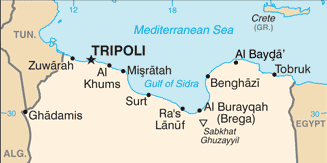
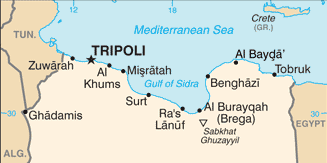
Hundreds of Black African migrants were rounded up from the Tunisian port city of Sfax, expelled across the country’s border with Libya and left stranded in the desert, sparking street protests by the large community of migrants waiting in the city. According to reports, some managed to escape back to the Tunisian side after being confronted by Libyan militiamen, but the fate of all those expelled has still not been accounted for.  The expulsions came after mobs attacked Black Africans in Sfax following the funeral of a Tunisian man who was stabbed to death in an altercation with migrants. Tensions have been rising for months in Tunisia, which has seen a sharp increase in people attempting to cross the Mediterranean from its shores this year. (Map: Google)