

Central America

Nicaragua ‘witch-hunt’ against dissent: UN experts

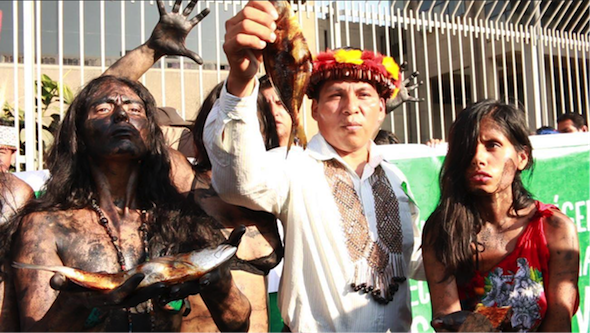
A group of UN human rights experts, including the special rapporteurs on freedom of assembly, freedom of expression and extrajudicial exections, issued a statement urging the government of Nicaragua to "stop the repression" following 100 days of unrest in which at least 317 have been killed and 1,830 injured. "Reports indicate that there has been an increase in targeted repression, criminalization and alleged arbitrary detention, which is creating an atmosphere of fear," the statement said. "We are appalled that many human rights defenders, journalists and other opposition voices are being criminalized and accused of unfounded and overly punitive charges such as 'terrorism'." (Poto via Noticiias ONU)

The Andes

Colombia: Duque sworn in amid terror, massacre

Colombia's newly-elected right-wing President Iván Duque took office pledging to unite the country. As he was sworn in, thousands marched in Bogotá to demand that Duque respect the peace pact with the FARC, and address the ongoing assassination of social leaders—thought to number 400 since the peace deal was signed in November 2016. Exemplifying the depth of the crisis, days before the inauguration armed men opened fire in broad daylight at a pool hall in the town of El Tarra, near the Venezuelan border. Among the slain were at least two demobilized FARC fighters and a local community leader. (Photo via Contagio Radio)

Syria

Propaganda and the accounting of death in Syria

The US State Department harshly condemned the Syrian regime over thousands of death notices it has released in recent weeks, saying they confirm suspicions of mass detentions, torture and murder. The State Department said that over 117,000 are believed to have been detained or forcibly disappeared in Syria since the conflict began in 2011, “the vast majority” by the regime. Amnesty International meanwhile issued a statement protesting the US-led Coalition’s “flurry of responses” rejecting the findings of its recent report on devastation wrought by the aerial bombardment of Raqqa last year, revealing “how deeply in denial the Coalition leadership is about its failure to protect civilians caught in conflict.” (Photo: SDF)

Africa

Ethiopia in peace pact wth Oromo Liberation Front

Following peace talks hosted by Eritrea, the government of Ethiopia announced a peace deal with the Oromo Liberation Front rebels. The deal guarantees rebel leaders the right to participate in Ethiopia's political process in exchange for laying down arms. The OLF has long been backed by Eritrea, and the pact comes one month after a formal end was declared to the two-decade state of war between Ethiopia and Eritrea, with Ethiopia ceding its claim to the contested border town of Badme. This points to a softening of positions under Ethiopia's new prime minister, Abiy Ahmed. The Badme deal was also said to have been quietly brokered by the United Arab Emirates, which has emerged as politically isolated Eritrea's most significant foreign patron, part of an apparent design to encircle Yemen. (Photo: Yassin Juma

Inner Asia

Podcast: The Tibetan uprising 10 years later

In Episode 15 of the CounterVortex podcast, Bill Weinberg reports on the 10-year commemoration of the 2008 Tibetan uprising held by Students for a Free Tibet in Astoria, Queens, New York City. A decade after the uprising was put down, struggles for land recovery and language preservation continue in Tibet, as well as among the Mongols, Uighurs and other indigenous peoples of the territory that constitutes the People's Republic of China. Weinberg provides an overview of these ongoing struggles, and draws parallels to related struggles in Peru, Ecuador, Colombia and elsewhere in the Americas—including the movement against the Dakota Access pipeline. These parallels point to the urgent need for grassroots-to-grassroots international solidarity across superpower infuence spheres. Listen on SoundCloud, and support our podcast via Patreon. (Photo: Uprising Archive)

Iran

Trump administration reimposes sanctions on Iran

US President Donald Trump issued an executive order reimposing certain sanctions against Iran. In a press statement, the White House criticized the Iran nuclear deal, the Joint Comprehensive Plan of Action (JCPOA) of July 2015, signed by Iran, Germany, the five permanent members of the UN Security Council and the EU. The US withdrew from the JCPOA in May, prompting a legal challenge from Iran before the International Court of Justice. The White House stated that JCPOA "threw a lifeline of cash to a murderous dictatorship that has continued to spread bloodshed, violence, and chaos." The administration claims Iran used funds obtained from the JCPOA to fund nuclear-capable missiles, terrorism, and to support conflict abroad. (Map: Myket.ir)

North Africa

Berber language rights at issue in Libya, Morocco

The Libyan Amazigh Supreme Council, representing the country's Berber ethnic minority, has decided to boycott the referendum on the country's newly released draft constitution, in protest of the lack of provisions for their language and cultural rights. Berbers want their language to be official in the Libyan constitution, given equal status with Arabic in administration and education. Meanwhile in Morocco, Berber leaders are protesting a move by the city of Agadir to remove street names in the Berber language, Tamazight. The Agadir city council voted to change Tamazight street names to the names of Palestinian cities, ostensibly as a show of support for Palestinians. Abdullah Badou, head of Morocco's Amazigh Network, said: "We do not have a problem with Palestine. Certainly, we support the Palestinians, but we do not agree with those who ignore the nature of the area and the history of Morocco." (Photo of Agadir port via Morocco World News)

Inner Asia

2008 Tibetan uprising remembered in Queens

Students for a Free Tibet held a 10-year commemoration of the 2008 Tibetan uprising at a hall n the Queens neighborhood of Astoria, New York City. The 2008 uprising, which began in Lhasa in March, continued for weeks and spread across the Tibetan plateau. It was put down at a cost of some 20 lives, by official Chinese figures. But Tibetan rights groups and the government-in-exile in Dharamshala, India, claim that hundreds were "disappeared" in a subsequent wave of repression, with some 200 presumed killed. Guest of honor at the commemoration was Dhondup Wangchen, producer of the 2008 documentary film Leaving Fear Behind, made in the prelude to the uprising, in which ordinary Tibetans spoke of their feelings about China hosting the Summer Olympics. Wangchen was subsequently arrested, convicted of "subversion," and served six years in prison. Upon his release, he fled Tibet and was granted asylum in the United States. He is shown here with his wife, Lhamo Tso, who waged a campaign for his release. (Photo: Rose Tang)

Syria

Book review: Impossible Revolution

This book is a necessary corrective to the dominant perception—left, right and center—that the opposition in Syria are all jihadists and dictator Bashar Assad the best bet for “stability.” Long a left-wing dissident in Assad’s Syria, Saleh is a veteran of the dictator’s prisons. Here, he traces the origins of the Syrian revolution to agony caused by the regime’s “economic liberalization” (socialist phrases aside), describes the initially unarmed opposition’s popular-democratic nature, and discusses the struggle to keep the Free Syrian Army accountable to this grassroots base after it became clear a military dimension to the revolution was necessary. He makes the case that the Assad regime can be termed “fascist” even by the most rigorous definition, and has been making good on its pledge to “burn the country” before ceding power. (Image: Haymarket Books)

South Asia

China expands Indian Ocean military footprint

In addition to stationing troops on the disputed islands it claims in the South China Sea, Beijing is rapidly expanding its network of commercial ports across the Indian Ocean. This comes as China is sending warships into the Ocean with growing frequency, leading to fears that the commercial ports could presage military bases, The latest addition is the port of Hambantota in Sri Lanka, acquired in a debt swap deal—the Colombo government was forgiven $1 billion in debt to Beijing in exchange for the Hambantota facility. China has also gained access to facilities in Burma, Bangladesh, Pakistan, the Maldives, Seychelles and Oman as part of the maritime component of its Silk Road trade and infrastructure initiative. While the Silk Road is an ostensibly civilian project, China has also established its first foreign military base at Djibouti, leading Western wonks to warn that Beijing is seeking a "string of pearls" network of bases across the Indian Ocean.  (Map via CIMSEC)