Syria
Daraa

Syria: starvation threat seen in Daraa siege

The siege imposed by Syrian government forces on Daraa al-Balad enclave since June could lead to serious humanitarian repercussions if it continues, Euro-Mediterranean Human Rights Monitor said in a statement. Russian-backed regime forces are trying to get remnant rebel fighters in the district of Daraa city to surrender their light weapons, and accede to installation of military checkpoints—demands that violate terms of the 2018 ceasefire in Daraa. The statement urgently called for lifting the siege and allowing entry of humanitarian aid, noting that shipments from the World Food Program have been barred entry. It also stressed that all roads to hospitals in government-controlled Daraa are cut off by regime troops, leaving district residents without access to medical facilities, except for a single insufficient clinic within the encircled area. Food, medicines and other basic materials are running low, threatening 40,000 residents with starvation. (Map: Wikimedia Commons)

Afghanistan
afghanistan

Podcast: Afghanistan and the politics of withdrawal

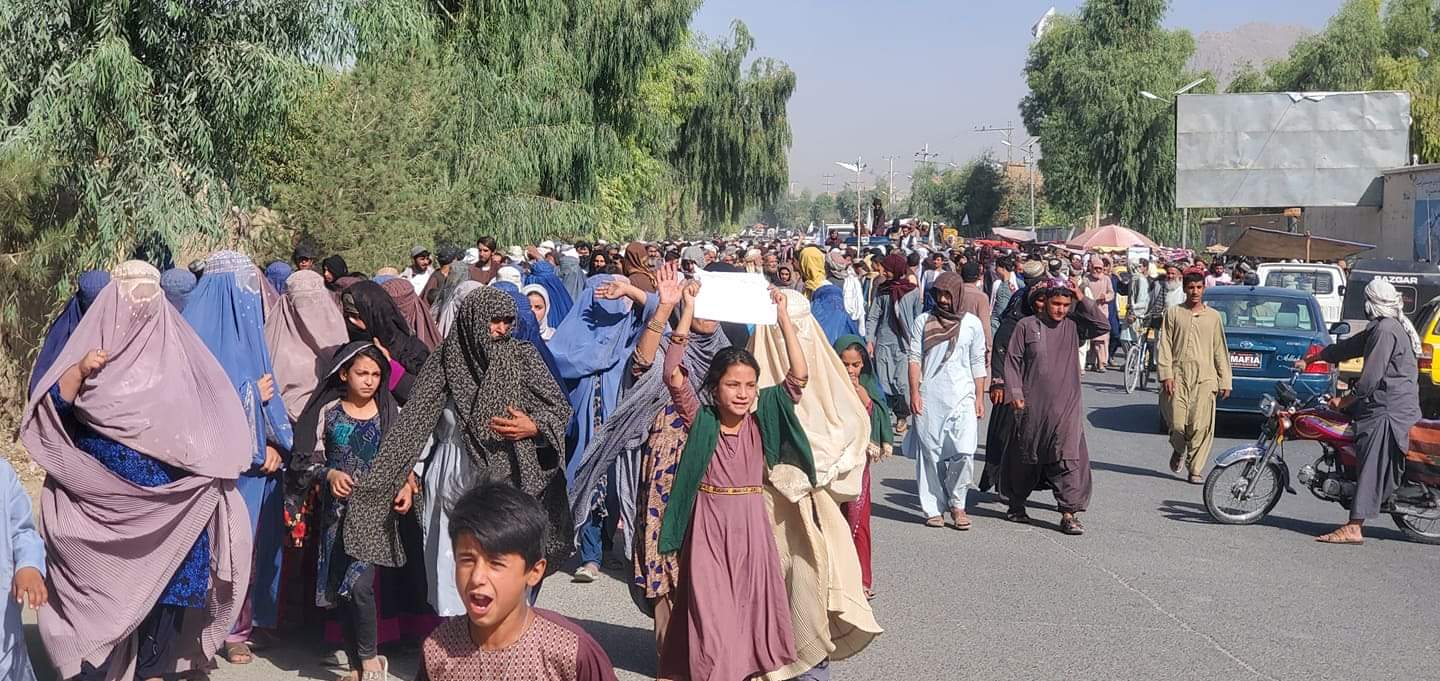
In Episode 82 of the CounterVortex podcast, Bill Weinberg calls out the Orwellian pronouncements from media and politicians that Biden is “ending the war” in Afghanistan—as the war is actually escalating. This is the same imperial narcissism we heard with the much-hyped US “withdrawal” from Afghanistan in 2014, and the US “withdrawal” from Iraq in 2011. In both cases, the war went on—and actually got worse, with the emergence of ISIS and the genocide of the Yazidis. Weinberg recalls with grim vindication that he similarly called out the glib optimism about a  withdrawal from Iraq in CounterVortex commentaries during the occupation. Meanwhile, Hazara women—who face the threat of genocide if the Taliban re-take power—are arming to resist the Taliban advance. The critical task now is to loan what solidarity and visibility we can to such efforts—not to engage in hubristic crowing about the “end of the war.” Listen on SoundCloud or via Patreon. (Map: Perry-Castañeda Library)

North Africa
Tunisia

Tunisia: president accused of ‘coup’

Tunisian President Kais Saied was accused by opposition parties of launching a “coup” with the help of the country’s military after firing the prime minister and freezing parliament. The move comes after anti-government protesters took over the streets of the capital Tunis, expressing dismay over ongoing economic turmoil and a demonstrably poor response to the COVID-19 pandemic. Recent loan negotiations with the International Monetary Fund aimed at controlling mass inflation further raised the ire of Tunisians; terms require Tunisia to raise taxes, set higher prices on goods, and implement austerity policies reducing public-sector employment and programs. (Image: Pixabay)

Syria
Raqqa

Survivors struggle four years after battle of Raqqa

Children in Raqqa, northeast Syria, are still living among ruins, with limited water, electricity, and access to education, four years after the city was taken from ISIS, according to a new report by Save the Children. Thousands of people have returned to Raqqa since the battle for the city ended in 2017. But levels of rebuilding and rehabilitation of housing remain low, with children living in constant fear of their homes collapsing on top of them. Research estimates that 36% of the city’s buildings remain entirely destroyed. At the peak of the bombing campaign, Raqqa faced 150 air-strikes a day. (Photo: Mahmoud Bali/VOA via Wikimedia)

Planet Watch
Greenland

Greenland suspends oil exploration, citing climate crisis

The government of Greenland announced that it will suspend all oil exploration, saying the territory “wants to take co-responsibility for combating the global climate crisis… The future does not lie in oil. The future belongs to renewable energy, and in that respect we have much more to gain.” The US Geological Survey estimates there could be 17.5 billion undiscovered barrels below the territory’s lands and waters. Many had hoped potential reserves could allow Greenland to acheive independence, compensating for the annual subsidy of 3.4 billion kroner ($540 million) the territory receives from Denmark. (Photo: Pixabay)

The Amazon
Amazon Fires

Brazil’s Amazon is now a net carbon source: study

The Amazon has long played a vital role in balancing the global carbon budget, but new evidence suggests the climate scales are tipping in the world’s largest rainforest. Now, according to a study published in Nature, the Brazilian Amazon is emitting more carbon than it captures. Southeastern Amazonia, in particular, switched from being a carbon sink to a carbon source during the study period. Emissions were high in 2010, when the study began, because of a dry El Niño year, and researchers expected to see emissions return to normal afterward. But this never happened. The reason: emissions from forest fires—which have accelerated dramatically under President Jair Bolsonaro. (Photo via Mongabay)

Planet Watch

Podcast: climate change and the global struggle

In Episode 81 of the CounterVortex podcast, Bill Weinberg takes stock of the fast-mounting manifestations of devastating climate destabilization—from Oregon to Siberia, from Germany to Henan. In Angola, traditional pastoralists are joining the ranks of “climate refugees” as their communal lands are stricken by drought. In Iran’s restive and rapidly aridifying Ahwazi region, protests over access to water have turned deadly. These grim developments offer a foreboding of North America’s imminent future. Yet media commentators continue to equivocate, asking whether these events are “linked to” or “caused by” climate change—rather than recognizing that they are climate change. And the opportunity for a crash conversion from fossil fuels that was posed by last year’s pandemic-induced economic paralysis, when already depressed oil prices actually went negative, is now being squandered. Oil prices are again rising, with the return to pre-pandemic dystopian “normality.” Listen on SoundCloud or via Patreon. (Photo of Ahwazi protesters in Iran: Ahwazna)

Africa
mumuila

Angola: drought threatens traditional pastoralists

Millions of people in southern Angola are facing an existential threat as drought continues to ravage the region, Amnesty International said. The organization highlighted how the creation of commercial cattle ranches on communal lands has driven pastoralist communities from their territories since the end of the civil war in 2002. This shift has left huge sections of the population food-insecure, and especially vulnerable as the acute drought persists for over three years. As food and water grow increasingly scarce, thousands have fled their homes and sought refuge in neighboring Namibia. (Photo of Mumuila woman: Pixabay)

North Africa
Libya detainee

Libya: ‘horrific violations’ in migrant detention

Fresh evidence of harrowing violations, including sexual violence, against men, women and children intercepted while crossing the Mediterranean Sea and forcibly returned to detention centers in Libya, highlights the grave consequences of Europe’s ongoing cooperation with Libyan authorities on migration and border control, said Amnesty International in a report. Since late 2020, Libya’s Directorate for Combatting Illegal Migration, a department of the interior ministry, has “legitimized abuse” by integrating two new detention centers under its structure where hundreds of refugees and migrants had been “forcibly disappeared” in previous years by militias. Amnesty is calling on European states to suspend cooperation on migration and border control with Libya. (Photo: Alessio Romenz/UNICEF)

Iran
Ahwazis protest

Iran: protests over water rights in Ahwazi region

Two were killed as Iranian security forces opened fire on Ahwazi Arab protesters in Ahvaz, capital of southwestern Khuzestan province. The deaths came after days of demonstrations in the Arab-majority region, which is stricken by withering drought. Hundreds of sheep, cattle, buffalo and other livestock have died over the past weeks. The protests began a week ago, with a peaceful vigil outside the governor’s office, demanding that authorities open the sluice gates on the network of massive hydroelectric dams built upstream on the region’s main rivers, which divert some 90% of the waters to other regions of Iran. Protesters held up placards in Arabic, Persian and English, with messages including: “Water is a human right”, “We are thirsty–give us water!”, “Stop killing our environment!”, and “Stop drying out the Ahwazi rivers and marshlands!” The protesters also chanted slogans condemning Iran’s central government, such as “The regime keeps us in poverty in the name of religion!” (Photo: Dur Untash Studies Center)

The Caribbean
Havana

Podcast: how do we respond to the Cuba protests?

In Episode 80 of the CounterVortex podcast, Bill Weinberg examines the actual politics of the Cuban protests—and how much of the response by supposedly progressive forces in the United States has been highly problematic. While opposing the embargo, and the inevitable attempts by US imperialism to exploit and co-opt the protests, we must guard against words and actions that abet the repression. Hundreds have been detained and at least one person killed as the protests have been put down by security forces. By uncritically rallying around the regime and portraying the protests as CIA astroturf, we not only make ourselves complicit with rights abuses—we help bring about exactly what we fear, showing the protesters that their only allies in the US are on the political right. Listen on SoundCloud or via Patreon. (Photo via Mal Salvaje)

Afghanistan
afghanistan

‘Imminent humanitarian crisis’ in Afghanistan

The Office of the UN High Commissioner for Refugees (UNHCR) warned of an “imminent humanitarian crisis” in Afghanistan as mounting conflict gives rise to suffering and displacement. An estimated 270,000 have been newly displaced since January, bringing the total uprooted population to over 3.5 million. The number of civilian casualties has risen 29% during the first quarter of this year compared to 2020. The UNHCR stressed its underfunded financial appeal for Afghanistan, which now stands at 43% of the total $337 million required. The agency urged the international community to support Afghanistan “in a spirit of solidarity and burden-sharing.” (Photo of displaced persons camp in Herat: Stefanie Glinski/TNH)