Africa
Oromo protest

Protests, ethnic violence rock Ethiopia’s Oromia

Nearly 70 people have been killed in Ethiopia’s central Oromia region following a week of unrest and ethnic violence. The eruption began after Jawar Mohammed, prominent advocate for the Oromo people, posted on social media about an imminent attempt on his life by security forces. Supporters surrounded his house and police retreated, but violence quickly spread. The army has now been deployed to put down the protests. Illegal sales of traditional Oromo lands to facilitate urban expansion on the outskirts of Addis Ababa has long been a grievance of the Oromo people. But anger has been unleashed on ethnic minorities in Oromia. In Sebeta, a town within the Oromia Special Zone surrounding the capital, eight members of Gamos people were killed, apparently by a mob of Oromo youth. Followers of the Ethiopian Orthodox Church as well as Muslims have also been targeted, with both churches and mosques attacked. (Photo of gathering outside Jawar Mohammed’s home via Twitter)

Central America
Costa Rica protest

Student strikes shake Costa Rica

A mass student protest filled the streets of San JosĂ©, opposing new budgetary terms being imposed on Costa Rica’s public universities. The demonstration, which was also attended by staff and even rectors of the universities, was called after the Ministry of Finance ordered an increase in the percentage of the Special Fund for Higher Education (FEES) that goes to capital expenditures—which effectively means a cut in salaries for teachers and staff. Banners read “The education of our children is not up for negotiation” and “Hands off the UCR,” a reference to the University of Costa Rica. University authorities and students did meet for several hours with government officials after the march in search of an agreement, while thousands of supporters maintained a vigil outside the presidential palace. President Carlos Alvarado, elected as leftist last year but now accused of imposing a neoliberal program, was among those who met with the protest leaders. (Photo: Poder Popular)

Mexico
ServĂ­n Herrera

Language rights advocate slain in Chihuahua

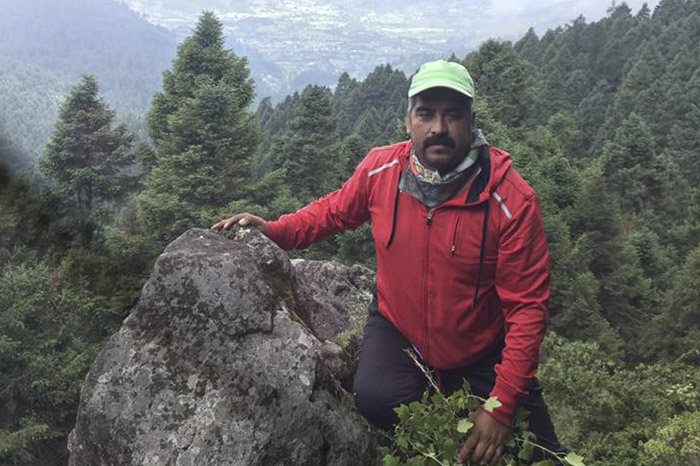
Enrique Alberto ServĂ­n Herrera, a promoter of indigenous language preservation in northern Mexico’s Chihuahua state, was found slain by a blow to the head at his home in the state capital, Chihuahua City. Authorities have made no arrests, nor named a motive in the attack. ServĂ­n Herrera headed the Department of Ethnic Cultures & Diversity at the state Secretariat of Culture, and was known for his efforts to help revive and sustain the language of the Tarahumara people. The Sierra Tarahumara, homeland of this indigenous people, has been torn by violence related to control of lands by narco-gangs and timber mafias in recent years. (Photo via La Izquierda Diario)

Southern Cone
Montevideo protest

Uruguay: mass march against militarization

Some 60,000 marched in Montevideo against the “Vivir sin Miedo” (Live Without Fear) campaign, an anti-crime initiative that goes before the voters in this week’s elections in Uruguay. The referendum, pushed by Sen. Jorge Larrañaga of the right-wing National Party, would create a new military police force, the National Guard; allow security forces to carry out night raids; and impose mandatory life terms for serious crimes. The group Madres y Familiares de Detenidos Desaparecidos, made up of survivors of those “disappeared” during the years of military rule in Uruguay, issued a statement warning that approval of the initiative could be a step back toward dictatorship. (Photo: La Izquierda Diario)

Central America
Honduras protest

Honduras: uprising against narco-president

Militant protests have swept through Honduras since the conviction by a federal jury in New York of the brother of President Juan Orlando Hernández on narco-trafficking charges. Thousands have filled the streets of cities and towns across the Central American country to demand the resignation of Hernández. Protesters have repeatedly blocked traffic arteries, erecting barricades with stones and flaming tires. A police transport truck was set on fire in Tegucigalpa. Opposition leader Salvador Nasralla of the Anticorruption Party has thrown his support behind the protests and called on the security forces to stand down, invoking a “right to insurrection” in Article 3 of the Honduran constitution. (Photo via AMW)

Southern Cone

Chile: Mapuche join protest mobilization

Leaders of Chile’s Mapuche indigenous people announced their support for the massive protests that are sweeping the country, saying they will press their demands for local autonomy in their traditional territories. Aucán Huilcamánn of the Consejo de Todas las Tierras (Council of All Lands) made the declaration in the city of Temuco, AraucanĂ­a region, standing beside Marcelo Catrillanca—father of a young Mapuche man killed by the paramilitary Carabineros last year, an outrage that sparked local protests. Camilo Catrillanca was shot in the back last November while working his lands in the community of Temucuicui. He had been driving his tractor away from an outpost of the Carabineros’ Special Police Operations Group (GOPE)—the same elite force that now being unleashed on protesters in Chile’s cities. Four ex-Carabineros have been arrested in the case. (Photo: Soy Chile)

Syria
Kurdish protest

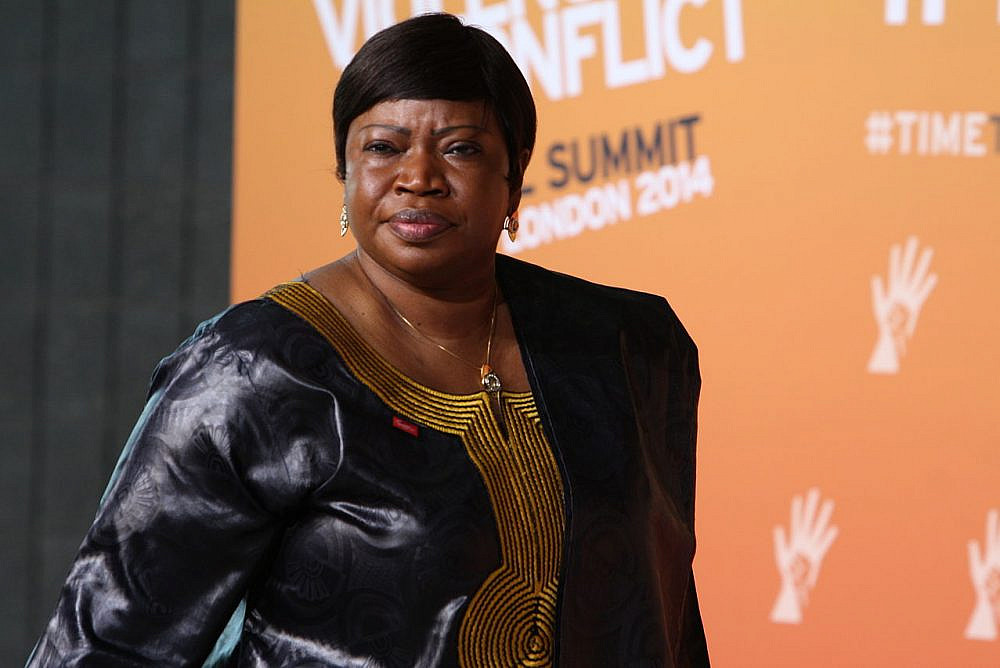
Syria: confusion, anger as US troops withdraw

US troops hastened their withdrawal from Syria, amid the anger of local Kurds and confusion over the future status of American forces in the area. Kurdish residents attempted to block a convoy of withdrawing US forces, with local youth pelting the vehicles with stones and rotten vegetables. But the Pentagon is now saying a remnant force of some 200 troops may remain—not to protect the Kurdish population from the Turkish aggression, but to help secure the Kurdish-held oil-fields from falling into the hands of ISIS. Trump actually broached turning the oil-fields over to “one of our big oil companies.” (Photo: ANHA via EA Worldview)

The Andes
Bolivia protest

Bolivia: protests as Evo victory contested

Riot police have clashed with protesters in cities across Bolivia as the Superior Electoral Tribunal (TSE) announced a clear win for incumbent President Evo Morales 24 hours after the elections, obviating the need for a second round with conservative challenger Carlos Mesa. The announced victory followed a sudden halt in the counting, before which Morales had been falling just short of the percentage needed to avoid the first run-off in his nearly 14 years in power. Crowds set fire to the TSE offices in Sucre and Potosi, and protesters torched ballots in Tarija. Street clashes erupted between Morales and Mesa supporters in La Paz and Santa Cruz. Mesa is charging fraud, saying, “We are confident that the citizenry will not accept these completely distorted results.” (Photo: OpiniĂłnBolivia via Twitter)

Syria
FSA-YPG

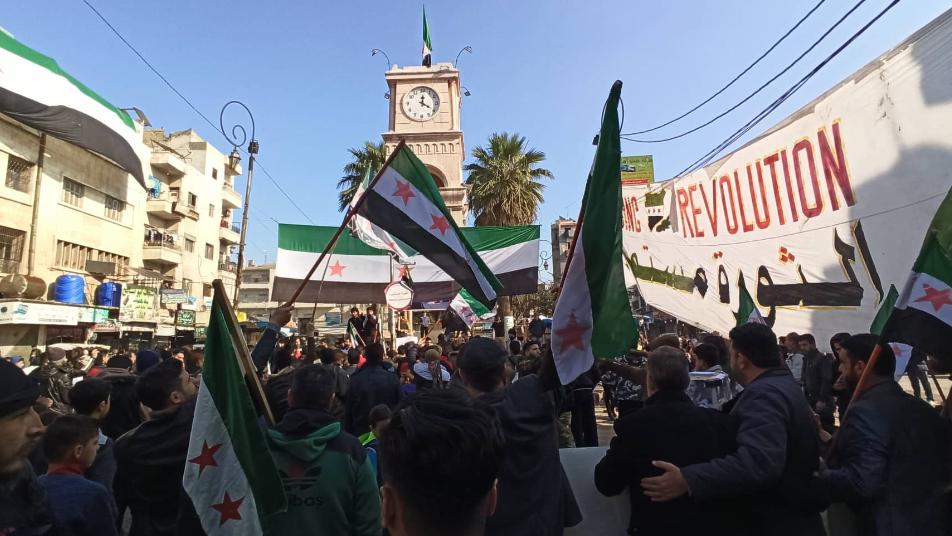
Podcast: against Arab-Kurdish ethnic war in Syria

In Episode 41 of the CounterVortex podcast, Bill Weinberg warns that the Turkish aggression in northern Syria holds the risk of an Arab-Kurdish ethnic war. But he recalls the inspiring moment in 2014 when the Kurds and Free Syrian Army were united in a common front against Assad and ISIS. This alliance was exploded by imperial intrigues. The FSA, under military pressure from Assad, accepted Turkish patronage—and Turkey is bent on destruction of the Kurdish autonomous zone. Now, under pressure from Turkey, the Kurds have made an alliance with Assad—who the Arab-led opposition have been fighting for eight brutal years. In the brief “ceasefire” now declared, it is urgent that progressives around the world raise a cry against the Turkish aggression—but with a single standard, also opposing the ongoing Russian and Assadist war crimes. Listen on SoundCloud, and support our podcast via Patreon. (Photo of 2014 FSA-YPG united front via Rojava Breaking News)

Southern Cone
Santiago protest

Econo-protests from Santiago to Beirut

A state of emergency has been declared in Chile following protests that initially erupted over transit fare hikes in Santiago but quickly escalated to an uprising over general economic agony. Youth have blocked thoroughfares, burned buses and ransacked shops, while whole families have filled the streets in a nationwide cacerolazo—beating pots and pans to express outrage over the high cost of living. Protesters have similarly taken the streets, erected barricades and clashed with police in Lebanon, where a state of “economic emergency” has been declared. Again, demonstrations were initially sparked by government plans to impose a tax on text messaging, but protests have continued even after the tax was rescinded in response to the upsurge of popular anger. Demonstrators have revived the slogan from the 2011 Arab Revolution, “The people demand the fall of the regime.” (Photo: KaosEnLaRed)

The Andes
Quito protest

Ecuador: celebration as protesters score victory

Celebrations broke out across Ecuador after President Lenin Moreno agreed to overturn Decree 883, which would have eliminated fuel subsidies. Moreno’s capitulation followed 10 days of nationwide protests that left at least eight dead, hundreds injured and more than 1,000 detained. Moreno and protest leaders are to open a dialogue to find other means to cut Ecuador’s public spending. (Photo: CONAIE via Twitter)

Europe
Free them all

Catalan independence leaders get prison terms

Spain’s Supreme Court ordered imprisoned nine Catalan political leaders—with sentences ranging from nine to 13 years for the crimes of sedition and misuse of public funds—over their role in organizing the 2017 independence referendum. The sentences are each followed by equal periods of absolute ineligibility for public office. Oriol Junqueras—the former vice-president of Catalonia and the highest-ranking of the defendants—received the longest sentence. The sentences sparked protests in the region, with assembled crowds causing flights to be canceled at Barcelona’s airport. Police used rubber bullets to regain control of the facility. Demonstrators also gathered at Barcelona’s Plaça San Jaume, the seat of the Catalan government, and erected barricades across roads and rail lines. Catalonia’s feared anti-riot force, the Mossos d’Esquadra, has been mobilized to clear the streets. (Image via Twitter)