The Amazon
Sierra del Divisor

Court bars oil exploitation in Peru’s Sierra del Divisor

A court in Peru’s Loreto region issued an order blocking all oil exploration or exploitation within a vast area of the Amazon rainforest along the Brazilian border, citing the presence of isolated or “uncontacted” peoples in the zone and the impossibility of obtaining their “prior consultation.” The order affects three oil blocs within Sierra del Divisor National Park. The case was brought in 2017 by the Regional Organization of Indigenous Peoples of Oriente (ORPIO), challenging the move by state agency PeruPetro to auction leases for the blocs. (Photo: Mongabay)

Central America

Indigenous rainforest dwellers massacred in Nicaragua

Six members of the Mayagna indigenous people are dead and another 10 missing following an attack by gunmen on a community within the UN-recognized Bosawás Biosphere Reserve in Nicaragua’s eastern rainforest. The autonomous Mayagna Territorial Government reported that some 80 armed men entered the community, firing indiscriminately on residents and setting homes on fire. The statement described the assailants as colonos, or peasant colonists who have been invading the reserve in growing numbers, illegally clearing forest and settling on indigenous lands. (Photo: Global Justice Ecology Project)

Europe
PKK flag

Belgian high court: PKK not ‘terrorist’ organization

The Court of Cassation of Belgium upheld a lower court’s judgement and ruled that the Kurdistan Workers Party (PKK) is not a “terrorist organization.” The case, one of several in Belgium relating to the nature of the PKK, stems from an investigation into three local Kurdish supporters of the party by Belgian judicial authorities. The legality of the investigation was challenged, and in May 2017 the Court of Appeals ruled for the three activists. The Federal Prosecutor’s appeal of this ruling has now been rejected. One of the three targeted leaders, Zübeyir Aydar of the Brussels-based Kurdistan National Congress, said: “The Court of Cassation ruling recognizes the fact that the Kurdistan freedom struggle cannot be accused of terrorism, that what is in question is not terror but a war, and the PKK is a party of this war. This is a first in Europe and we hope it will set an example to other countries.” A case has been pending since November 2018 before the European Court of Justice challenging the European Union’s listing of the PKK as a “terrorist organization.” (Photo: ANF)

Iraq
yazidi protest

Protest Turkish bombardment of Yazidi territory

The Turkish air force again carried out raids targeting the Sinjar Resistance Units (YBS), a Yazidi militia, in the autonomous Sinjar area of Iraq’s Ninevah province. Reports said at least four people were killed, including militia commander Zardasht Shingali. The YBS, aligned with the Kurdistan Workers Party (PKK), played a key role in liberating the Sinjar area from ISIS after the Islamic State’s genocide against the Yazidis in 2014. After the new air-strikes, the Kurdish Freedom Movement umbrella group called for protests against the Turkish aggression in cities across Europe. Demonstrations were reported from Athens, Nuremberg, Frankfurt, Marseille, Stockholm and Utrecht. (Photo via The Canary)

Europe
ATR

Exiled Crimean Tatar TV threatened with silence

The only Crimean Tatar TV channel is facing a new threat to its existence—this time not from the Russian occupiers of Crimea, but the Ukrainian authorities. A dramatic cut in state funding for ATR TV has coincided with Kiev’s decision to drop Tatar-language services on the state network UATV in favor of a new Russian-language channel to be broadcast into rebel-held territory in Ukraine’s heavily Russophone east. ATR has reduced production of its own programs by 90% due to underfunding, and the station’s debts forced it to turn off its satellite signal this month—the only means of actually reaching the Crimean Peninsula. It has been able to restart its satellite service thanks to emergency aid from the Chief Rabbi of Ukraine, Yaakov Dov Bleich. (Photo: European Federation of Journalists)

Mexico

Butterfly conservationist disappears in Mexico

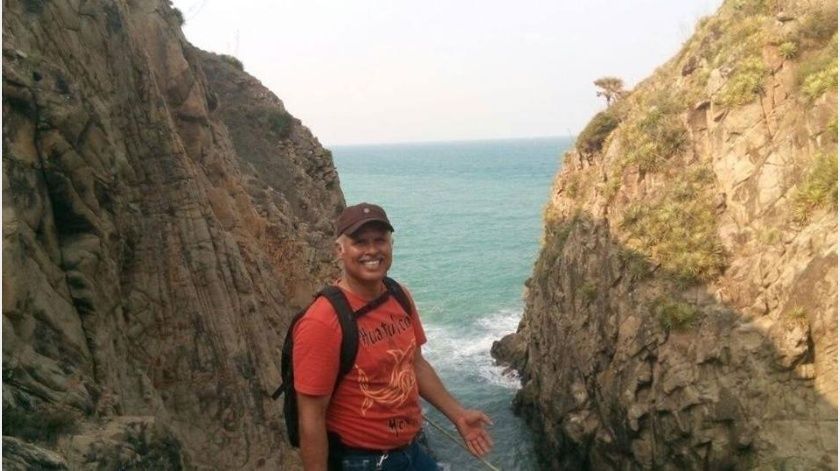
The State Human Rights Commission in Mexico’s west-central state of Michoacán is exhorting authorities to intensify their search for a campesino ecologist and advocate for protection of the world-famous monarch butterfly habitat, who has “disappeared.” Homero Gómez González went missing one day after he posted a video of himself on Twitter standing amid a swarm of butterflies at their wintering grounds in the Michoacán highlands. He has long served as administrator of Ejido El Rosario, an agrarian community of the Mazahua indigenous people in Ocampo municipality, which overlaps with the UNESCO-recognized Mariposa Monarca Biosphere Reserve. The Michoacán prosecutor’s office says that 53 police officers from the municipalities of Ocampo and Angangueo have been detained in relation to the disappearance. Family members say Gómez González told authorities that he had received threats from local organized crime networks. (Photo: La Voz de Michoacán)

The Andes
Medellin march

Colombia: protests met with repression —again

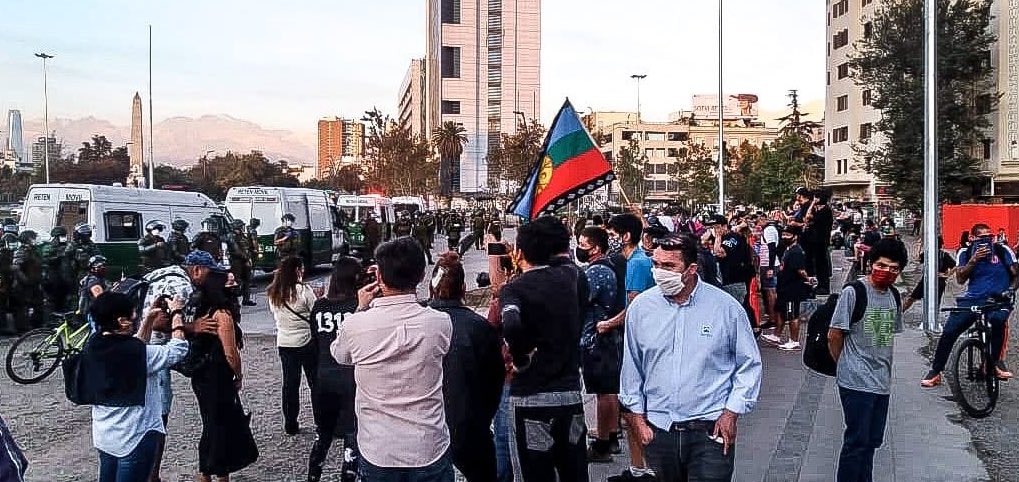
The protest wave in Colombia was revived with a national mobilization—to be again met with repression from the security forces. Protest organizers explicitly rejected violence, but police and gangs of masked men sabotaged efforts by municipal authorities to maintain the peace in the country’s two biggest cities. In both Bogotá and Medellín, the progressive mayors who defeated President Ivan Duque‘s far-right Democratic Center party in local elections last year had adopted protocols to prevent attacks on peaceful protesters by the feared National Police riot squad, ESMAD. Yet in both cities, clashes erupted, with several injured and scores arrested. In a repeat of a strategy also seen in last November’s protests, police raided the homes of two Bogotá activists the night before the mobilization. (Photo via Colombia Reports)

The Andes
false positives

Colombia: ex-army chief called to trial over killings

The former commander of Colombia’s armed forces, retired general Mario Montoya, has been summoned to appear before a trial to take place under the Special Jurisdiction for Peace (JEP) concerning the grisly practice of “false positives”—the killing of thousands of non-combatants in the guise of military operations against the guerillas. Under terms of the JEP, Montoya will receive leniency if he confesses the full truth. However, if he is caught lying or trying to conceal even a portion of the truth, he may be expelled from the transitional justice court and could face a 40-year prison term. Montoya has always maintained his innocence in the “false positives” scandal, but the JEP judicial authorities say this is contradicted by evidence and the testimony of 11 of his former subordinates. (Photo: Contagio Radio)

The Andes
paramilitaries

Colombia: UN protests slaying of rights activists

The Office of the UN High Commissioner for Human Rights expressed concern over the killings of human rights defenders in Colombia last year. The statement said the commission is “deeply troubled by the staggering number of human rights defenders killed in Colombia during 2019.” The commission asserted that there were between 107 and 120 killings of rights activists in Colombia over the course of the year. It called on the “Colombian Government to make a strenuous effort to prevent attacks on people defending fundamental rights, to investigate each and every case and to prosecute those responsible for these violations, including instigating or aiding and abetting violations.” (Photo via Contagio Radio)

North America
border wall

Trump to divert Pentagon funds for border wall —again

President Trump plans to divert $7.2 billion from the Pentagon to go toward border wall construction this year, a sum five times greater than what Congress authorized in the 2020 budget last month, the Washington Post reported. This marks the second year in a row that Trump has sought to redirect money to the planned border wall from military construction projects and counter-narcotics funding. The administration will take $3.7 billion from military construction and $3.5 billion from counter-narcotics programs, according to figures obtained by the Post, compared to $3.6 billion and $2.5 billion last year, respectively. (Photo via Jurist)

Palestine
Bensouda

ICC prosecutor rejects Bibi’s ‘anti-Semitism’ charge

The chief prosecutor of the International Criminal Court responded to Israeli Prime Minister Benjamin Netanyahu, who accused her of “pure anti-Semitism” for seeking to investigate possible war crimes committed in Gaza, the West Bank and East Jerusalem. “This is a particularly regrettable accusation that is without merit,” Fatou Bensouda told the Times of Israel in an interview. “I, along with my office, execute our mandate under the Rome Statute with utmost independence, objectivity, fairness and professional integrity. We will continue to meet our responsibilities as required by the Rome Statute without fear or favor.” (Photo: Wikimedia Commons via +972)

Syria
Idlib

Idlib demonstrators revive Syrian revolution

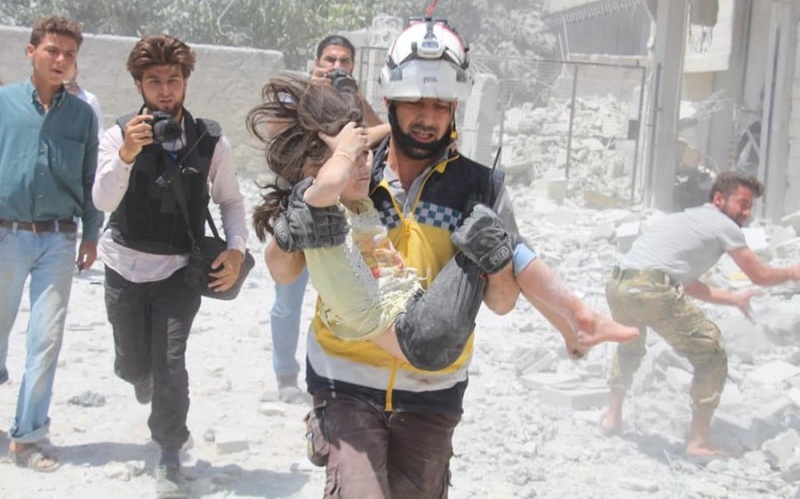
Reviving Friday demonstrations that were a tradition of the Syrian revolution, activists in besieged Idlib province in the north filled the Idlib city center, flying the Free Syria flag, chanting slogans against the Assad regime and Russia, and demanding international action against the ongoing bombardment of the province. The demonstrators especially expressed sympathy and support for the displaced from Maarat al-Nuaman, a town which has come under especially intense bombardment. The Assad regime and Russia launched their bombing campaign in April, violating the “de-escalation” zone deal reached between Russia and Turkey. Since then, some 700,000 people have been forced to flee. (Photo: OrientNet)