


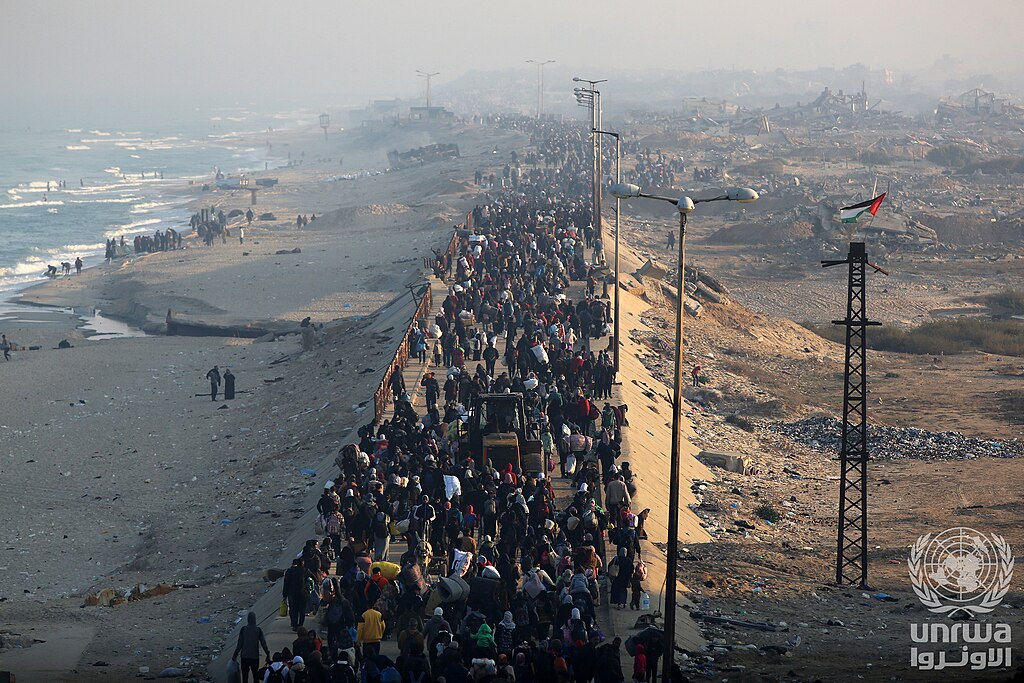
The UN Security Council passed a US-backed resolution on Nov. 17 endorsing the Trump administration’s 20-point Gaza peace plan. The Security Council urged all parties to implement the peace plan “in good faith and without delay.”
The resolution, passed by a vote of 13 members in favor with China and Russia abstaining, recognizes the proposal’s “Board of Peace” (BOP) as a “transitional governance administration” in Gaza to coordinate funding and the redevelopment of the Gaza Strip until the Palestinian Authority (PA) completes its “reform program.”
The resolution also authorizes the BOP to establish a temporary International Stabilization Force (ISF) in Gaza. The ISF will consist of forces contributed by participating states in consultation with Egypt and Israel. The force, along with Israel, Egypt, and a newly trained PA police force, will secure border areas, monitor humanitarian operations, and enforce the permanent disarmament of Hamas. To carry out its mandate, the resolution empowers the ISF to “use all necessary measures” in accordance with international law.
Under the plan, as the ISF stabilizes the Gaza Strip, Israel Defense Forces (IDF) is to withdraw from the territory, based on a demilitarization timeframe that the IDF, ISF and the US will agree upon. An IDF-controlled security perimeter will remain in force until the Gaza Strip is properly secured.
US Ambassador to the UN Mike Waltz hailed the resolution, stating that the ISF “will stabilize the security environment, support the demilitarization of Gaza, dismantle terrorist infrastructure, decommission weapons and maintain the safety of Palestinian civilians.” The Chinese Foreign Ministry, however, denounced the resolution as vague, and for failing to incorporate key principles, including “the Palestinians governing Palestine” and the two-State solution.
The BOP and the ISF were first outlined in the “Comprehensive Plan to End the Gaza Conflict” (also known as the “20-Point Plan”), with the first phase taking effect on Oct. 9. According to the plan, the BOP will be chaired by President Donald Trump, with other international leaders serving, including former British prime minister Tony Blair. The plan, which led to the current ceasefire in Gaza, called for the release of hostages, a partial withdrawal of the IDF from Gaza, and an increase in humanitarian aid into the territory.
As of today, Hamas has released all living hostages and the remains of most deceased ones, while Israel has released 2,000 Palestinian detainees.
The ceasefire, however, appears fragile as both sides have accused the other of violating the agreement, with at least one prominent Palestinian journalist killed by the IDF in a post-ceasefire clash. Israel also continues to restrict the delivery of humanitarian aid.
The UN resolution has drawn criticism from many experts, including Dennis Ross and Assaf Orion of the Washington Institute for Near East Policy. They note that the resolution falls under Chapter VII of the UN charter, the category for those that concern threats to peace and the use of force or sanctions in response. They argue that applying this category to the Israeli-Palestinian conflict is counterproductive, as force cannot resolve the question. Instead, they assert that Chapter VI resolutions, which emphasize diplomacy, are more appropriate.
From JURIST, Nov. 18. Used with permission.
Photo: displaced Palestinians returning home during this January’s ceasefire. Credit: UNRWA via Wikimedia Commons


US lawmakers introduce resolution to recognize Gaza genocide
Democratic lawmaker Rashida Tlaib on Nov. 14 introduced a resolution in the US Congress to recognize Israel’s assault on Gaza as a genocide. This resolution, if passed, would officially recognize that the Israeli government has committed the crime of genocide against the Palestinian people in Gaza.
Co-sponsored by 21 Democratic lawmakers, Resolution H.RES. 876 urges the US government to fulfill its obligations under the Genocide Convention. It specifically calls for an immediate halt to all relevant arms and equipment transfers to Israel, the investigation and prosecution of the US-based individuals and corporations complicit in acts of genocide, and the imposition of targeted, lawful sanctions against the State of Israel.
“Impunity only enables more atrocity,” Rep. Tlaib emphasized, “as our government continues to send a blank check for war crimes and ethnic cleansing, Palestinian children’s smiles are extinguished by bombs and bullets that are made in the USA.”
Since the onset of the Israel-Hamas war in October 2023, the US has provided $21.7 billion in military aid to Israel, while approving over $30 billion in new arms sales agreements, including fighter jets, tank shells, and precision-guided munitions.
The resolution invokes the Genocide Convention‘s definition of genocide: acts committed with the intent to destroy, in whole or in part, a national, ethnic, racial, or religious group, including: (a) killing its members, (b) causing serious bodily or mental harm, and (c) deliberately inflicting conditions of life intended to bring about the group’s physical destruction. (Jurist)
Israeli air-strikes have continued at a diminished level since announcement of the peace plan.
See our last report on genocide accusations against Israel.
UN expert condemns Security Council Resolution on Gaza
United Nations Security Council (UNSC) Resolution 2803 violates Palestine’s right to self-determination, Special Rapporteur Francesca Albanese stated Nov. 19, calling it “security-first, capital-driven model of foreign control” that entrenches existing power asymmetries. Albanese, a UN expert appointed as Special Rapporteur on the situation of human rights in the Occupied Palestinian Territory, said that the resolution consolidates Israel’s unlawful presence in the Palestinian Territory and legitimizes ongoing violence.
Albanese charged that the resolution fails to abide by international human rights law, international law governing the use of force, and the principles of the UN Charter.
Albanese said the resolution legitimizes Israeli domination over Palestinians without sufficiently protecting civilian populations. “Rather than charting a pathway toward ending the occupation and ensuring Palestinian protection, the resolution risks entrenching external control over Gaza’s governance, borders, security, and reconstruction,” Albanese said. “A military force answering to a so-called ‘Board of Peace’ chaired by the President of the United States, an active party to this conflict that has continually provided military, economic and diplomatic support to the illegal occupying Power, is not legal.” (Jurist)
Israel’s Gaza genocide continues: Amnesty
Amnesty International said Nov. 27 that Israel is “still committing genocide” against the Gazans despite an October ceasefire, by continuing to deliberately inflict conditions of life calculated to bring about their physical destruction, without signaling any change in their intent.
Israeli-backed militia leader killed in Gaza
Yasser Abu Shabab, the leader of an Israeli-backed militia in the Gaza Strip, has died in an Israeli hospital from wounds sustained during a gunfight with powerful clans in the territory. In June, Israeli Prime Minister Benjamin Netanyahu confirmed that Israel was arming militias in Gaza to fight Hamas. Abu Shabab and his group of fighters were widely rejected by Palestinians as collaborators with Israel. (TNH)
Gaza’s enduring suffering, as malnutrition death toll revealed
At least 165 children in Gaza are reported to have died “painful, preventable” deaths related to malnutrition since Israel began its assault on the Palestinian territory two years ago, according to new statistics from UNICEF. Spokesperson Tess Ingram said hunger among pregnant and breastfeeding women is a lesser-known but severe problem in Gaza, with 8,300 such women admitted for treatment for acute malnutrition this October alone, “in a place where there was no discernible malnutrition among this group” before the war. This, plus maternal stress and the lack of prenatal care has contributed to a doubling of infants born at low birthweight, which massively increases the chances of infant death.
Even if Israel fully stops bombing Gaza in line with the current ceasefire (it has not), these knock-on effects will be felt for a long time to come. Meanwhile, heavy winter rains and flooding in Gaza are bringing further misery, with water and sewage flooding tents and shelters, putting people at risk of hypothermia and waterborne diseases. Some deaths have already been reported. Aid groups point out that this suffering could be prevented if Israel would allow more aid in, including proper shelter and medical support. (TNH)
Amnesty International accuses Hamas of crimes against humanity
New research from Amnesty International says the attacks by Hamas and other Palestinian armed groups on Oct. 7, 2023 (as well as against the people captured and held hostage that day) amount to crimes against humanity. The watchdog group investigation says the crimes were “part of a systematic and widespread assault” against a civilian population, and finds that fighters were instructed to target civilians. (TNH)
Israel to bar designated aid groups from Gaza
Israel on Dec. 30 said it had suspended more than two dozen humanitarian organizations, including Doctors Without Borders and CARE, from operating in the Gaza Strip for failing to comply with new registration rules.
Israel says the rules are aimed at preventing Hamas and other militant groups from infiltrating the aid organizations. But the organizations say the rules are arbitrary and warned that the new ban would harm a civilian population desperately in need of humanitarian aid. (NPR)
Meanwhile, the new US global humanitarian aid pledge explicitly excludes Gaza from receiving any of the assistance.
UN condemns Israel suspension of aid agencies from Gaza
UN Human Rights Chief Volker Türk on Dec. 31 condemned Israel’s suspension of numerous aid agencies operating in Gaza, warning that the move worsens an already intolerable situation for the people in Gaza. Türk urged all states with influence to use their voice to press Israel to immediately allow unhindered aid to enter Gaza.
Israel recently revised the registration regulations for international non-governmental organizations (INGOs) operating in Gaza and revoked the licenses of 37 INGOs for failing to meet the new requirements. Several organizations, such as ActionAid, the International Rescue Committee, Médecins Sans Frontières (MSF), and the Norwegian Refugee Council, are set to have their licenses suspended on Jan. 1, 2026. The new registration rule, which the INGOs failed to comply with, requires identification details for all individuals employed by the organizations. However, some INGOs claim they cannot fulfill the required criteria without violating international rules or humanitarian principles.
In response to the suspension, MSF stated that Israel’s decision could severely damage its operations in Gaza. MSF called on the Israeli authorities to permit ongoing activities and stressed the organization’s impartial and independent approach in the region. Pascale Coissard, MSF’s emergency coordinator for Gaza, said: “MSF teams are trying to expand activities and support Gaza’s shattered health system; in 2025 alone, we carried out almost 800,000 outpatient consultations and handled more than 100,000 trauma cases, and if we obtain registration, we plan to continue strengthening our activities in 2026.”
The foreign ministers of the UK, France, Canada, Denmark, Finland, Iceland, Japan, Norway, Sweden and Switzerland released a joint statement emphasizing the importance of INGOs to the humanitarian effort in Gaza. They cautioned, “Without them, it will be impossible to meet all urgent needs at the scale required.”
Following the Israeli ban on the UN Relief and Works Agency for Palestinian Refugees (UNRWA) in February 2025, new legislation restricting UNRWA was passed by the Israeli parliament on December 29. The new legislation “cuts off water, electricity, fuel, and communications from UNRWA and grants the government of Israel authority to expropriate UN properties in East Jerusalem.” UNRWA commissioner-general Philippe Lazzarini called this is a clear violation of international law. (Jurist)
Hamas to hand Gaza governance to ‘technocratic’ body
The Islamic Resistance Movement, commonly known as Hamas, stated Jan. 11 that it is prepared to dissolve its government entities administering the Gaza Strip band hand them over to a “technocratic” Palestinian body.
Spokesperson Hazem Qassem made the announcement in a televised address, stressing that the movement’s decision to relinquish control was “clear and final.” He added that instructions have been given to government agencies and institutions in Gaza to prepare for the transition.
Hamas had previously expressed support for technocratic administration over Gaza as an interim measure, and indicated willingness to hand over governance since at least February 2025.
The October ceasefire deal signed between Israel and Palestinian resistance factions foresaw the development of a “board of peace” to temporarily govern Gaza. Palestinian technocrats and independent experts will head the transitional committee. Hamas leader Mohammad Nazzal claimed to have submitted a list of 40 names to Egyptian authorities.
At the end of October, Hamas agreed to appoint Amjad al-Shawa, Gaza head of the Palestinian NGO Network, to head the technocratic committee for the Strip. Few details have been released on who will compose the committee. In November, American and Palestinian delegations met in Cairo to discuss the development of the committee, but the results of the talks have not been released.
Israeli Prime Minister Benjamin Netanyahu announced on Jan. 8 that former UN envoy to the Middle East, Nickolay Mladenov, would serve as director-general of the Board of Peace in Gaza, a move Nazzal asserts is due to Hamas’ reservations regarding the previously proposed former British prime minister Tony Blair.
The governance model is based on the United Nations Security Council’s UNSC Resolution 2803, which endorsed US President Donald Trump’s 20-point Gaza peace plan. The resolution recognizes the “Board of Peace” and authorizes it to establish a temporary International Stabilization Force to oversee Gaza’s governance.
The Gaza Health Ministry reported Jan. 12 that Israeli attacks have resulted in 447 deaths since the October ceasefire. Among those killed during the ceasefire was journalist Saleh Al-Jafarawi. (Jurist)
Gaza: 100 children killed since ‘ceasefire’
More than 100 children have been killed in the Gaza Strip since a nominal ceasefire between Israel and Hamas last October, according to UNICEF. That’s roughly one child every day, and at least six children have frozen to death amid cold weather and harsh winter storms. Israel has continued to carry out airstrikes at will in Gaza, despite the October agreement, and the vast majority of the enclave’s population is homeless, living in inadequate shelters, and entirely dependent on humanitarian aid, which Israel is still restricting. (TNH)
Demolition of East Jerusalem UNRWA building denounced
UN Special Rapporteur on the occupied Palestinian territory, Francesca Albanese, on Jan. 23 expressed grave concern following Israeli forces’ demolition of the UNRWA compound in East Jerusalem. Albanese called for invocation of Article six of the UN Charter to suspend Israel’s membership. Article six permits the expulsion of a UN member for persistently violating the principles of the UN Charter.
Albanese stated:
On Jan. 20, Palestinian Wafa News Agency reported that “an Israeli army force, accompanied by bulldozers, stormed the agency’s compound after sealing off the surrounding streets and intensifying its military presence in the area, and proceeded to demolish structures inside the compound.”
On Jan. 23 UNRWA warned that Israeli authorities may shut down the Qalandia training center on the West Bank, which could interrupt the education of hundreds of students.
The destruction of the UNRWA compound has been widely condemned by institutions such as the UN itself, the Organization of Islamic Cooperation, and the EU, among others.
Israeli foreign minister, Gideon Sa’ar, defended the move, stating: “UNRWA-Hamas had already ceased its operations at this site and no longer had any UN personnel or UN activity there. The compound does not enjoy any immunity and the seizure of this compound by Israeli authorities was carried out in accordance with both Israeli and international law.”
According to section two of Israel’s Law to Cease UNRWA Operations in the Territory of the State of Israel, UNRWA shall not operate within the sovereign territory of the State of Israel. The passing of the bill in 2024 was widely condemned as violating international law. Further, the UNRWA compound operates in East Jerusalem which is part of the Occupied Palestinian Territories and as such is not subject to Israeli sovereignty. (Jurist)
What Francesca Albanese actually said
Several European governments, including the foreign minister of France, called for the resignation of Francesca Albanese, the UN special rapporteur for the occupied Palestinian territories, amid claims that Albanese had referred to Israel as “the common enemy of humanity” while speaking at an Al Jazeera-run media event. The only problem: Albanese said no such thing. She simply said that humanity had a common enemy, referring to a system that supported Israel. Side-by-side comparisons show how video of Albanese’s remarks was doctored and then picked up by politicians, commentators, and activists throughout Europe who rushed to judgement and accused Albanese of anti-semitism. A review by a committee of UN experts dismissed the allegations against Albanese as unfounded and “rooted in disinformation.” (TNH)
UNICEF suspended as aid dwindles in Gaza
Israeli authorities have suspended UNICEF from bringing aid into Gaza after claiming to have found smuggled nicotine products in hygiene kits belonging to the UN agency. The brother of the head of Israel’s internal security service and numerous reserve soldiers were recently indicted by an Israeli court for smuggling cigarettes into Gaza. UNICEF ranks third among UN agencies and NGOs in terms of aid brought into Gaza since Hamas and Israel reached a ceasefire agreement last October, according to a UN tracking mechanism.
The suspension comes as humanitarian groups are having to dip into stockpiles because needs are outpacing the amount of aid Israeli authorities are allowing in. Israel closed all of Gaza’s border crossings following the beginning of the war with Iran. The Kerem Shalom/Karem Abu Salem border crossing has since reopened, but Israeli authorities are severely restricting what and how much is allowed to enter. The Rafah border crossing with Egypt partially reopened on March 19 for limited medical evacuations and returns. (TNH)