Syria

Twins of genocide schmooze in Damascus
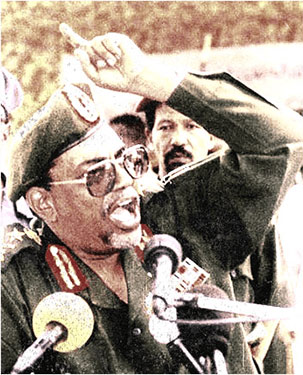
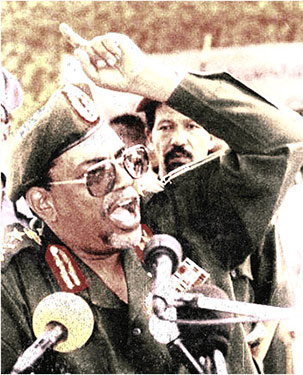
Omar BashirSeeking to legitimize his regime now that he’s reconquered most of Syria (with massive Russian military help), Bashar Assad has just welcomed the first Arab League leader to Damascus since the war began in 2011—none other than President Omar Bashir of Sudan, who is wanted by the International Criminal Court for crimes against humanity and genocide in Darfur. The Assad regime’s official news agency SANA said the two dictators discussed the “situations and crises faced by many Arab countries,” stressing the need to build “new principles for inter-Arab relations based on the respect of the sovereignty of countries and non-interference in internal affairs.” The Assad regime is itself now credibly accused of genocide, with a mass extermination of detainees amply documented, not to mention serial use of chemical weapons and massive bombardment of civilian populations. Assad and his generals may yet face war crimes charges before the ICC. (Photos: Pinterest, BashirWatch)

Africa

South Sudan: will ‘permanent’ ceasefire hold?

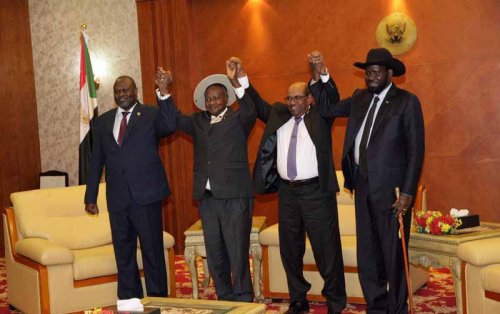
South Sudanese President Salva Kiir and his bitter rival and former vice president Riek Machar, now leader of the SPLM-IO rebels, met in the Sudanese capital Khartoum to sign a "permanent" ceasefire agreement, pledging to form an inclusive transitional government. The parties agreed to open humanitarian corridors, release detainees, withdraw troops and militarily disengage. The transitional government is to form a national army and security forces not linked to tribalism. However, the challenges for the 36-month transition period are great. Millions in South Sudan are on the brink of famine, and more than 2.5 million have fled the country. Hundreds of thousands more—mostly members of minority ethnic groups—are internally displaced, with many sheltering in camps administered by the United Nations. Previous efforts at a negotiated peace have broken down. (Photo: Sudan Tribune)

Planet Watch

Podcast: Anti-austerity and the utopian moment

Protests against austerity and the lords of capital are erupting simultaneously in Iran, Tunisia, Sudan, Morocco, China, Peru, Honduras, Argentina and Ecuador, recalling the international protest wave of 2011. Such moments open windows of utopian possibility, but those windows inevitably seem to close as protest movements are manipulated by Great Power intrigues or derailed into ethnic or sectarian scapegoating. What can we do to keep the revolutionary flame alive, build solidarity across borders, and resist the exploitation and diversion of protest movements? Bill Weinberg explores this question on Episode One of the long-awaited CounterVortex podcast. You can listen on SoundCloud.

Africa

Harsh repression as bread riots rock Sudan

Sudanese authorities carried out mass arrests and confiscated newspapers as protests exploded over rising bread prices and severe economic austerity. One student was killed amid demonstrations in Geneina, capital of West Darfur state. Protests were also reported from the cities of Nyala, al-Damazin and the capital Khartoum. The unrest broke out as bakeries doubled the price of bread following a government decision to increase the price of flour nearly fourfold. The decision was part of a package of austerity measures issued under the country's 2018 budget, seeking to address the spiralling inflation rate.

North America

Court issues stay on Trump immigration order

A Brooklyn federal judge blocked Trump's order barring immigrants from seven Muslim-majority countries, as activists occupied JFK and several other US airports.

Africa

Chemical attacks in Darfur claimed

Amnesty International claims "horrific evidence" of repeated chemical weapons attacks carried out by Sudanese government forces against civilians, including young children.

Planet Watch

ICC to prosecute environmental crimes

The International Criminal Court released a policy document calling for prosecution of individuals for atrocities committed by destroying the environment.

Africa

Darfur: Sudan planning ‘Final Solution’?

Amid a referendum portrayed by Khartoum as a step toward peace, regime-backed militias unleash a new scorched-earth campaign in Darfur—reviving calls for US intervention.

Africa

Mining fuels renewed Darfur conflict

Russia is blocking release of an internal UN report that apparently shows how pro-government militias in Darfur are making some $54 million per year in gold mining.

Africa

Sudan: mass rape by army in Darfur

Sudanese army forces raped more than 200 women and girls in an organized attack on the north Darfur town of Tabit in October, Human Rights Watch charges.

Africa

China sends combat troops to South Sudan

A 700-strong Chinese battalion is headed for South Sudan as part of a UN "peacekeeping" mission—but the deployment follows China's massive investment in the country's oil sector.