

Planet Watch
refinery

Will COVID-19 mean oil industry bailout?

Already depressed oil prices are now plummeting in response to COVID-19 pandemic. Global oil consumption is said to be in “free-fall,” now predicted to lead to the largest “annual contraction in history.” Canada’s federal government is preparing a bailout package for the oil and gas sector, with a possible value of $15 billion. Among the proposals is a share buyout along the lines of the US Troubled Asset Relief Program (TARP) for banks and automotive companies during the 2008 financial crisis. (Photo: kris krüg)

The Andes
Medellin march

Colombia: protests met with repression —again

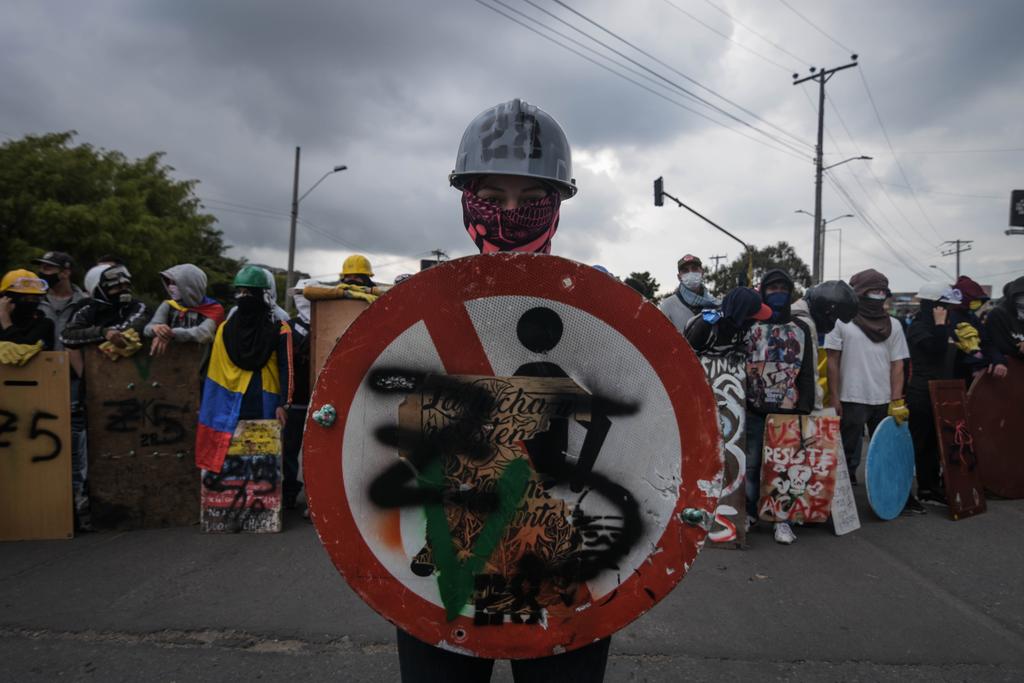
The protest wave in Colombia was revived with a national mobilization—to be again met with repression from the security forces. Protest organizers explicitly rejected violence, but police and gangs of masked men sabotaged efforts by municipal authorities to maintain the peace in the country’s two biggest cities. In both Bogotá and Medellín, the progressive mayors who defeated President Ivan Duque‘s far-right Democratic Center party in local elections last year had adopted protocols to prevent attacks on peaceful protesters by the feared National Police riot squad, ESMAD. Yet in both cities, clashes erupted, with several injured and scores arrested. In a repeat of a strategy also seen in last November’s protests, police raided the homes of two Bogotá activists the night before the mobilization. (Photo via Colombia Reports)

Iran
Iran protests

Podcast: solidarity with Iran —the people, not the state

In Episode 46 of the CounterVortex podcast, Bill Weinberg calls out the racist imperial narcissism in coverage of the assassination of Qassem Soleimani—all of which (left, right and center) is solely concerned with whether he was responsible for the deaths of “hundreds of Americans.” Safely invisible is the reality that Soleimani and his militia networks were responsible for the deaths of hundreds of thousands of Iraqis and Syrians. Iranian forces in Syria have been carrying out a campaign of sectarian cleansing, with Shi’ite militia leaders usurping the lands of displaced Sunnis. Soleimani’s militias in Iraq have meanwhile been serially massacring protesters. Over this same period, hundreds of protesters have been killed in state repression in Iran itself. Anti-war forces in the West must not be confused by Trump’s cynical pretense of support for the Iranian protesters. Our opposition to Trump’s war moves must be in explicit solidarity with Iran —meaning the people of Iran, not the state. And that includes solidarity with the struggle of the Iranian people against an oppressive regime. Listen on SoundCloud, and support our podcast via Patreon. (Image: @iranprotest2019)

Iran
Tabandeh

Iran on edge following death of Sufi leader

The death of 92-year-old Noor-Ali Tabandeh, also known as Majzoub Ali Shah, leader of Iran’s Gonabadi Sufi order, prompted the regime to take pre-emptive measures against a new outbreak of protests. Riot police took over all streets leading to the hospital where he was held. Tabandeh was a harsh critic of Velayat-e Faqih (Guardianship of Islamic Jurists), the system by which Iran’s orthodox Shi’ite establishment has final say over all laws. He had been under effective house arrest since February 2018, when a wave of protests by Gonabadi dervishes against persecution of their Order led to hundreds of arrests. Since Tabandeh’s death, his followers on social media have been speculating that he was poisoned by the authorities. His passing comes as Iranian authorities have restricted mobile internet use in response to a new call for mass demonstrations. (Photo: Center for Human Rights in Iran)

Southern Cone
Chile protests

UN documents rights abuses in Chile protests

The Office of the UN High Commissioner for Human Rights (OHCHR) said in a new report that international human rights norms had been violated by both police and army personnel during the recent mass protests in Chile which led the government to declare a state of emergency. The report said that these rights violations should be prosecuted. The 30-page report, based on research during the first three weeks of November, extensively details multiple allegations, including of torture, and rape and other forms of sexual violence, against people held in detention. The leader of the OHCHR mission in Chile, Imma Guerras-Delgado, told journalists in Geneva, that the overall management of demonstrations by the police “was carried out in a fundamentally repressive manner.” (Photo: KaosEnLaRed)

The Andes
sutesal

Peru next for regional protest wave?

Weeks after a nationwide uprising in Chile was sparked by protests over transit fare hikes in the capital, politicians in neighboring Peru are issuing nervous warnings in the wake of days of street demonstrations in Lima. This week, students occupied Central Station on Lima’s Metro to demand subsidized transit fares, workers marched to oppose the privatization of the city’s water system, and hundreds protested the pending release of imprisoned right-wing political leader Keiko Fujimori. President Martin Vizcarra took note of the threat of widespread unrest when he told the Annual Conference of Executives that Peru “is not free of protests” and must work to fight corruption and close the wealth gap. But his prescription was for an “authentic” free market—precisely the policies now being protested. (Photo: Diario Uno)

Southern Cone
Salar de Atacama

Chile: lithium interests under pressure by uprising

Chilean company Sociedad Quimica y Minera (SQM), under pressure from the government amid falling prices and rising protests, committed to define by year’s end the destination for lithium from its lease area at the Salar de Maricunga. SQM, one of the world’s top producers, already has a larger lithium mine in production at another area of salt-flats, the Salar de Atacama—but operations there were suspended for several days as campesinos blocked roads to the site as part of the popular uprising in Chile. Leaders of the Consejo de Pueblos Atacameños, representing 18 indigenous communities, pledged to resist any expansion of lithium operations in the area, citing threats to local water sources. (Photo via El Ciudadano)

The Andes
Bogota protest

Duque starts dialogue after Colombia strike

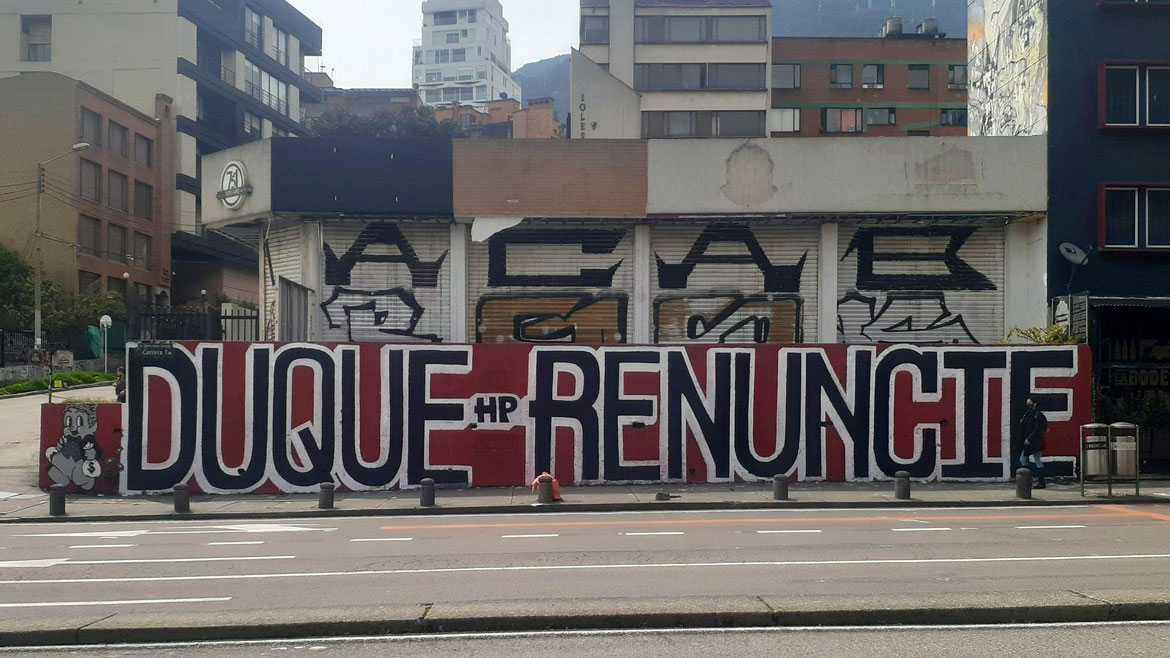
Colombia’s President Ivan Duque has convened his National Labor Concord Commission to begin the “National Conversation” he pledged this week in a bid to quell a fast-mounting anti-government protest wave. Social leaders, mayors and departmental governors from across the country are to participate in the talks. The protests escalated when trade unions, including the giant Unitary Workers Central (CUT), called a nationwide general strike, and repressive measures by the National Police only fueled the mass mobilization. (Photo: Hollman Morris via Colombia Reports)

Iran
#iranprotests

Net silence as Iran explodes into protest

Protests erupted in Iran after the government announced a 50% increase in the price of fuel, partly in response to the re-imposition of US sanctions. Spontaneous demonstrations first broke out in Sirjan, but quickly spread to several other cities, including Tehran, where petrol stations were set on fire. The regime quickly responded by imposing a near-total shut-down of the Internet and mobile data throughout the country. Security forces have already killed several protesters, and the the Islamic Revolutionary Guards Corps has warned of “decisive” action if the unrest does not cease. (Image: Hajar Morad via Twitter)

Planet Watch
Chile protester

Podcast: world revolution in 2020?

In Episode 43 of the CounterVortex podcast, Bill Weinberg takes stock of the current wave of popular protest and uprisings around the world, and asks if the planet is approaching another moment of revolutionary possibilities, such as was seen in 2011. He examines the prospects for these disparate movements to build solidarity across borders, repudiate ethnic and national divide-and-rule stratagems, and recognize the enemy as transnational capital and the authoritarian states that serve it. With discussions of Hong Kong, mainland China, Indonesia, Bolivia, Chile, Ecuador, Peru, Uruguay, Honduras, Costa Rica, Haiti, Puerto Rico, Iraq, Lebanon, Turkey Iran, Egypt, Algeria, Sudan, Uganda, Ethiopia and Guinea. Listen on SoundCloud, and support our podcast via Patreon. (Photo: David Lynch via Twitter)

Southeast Asia
Indonesia anarchists

Indonesia: inauguration amid revolt, repression

Indonesia’s President Joko Widodo was sworn in for a second term amid an official ban on protests, and Jakarta’s streets flooded with military troops. The inauguration was preceded by a wave of mass protests, led by students but joined by labor unions and radicalized anarchist youth. The demonstrations were sparked by a new law that weakens Indonesia’s anti-corruption agency, and another instating such moralistic measures as a ban on extramarital sex. But anger was also directed at plans for a tough new criminal code, at troops mobilized to put down unrest in Papua region, and failure to stem forest fires in Sumatra and Borneo now causing toxic haze across Southeast Asia. (Photo: Anarchist Communist Group)

Central America
Costa Rica protest

Student strikes shake Costa Rica

A mass student protest filled the streets of San José, opposing new budgetary terms being imposed on Costa Rica’s public universities. The demonstration, which was also attended by staff and even rectors of the universities, was called after the Ministry of Finance ordered an increase in the percentage of the Special Fund for Higher Education (FEES) that goes to capital expenditures—which effectively means a cut in salaries for teachers and staff. Banners read “The education of our children is not up for negotiation” and “Hands off the UCR,” a reference to the University of Costa Rica. University authorities and students did meet for several hours with government officials after the march in search of an agreement, while thousands of supporters maintained a vigil outside the presidential palace. President Carlos Alvarado, elected as leftist last year but now accused of imposing a neoliberal program, was among those who met with the protest leaders. (Photo: Poder Popular)