The Amazon

Peru: butcher of Bagua goes out by his own hand

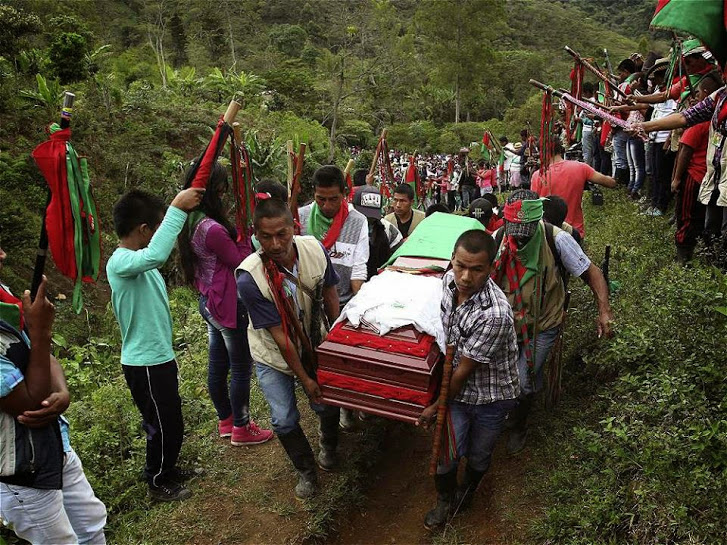
The ongoing political crisis in Peru reached a grisly climax with the suicide of ex-president Alan GarcĂ­a as he was being arrested over his suspected involvement in corruption surrounding troubled Brazilian construction giant Odebrecht. GarcĂ­a’s last presidency was most significantly marked by Peru’s entrance into the Free Trade Agreement with Washington, and harsh repression against the indigenous protest wave that this set off. This repression was notoriously punctuated by the Bagua massacre of June 2009, when National Police troops attacked an indigenous roadblock—known as the “Amazon’s Tiananmen Square Massacre.” The grievances that animated the 2009 protests are still very much alive—and sparking renewed militant action by indigenous Amazonians. (Photo: La Mula)

Syria

Syria’s Idlib still under bombardment

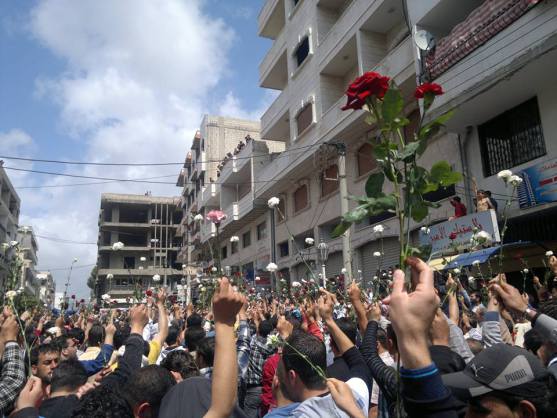
Syria’s last opposition-controlled province of Idlib has receded from the headlines since a joint Russian-Turkish deal was announced last September, forestalling an Assad regime offensive on the province and establishing a “demilitarized zone” policed by the two foreign powers. But shelling and bombardment of the province by Assadist and Russian forces has escalated over the past month—and much of the shells and missiles are falling within the “demilitarized zone.” UN Senior Humanitarian Advisor for Syria Najat Rochdi reports that over 100,000 Idlib residents have fled their homes since February as a result of increased fighting. More than 90 civilians, half of them children, were killed in the province in March. As ever, medical facilities and schools continue to be targeted. (Photo via EA Worldview)

Afghanistan
warplane

ICC rejects investigation of Afghanistan war crimes

Judges at the International Criminal Court (ICC) rejected a request to open an investigation into allegations of war crimes and crimes against humanity in Afghanistan. The request by ICC prosecutor Fatou Bensouda was turned down by Pre-Trial Chamber II, which decided that pursuing this investigation would not be an efficient use of the court’s resources. The statement from the Pre-Trial Chamber noted that the prosecutor has not obtained cooperation from sources in Afghanistan. The decision came four days after he US State Department revoked the entry visa for Fatou Bensouda. In March, Secretary of State Mike Pompeo said that the US would deny visas to ICC personnel investigating any allegations against the US or its allies. Bensouda had been making inquiries into allegations of war crimes against all participants in the Afghanistan conflict since the fall of 2017. (Photo: USAF)

Watching the Shadows
belarus cops

Podcast: Julian Assange, agent of fascism

In Episode 31 of the CounterVortex podcast, Bill Weinberg documents the ugly far-right politics of Julian Assange of WikiLeaks, and how the 2010 document dump risked the lives of dissidents under authoritarian regimes in places like Zimbabwe—and may have constituted outright collaboration with the repressive dictatorship of Alexander Lukashenko in Belarus. An objective reading of the circumstances around the 2016 Wikileaks dump of Democratic Party e-mails reveals Assange as a Kremlin asset and Trump collaborator, an active agent in a Russian-lubricated effort to throw the US elections—part of Putin’s grander design to impose a fascist world order. Weinberg also notes that the ACLU and Committee to Protect Journalists have issued statements warning that the charges against Assange may pose a threat to press freedom. But he argues that even if we must protest his prosecution, we should do so while refraining from glorifying Assange—and, indeed, while forthrightly repudiating him as a dangerous political enemy of all progressive values. Listen on SoundCloud, and support our podcast via Patreon. (Photo Libcom.org)

The Amazon

Violence escalates in Brazilian Amazon

In the last two weeks, Brazilian Amazonia has seen an alarming increase in targeted killings, with three massacres and at least nine deaths. The Catholic Church’s Pastoral Land Commission defines a massacre as the killing of three or more people. The most recent killings took place when military police attacked a landless peasants’ camp near the hamlet of Vila de MocotĂł in Pará state. Days earlier, four were killed when hooded gunmen evicted a squatter camp at Seringal SĂŁo Domingos, near the intersection of the borders of Acre, Amazonas and RondĂ´nia states. Days before that, Dilma Ferreira Silva, a social leader with the Movement of People Affected by Dams (MAB), her husband, and a friend, were killed by hooded motorcyclists in BaiĂŁo municipality, Pará state.  (Photo via Earth Island Journal)

Afghanistan

Hazaras targeted with relentless terror

In Quetta, capital of Pakistan’s restive Baluchistan province, at least 16 were killed and over two dozen injured in a blast that targeted members of the Shi’ite Hazara community. Eight of those killed in the blast at a crowded vegetable market were Hazara. This was the latest in a relentless wave of terror against the Hazara people in both Pakistan and Afghanistan. In March, three were killed and some 20 injured when a mortar attack struck a gathering in Kabul commemorating the death of Abdul Ali Mazari, leader of the Hazaras’ Hizb-e-Wadhat Party and a key figure in the Mujahedeen resistance movement of the 1980s. Assassinated in 1995 by the Taliban, he was recently awarded the title of “Martyr of National Unity.” The Kabul ceremony was attended by high officials and billed as a step toward national reconciliation. ISIS took credit for the attack, but the ongoing terror campaign leaves many Afghan Hazaras concerned about the current peace talks with the Taliban.

Africa

Sudan: new Arab Revolution wins another round

Sudan’s longtime ruler Omar al-Bashir was removed from power and arrested by the military, following months of popular protests that culminated in clashes between his loyalist security branches and the military. Armored vehicles from the military’s elite Rapid Support Forces have taken strategic positions around the capital. But protesters continue to fill the streets, chanting: “It has fallen, we won.” Opposition leaders are clear they will oppose any attempt at military rule. International rights groups are calling for Bashir to be turned over to The Hague to face genocide charges.

Iran

US-Tehran terror-baiting tit-for-tat

In an amusingly grim development, Donald Trump formally designated Iran’s Islamic Revolutionary Guard Corps a “foreign terrorist organization,” and Tehran’s Supreme National Security Council immediately retaliated by declaring the Pentagon’s Central Command a “terrorist organization.” Both moves mark a first, applying the designation to government entities. The perverse irony, of course, is that both Trump and Tehran can be seen as perfectly correct. Left-secular forces in the Middle East have long decried that the region is caught between two poles of terrorism—that of political Islam and that of US imperialism. Iran’s Revolutionary Guards are complicit with “sectarian cleansing” of Sunni Muslims in Syria. CENTCOM’s warplanes meanwhile virtually destroyed the city of Raqqa in the battle against ISIS—with civilian casualties nearly doubling after Trump took over. Yet in Iraq, the US and Iran were in a de facto alliance—both supporting Baghdad and fighting ISIS. And indeed, given Washington’s growing tilt to Assad in the Syrian war, an element of this alliance can be seen there as well. That’s why they call it a Great Game.

East Asia

Umbrella activists convicted in Hong Kong

Nine leading activists of Hong Kong’s Umbrella Movement were convicted under colonial-era “public nuisance” laws, concluding the city’s most politically charged trial in years. The nine may face up to seven years in prison. They include the famous “Occupy Trio”—legal scholar Benny Tai, sociology professor Chan Kin-man and Rev. Chu Yiu-ming. The Umbrella Movement was the biggest pro-democracy protest in Hong Kong’s history, with thousands occupying the city’s central districts for several weeks between September and December 2014.

Europe

‘Rehabilitation center’ planned for Crimean Tatars

Russia has announced plans for a “rehabilitation center” in the annexed Crimean Peninsula to “re-educate” Muslims considered to be under the influence of “extremist ideology.” The move comes less than a week after Russia’s Federal Security Service (FSB) carried out raids targeting Crimean Tatars thought to be linked to Hizb ut-Tahrir, a pan-Islamist party that is legal in Ukraine. Detained in the raids were 23 civic activists and journalists, all now facing what monitoring group Human Rights in Ukraine calls “fundamentally flawed charges.” The plan is moving ahead despite that fact that Russia’s Human Rights Commissioner pledged last month to review the legality of a 2003 court order labeling Hizb ut-Tahrir a terrorist organization. Hizb ut-Tahrir is banned in 13 countries around the world, but operates legally in the United States and United Kingdom.

Palestine

Netanyahu pledges to annex West Bank territory

Prime Minister Benjamin Netanyahu threatened to annex areas of the occupied West Bank ahead of the coming week’s Israeli Knesset elections. In an interview on Israeli Channel 12 TV, he was asked about plans to annex settlement blocs in the occupied territory, and responded: “Will we go to the next phase? The answer is yes. We will go to the next phase to extend Israeli sovereignty…” In a part of the interview seemingly reported in English only by the independent Palestinian Ma’an News Agency, Netanyahu also appeared to broach annexation of all Area C, the zone of mixed Israeli and Palestinian control, which covers 62% of the West Bank’s territory. Asked about the future status of Area C, he reportedly replied: “I promise that you will be surprised. I cannot talk about the plan, but Trump is a big friend and I doubt there will ever be any bigger friend than him.”

Mexico
Mexico army

Mexico remilitarizes drug enforcement

Despite his boast to have “ended” the drug war and pledge to explore cannabis legalization, Mexico’s new populist president is seeking to create a special anti-drug “National Guard” drawing from the military and police forces. Use of the military in drug enforcement was already shot down by the Supreme Court, but President AndrĂ©s Manuel LĂłpez Obrador is going around the judiciary by changing the constitution. This plan is moving rapidly ahead—and meanwhile the military is still being sent against campesino cannabis growers and small traffickers.