


Inner Asia
Ilshat Kokbore

Podcast: Ilshat Kokbore on the Uyghur struggle

In Episode 96 of the CounterVortex podcast, Bill Weinberg interviews Ilshat Kokbore, former president of the Uyghur American Association and current director for China affairs with the World Uyghur Congress. Kokbore relates the story of his exile from his homeland in East Turkistan, known to its current Chinese rulers as Xinjiang, for petitioning against the purge of the Uyghur language from the educational system in 2003. Since then, of course, the situation has escalated to mass detention and even, in the opinion of many international legal experts, genocide. Kokbore discusses the history of the independence struggle in East Turkistan and the current campaign to boycott the 2022 Beijing Winter Olympics. Listen on SoundCloud or via Patreon. (Photo: CounterVortex)

The Andes
antamina

Protests shut down Peru’s largest copper mine

Peru’s massive Antamina copper mine had to halt operations due to protest blockades on an access road by local campesinos. The company, owned by multinationals BHP Billiton and Glencore, urged the government “to restore order” and open dialogue with the protesters, stating that as long as “these conditions are not met, we cannot continue to operate.” Residents of the local communities charge that Antamina “usurped” campesino lands for the project, which bring no benefit to the community. After a week of blocking the access roads, the campesinos agreed to lift the protest following intercession by the Ministry of Energy & Mines. However, they pledged to maintain the blockades until Antamina signs a formal agreement recognizing them as dialogue partners. (Photo via MercoPress)

Greater Middle East
egypt police

State of emergency lifted in Egypt —charade?

The ending of Egypt’s nearly four-year state of emergency, announced by President Abdel Fattah al-Sisi, was hailed by international human rights groups as a positive step. But Sisi is now trying to make permanent a more recent, and officially temporary, national security law that would give the military powers normally used during a state of emergency. The amendments to the national terrorism law, which have been approved by the House of Representatives, would give the president the authority to take “measures necessary to preserve security and public order,” including the ability to impose curfews. It would also expand the purview of military courts, giving them power over any crimes concerning “public infrastructure.” A related measure passed by the House would impose penalties for conducting “research” on the military. (Photo via Wikipedia)

South Asia
Maharashtra

India: anti-mine protesters face repression

Police in Gadchiroli district of India’s Maharashtra state broke up a thiya andolan (sit-in) by local peasants and adivasis (tribal people) at the site of the contested Surjagarh iron-ore mining project, and arrested six of the organizers. Gadchiroli is within central India’s “Red Corridor” of Naxalite guerilla activity, and local authorities accuse the rebels of stirring up the protests. Following a demonstration at the mine site earlier in the week, two attendees were arrested by a local police “special operations team” as they departed, on charges of being Naxals. The mine at Surjagarh, in Etapalli taluka (subdistrict), is under lease by Lloyds Metals & Energy Ltd (LMEL). Since it began operations in June, it has faced repeated protests from local residents over its ecological impacts and usurpation of traditional lands. (Map: Google)

Africa
ASWJ

Somalia: Sufi militia takes up arms against regime

Fighting in Somalia’s central Galmudug state has killed 120 people and displaced 100,000 in recent days. Two hospitals were shelled, presumably by government forces, in the town of Guri-El, causing aid groups to suspend operations in the area. The conflict pits government forces against the regional militia group Ahlu Sunna Wal Jamaa (ASWJ)–former allies in the fight against the jihadist al-Shaabab insurgency. A moderate Sufi sect, ASWJ has been fighting the Shaabab since 2008, and forged a pact with the government two years later. But Mogadishu is now denying the group’s bid for a regional power-sharing deal, and demanding that the militia be integrated into the national armed forces. (Photo via Strategic Intelligence)

Planet Watch
extinction rebellion

Podcast: anarchism and the climate crisis

With the inauspicious opening of the Glasgow climate conference, activists around the world are increasingly looking to local action as an alternative to the moribund United Nations process on addressing what has been called a “Code Red for humanity.” In Episode 95 of the CounterVortex podcast, Bill Weinberg explores the ideas of Social Ecology and radical municipalism, developed by the late Vermont anarchist thinker Murray Bookchin, and how they provide a theoretical framework for localities struggling to lead from below on the climate question. Examples discussed include the Zapatistas in Chiapas, the Rojava Kurds in Syria, and the community gardens and ongoing struggles for reclaimed urban space on New York’s Lower East Side. Listen on SoundCloud or via Patreon. (Photo: East River Park Action)

Africa
kampala

ISIS claims Uganda bomb attacks

A suicide bomber killed himself and injured several others on a bus as it travelled to the Ugandan capital, Kampala. The blast, on the road from the Democratic Republic of Congo, followed a bomb attack in a Kampala cafĂ© two days earlier that killed a worker and injured three others. The police described the devices as “crude.” Both attacks were claimed by the Islamic State in Central Africa, which is said to be operating in both Uganda and Congo through the former Uganda-based opposition group, the Allied Democratic Forces, although exact links are uncertain. (Photo: Travel Aficionado via Flickr)

Palestine
DCIP

Israel outlaws human rights organizations

Israeli Defense Minister Benny Gantz declared six Palestinian human rights groups to be terrorist organizations, claiming they are “secretly linked” to the Popular Front for the Liberation of Palestine (PFLP)–a leftist resistance group that Israel has long designated a “terrorist organization.” The groups on Gantz’s list are Addameer, al-Haq, the Bisan Center, Defense for Children Palestine (DCIP), the Union of Agricultural Work Committees (UAWC), and the Union of Palestinian Women’s Committees (UPWC). International rights groups Humans Rights Watch and Amnesty International released a joint statement calling the announcement a “brazen attack on human rights.” The Israeli rights group B’Tselem called the declaration “an act characteristic of totalitarian regimes, with the clear purpose of shutting down these organizations.” (Photo of raid on DCIP office via YouTube)

Afghanistan
Afghan-Women

Afghan women protest barring of girls from schools

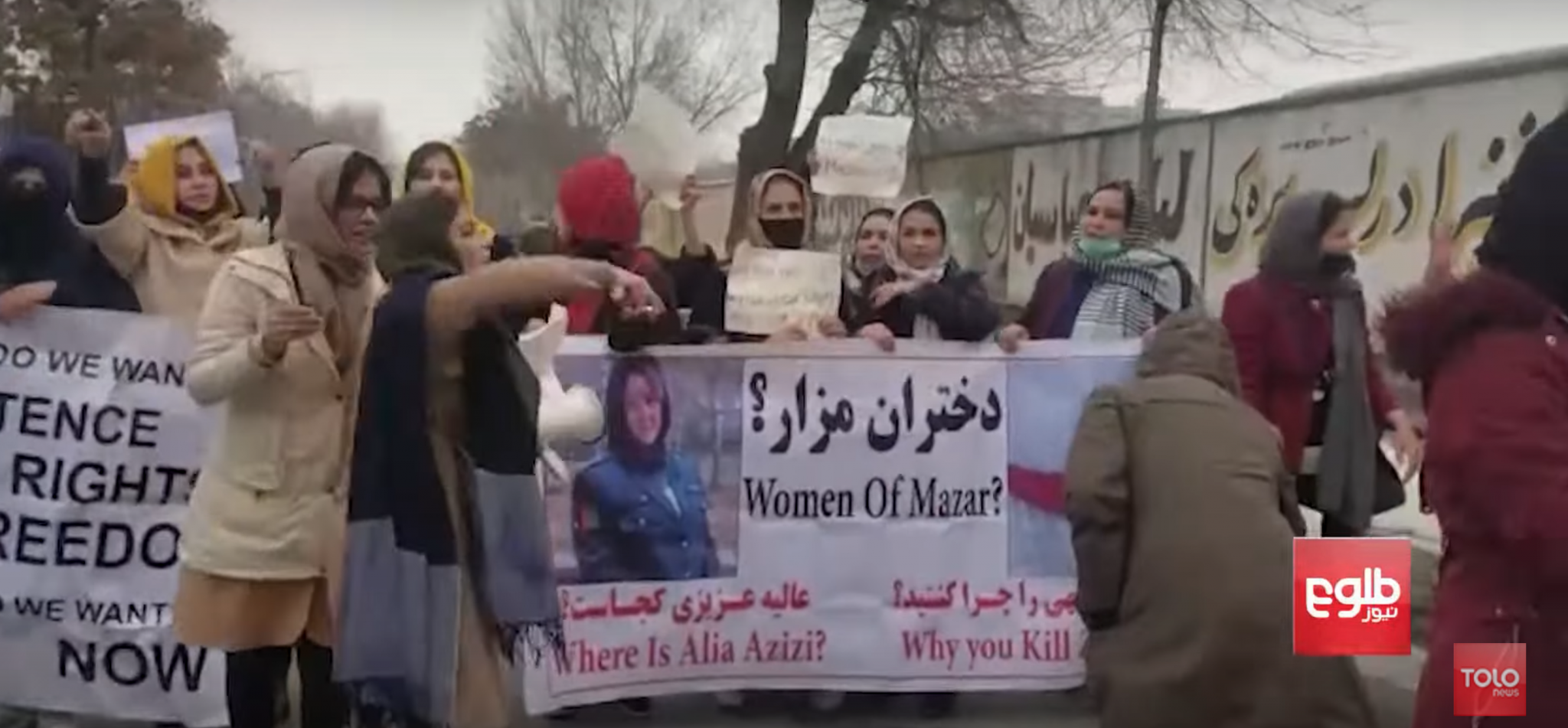
A group of women took to the streets of Kabul to protest the continued barring of girls from schools since the Taliban takeover, and accused the international community of being silent about what is going on in Afghanistan. The women gathered at the gates of the UN Assistance Mission in Afghanistan (UNAMA), demanding an audience with the agency’s head Deborah Lyons and calling UNAMA’s silence on the situation for women and girls in the country “shameful.” The women chanted “right to education, right to work, are fundamental rights of women” and “history will be ashamed of the silence of the UN.” (Photo: Khaama)

Africa
Sudan

Counter-revolutionary coup in Sudan

Sudan’s interim prime minister Abdalla Hamdok and his senior officials were arrested as the military seized full power in a coup d’etat and imposed a state of emergency. The two principal pro-democracy formations, the Forces for Freedom & Change and Sudanese Professionals Association, have called for a popular mobilization to overturn the coup, and thousands have answered the call, filling the streets of Khartoum, Omdurman and other cities. Troops fired on protesters outside the army headquarters in Khartoum, killing at least three and injuring more than 80. The paramilitary Rapid Support Forces have also been mobilized. The military head of the now officially dissolved joint civilian-military Transitional Sovereign Council, Lt Gen Abdel Fattah al-Burhan, is apparently behind the coup and in control. The putsch follows days of rival demonstrations in Khartoum, with pro-democracy protesters demanding full civilian rule and pro-army counter-demonstrators demanding that the military take complete control. (Map: Perry-Castañeda Library Map Collection)

The Andes
paramilitaries

Colombia’s most wanted para boss arrested

Colombia’s most wanted fugitive, the notorious paramilitary commander Dairo Antonio Ăšsuga AKA “Otoniel,” was arrested by security forces following a years-long manhunt, the government announced. The chief of the outlawed Gaitanista Self-defense Forces of Colombia (AGC) was apprehended in a joint operation by the army and National Police in Necocli, a municipality of Urabá region on the Caribbean coast. The raid on Necocli involved hundreds of troops and some 20 helicopters. The US government considers the AGC Colombia’s largest drug trafficking organization, and offered a $5 million reward for information leading to the arrest of Otoniel in 2017, eight years after he was indicted by a federal court in New York. It is unclear if the Colombian government intends to extradite. (Photo: Colombia Reports)

North America
cannabis

Podcast: the dialectics of cannabis liberation II

In Episode 94 of the CounterVortex podcast, Bill Weinberg presents a special cannabis harvest season interview with Karla Avila in Northern California’s Emerald Triangle. A licensed producer of artisanal outdoor cannabis for the legal market through her homestead-based company Flowerdaze Farm, Avila is an advocate for small-scale “legacy” growers through her work with the Trinity County Agriculture Alliance. She is also a founding member of the statewide Origins Council, which is seeking to establish official “appellations” for cannabis, certifying a strain’s regional origin. Avila discusses the challenges now facing small legacy growers who are struggling to keep alive heirloom genetics and ecologically sound cultivation methods in a legal market increasingly dominated large-scale enterprises on an agribusiness model. Listen on SoundCloud or via Patreon. (Photo via Wikimedia Commons)