
Greater Middle East
Iran

Biden’s air-strikes bode poorly for Iran nuke deal

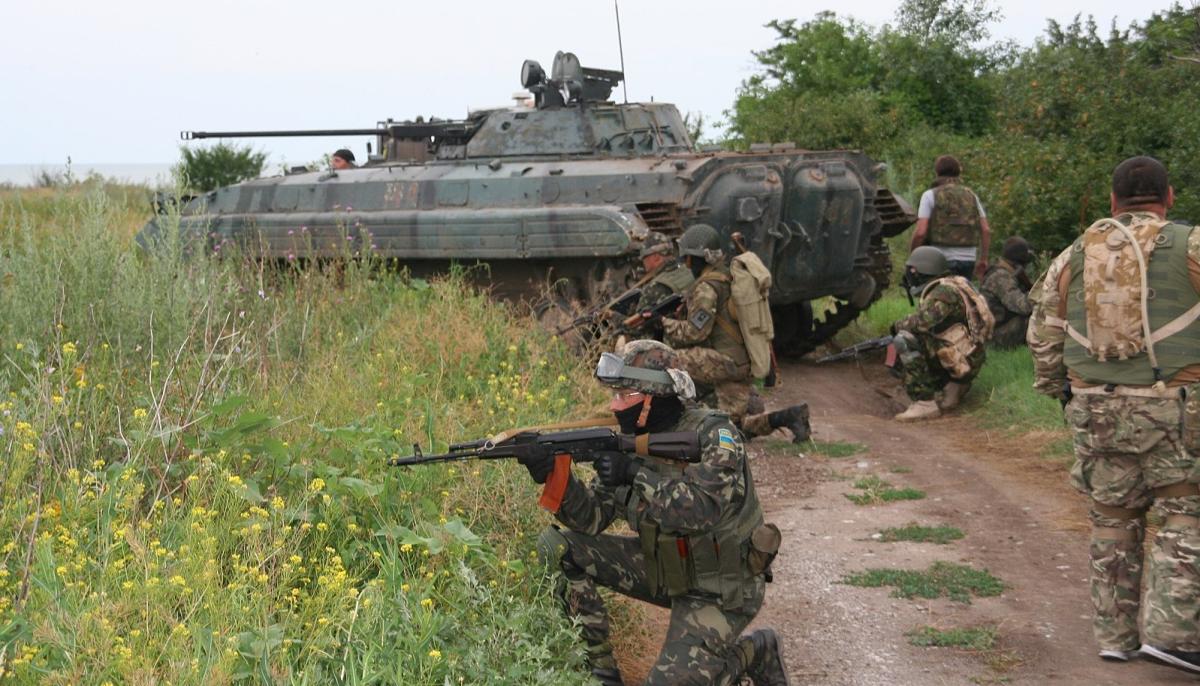
US warplanes carried out strikes on Iran-backed militias in Syria and Iraq. The Pentagon said the targets were arms depots in the border area used by the militias Kataib Hezbollah and Kataib Sayyid al-Shuhada, which have carried out attacks against US personnel in Iraq for years. The militias have vowed to avenge the air-strikes. The strikes followed talks in Vienna on the Iran nuclear deal, including US re-entry, lifting of sanctions, and an Iranian return to compliance with limits on uranium enrichment. The discussions adjourned over a week ago, with Iranian officials saying a deal could be reached in the next round. However, since then, both Tehran and Washington have taken tougher public positions. (Image: Pixabay)

Greater Middle East
Khashoggi

Khashoggi killers trained in US: report

Operatives of the Saudi secret unit responsible for the 2018 killing of journalist Jamal Khashoggi received paramilitary training in the United States, the New York Times reported. According to the account, Arkansas-based security firm Tier 1 Group trained six unit members. Although the training was described as “defensive” and “devised to better protect Saudi leaders,” the unit was then undertaking a series of kidnappings, detentions and torture to crush dissent within the kingdom. (Photo via Wikimedia Commons)

Iran
baghdad

Baghdad under pressure on militia repression

One protester was killed and dozens injured as security forces opened fire on a rally in Baghdad, where thousands had gathered to demand accountability in the murder of Iraqi activists and demonstrators. Video footage on social media showed live fire, tear-gas and street-fighting reminiscent of October 2019, when the nationwide uprising first broke out. Since then, almost 600 protesters have been killed and at least 30 activists slain in targeted killings. Many of these have been carried out by paramilitary militias, which were formed to fight ISIS, but have since been used to repress protests. The US has placed sanctions on militias held responsible for internal repression in Iraq, but one senses the real issue for Washington is Tehran’s role in backing this paramilitary apparatus. (Photo via Twitter)

Europe
belarus cops

Fascist pseudo-anti-fascism in Belarus

Under long-ruling dictator Alexander Lukashenko, a fascistic order has long obtained in Belarus—and amid the wave of state terror following last year’s stolen elections, it may now be going over the edge into outright fascism. Which is why it’s particularly sickening that Lukashenko and his propaganda machine are playing to anti-fascism in the international flare-up over his latest outrage. Activist and blogger Roman Protasevich, arrested when a passenger plane was forced down by a Belarusian fighter jet, may face the death penalty for “terrorism” charges. But it all appears to rest on Protasevich’s supposed involvement in Ukraine’s Nazi-nostalgist Azov Battalion—and this seems entirely a matter of conjecture. (Photo: Libcom.org)

North Africa
tarhouna_collage

Libya: UK slaps sanctions on Haftar-aligned militia

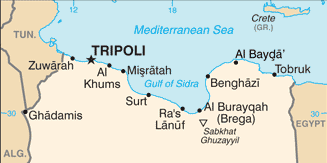
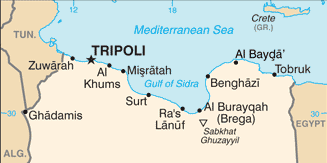
The UK government imposed sanctions on Libya’s al-Kaniyat militia and its leaders for violations of international law. The militia is reportedly responsible for 27 mass gravescontaining the remains of hundreds of residents reported missing in the Libyan town of Tarhuna, on the southern outskirts of Tripoli. The group, aligned with the forces of eastern warlord Khalifa Haftar, is additionally held responsible for atrocities such as torture, murder, arbitrary detention, and enforced disappearance. Of the five permanent members of the UN Security Council, the UK and the US are the two that have imposed sanctions on the militia. A Security Council resolution that would have placed international sanctions on the militia was blocked by Russia last November. (Map: CIA)

The Andes
paro

Colombia: gunmen fire on indigenous protesters

Colombian President Iván Duque flew to Cali in the middle of the night after street clashes in the southwestern city left several indigenous protesters injured. Amid a national strikesparked by Duque’s proposed burdensome tax reform, some 5,000 indigenous activists from the nearby administrative department of Cauca had been holding a “Minga,” or protest gathering, on the outskirts of Cali, when unknown gunmen in civilian dress arrived in a pickup truck and opened fire. The Regional Indigenous Council of Cauca (CRIC) reported that at least 10 activists were wounded, and that the gunmen were intermingled and cooperating with uniformed police. Bogotá has also seen days of street fighting, while an ongoing street festival, with music and dancing, is being maintained by strike supporters in Medellín—despite police repression that has led to hundreds of detentions. (Photo: Colombia Informa)

The Andes
Cauca

Massacres, assassinations continue in Colombia

Police killed at least eight people in Colombia’s southwestern city of Cali, amid national protests against President Iván Duque’s proposed reform of the tax code. Clashes between police and protesters also took place in Bogotá, Medellin and other cities. In response to the protest wave, Duque said he would revise his proposed reform, and that new taxes on sales of food and gasoline would be dropped. The protests come as political violence is escalating nearly across Colombia, but especially the southwest. Amid the violence, a locally-organized “Caravan for Peace” is making its way through the region, calling for a dialogue with armed actors and civil society to arrive at a new “Pact for Life & Peace,” addresing needs for security, land, and economic sustenance. (Photo: Colombia Informa)

Syria
qamishlo

Syria: Kurdish forces take Qamishli from regime

The local Kurdish Asayish militia announced that it has taken control of the last contested district of the northeast Syrian town of Qamishli from pro-regime forces. An Asayish statement said that after several days of fighting, al-Tay neighborhood is to be in their hands under terms of a truce with the pro-regime National Defense Forces (NDF), enforced by Russian troops and the Kurdish-led Syrian Democratic Forces (SDF). The Qamishlo District Council, an organ of the Rojava autonomous administration, issued its own statement, charging that NDF attacks on Asayish checkpoints were “evidence of their desire to inflame the discord among the components of the region…in particular the Kurdish and Arab.” (Photo of Qamishlo District Council reading statement: ANHA)

Syria

Russian rights groups protest Syria war crimes

The first-ever extensive report on the Syria war by Russian human rights groups has been released, highlighting the role of Moscow’s military intervention in the conflict and its impact on civilians. The report, “A Devastating Decade: Violations of Human Rights & Humanitarian Law in the Syrian War,” is the result of two years of research by Russian rights groups, including Memorial Human Rights Center, the Civic Assistance Committee, Soldiers’ Mothers of Saint Petersburg, and the Youth Human Rights Movement. The report provides chilling first-hand testimonials of life inside besieged areas, aerial bombardment, chemical weapons attacks, as well as the widespread use of torture and deprivation in regime prisons. The report is critical of all parties in the conflict—including the US-led coalition—but especially focuses on the impacts of the Russian intervention. (Photo of Aleppo ruins from UNHCR)

Southeast Asia
Bloody Sunday

Duterte under fire after ‘Bloody Sunday’ massacre

In the wake of the “Bloody Sunday” killings of nine activists in the Philippines, advocates are demanding passage of the Philippine Human Rights Act (PHRA) in the US Congress, which would suspend aid to the Manila government until the rights crisis in the archipelago nation is addressed. In a supposed operation against the New People’s Army (NPA) guerillas, national police backed up by the army killed nine members of New Patriotic Alliance (BAYAN) civil organization in Calabarzon region of Luzon island. Among the slain was Emmanuel “Manny” Asuncion, secretary general of BAYAN in Cavite province, and an important mass organizer in Calabarzon. The killings came two days after President Rodrigo Duterte ordered government forces to “kill” and “finish off” all communist rebels in the country. (Photo via Twitter)

Syria
syria betrayed

Ten years after: the Syrian Revolution betrayed

Ten years after the Syrian Revolution began with peaceful anti-regime protests, the UN Human Rights Commission released a report finding that actions by the Assad regime and its Russian allies over the course of the Syrian war have likely constituted “crimes against humanity, war crimes and other international crimes, including genocide.” The UN and human rights groups have issued such findings repeatedly—to little media coverage. The charge of genocide officially requires the world to act under the Genocide Convention. But the world is no longer even paying attention. (Image: Delawer Omar)

Iran
Iran

Biden’s first air-strikes: the Great Game in Syria

In the first air-strikes on Syria under the Joseph Biden administration, US warplanes struck positions of Iran-backed militia forces at a Revolutionary Guards base near the Iraqi border in the country’s desert east. The Pentagon said the strikes “destroyed multiple facilities at a border control point used by a number of Iranian-backed militant groups,” including Kataib Hezbollah. It was also a Tehran-backed paramilitary formation that claimed responsibility for last week’s missile attack on the US airbase at Erbil, in northern Iraq. The US bombing an Iran-backed militia in retaliation for an attack in Iraq is a textbook example of how Syria has been turned into a playing field in the Great Power game. (Image: Pixabay)