

Afghanistan

Afghanistan: pilgrims slain in Kandahar attack

In the latest of mounting attacks across Afghanistan, an bomb blast near Kabul University left eight people dead and some 30 wounded. Days earlier, a roadside bomb killed at least 11 pilgrims riding a truck in the southern province of Kandahar, headed for the shrine that houses the tomb of Sufi Shah Agha, a companion and relative of the Prophet Mohammad. No group immediately claimed responsibility for the bombing, but Kandahar authorities blamed the Taliban, which often uses roadside bombs to target security forces in the province. Days before that, at least six people were killed and 14 wounded when a suicide bomber targeted a wedding celebration in Nangarhar province. Paradoxically, the escalating violence comes just after Afghan officials met face-to-face with Taliban leaders as well as US negotiators at the peace talks in Doha, Qatar. (Photo of Shah Agha shrine via Geoview)

Watching the Shadows

SCOTUS lets stand Guantánamo detention

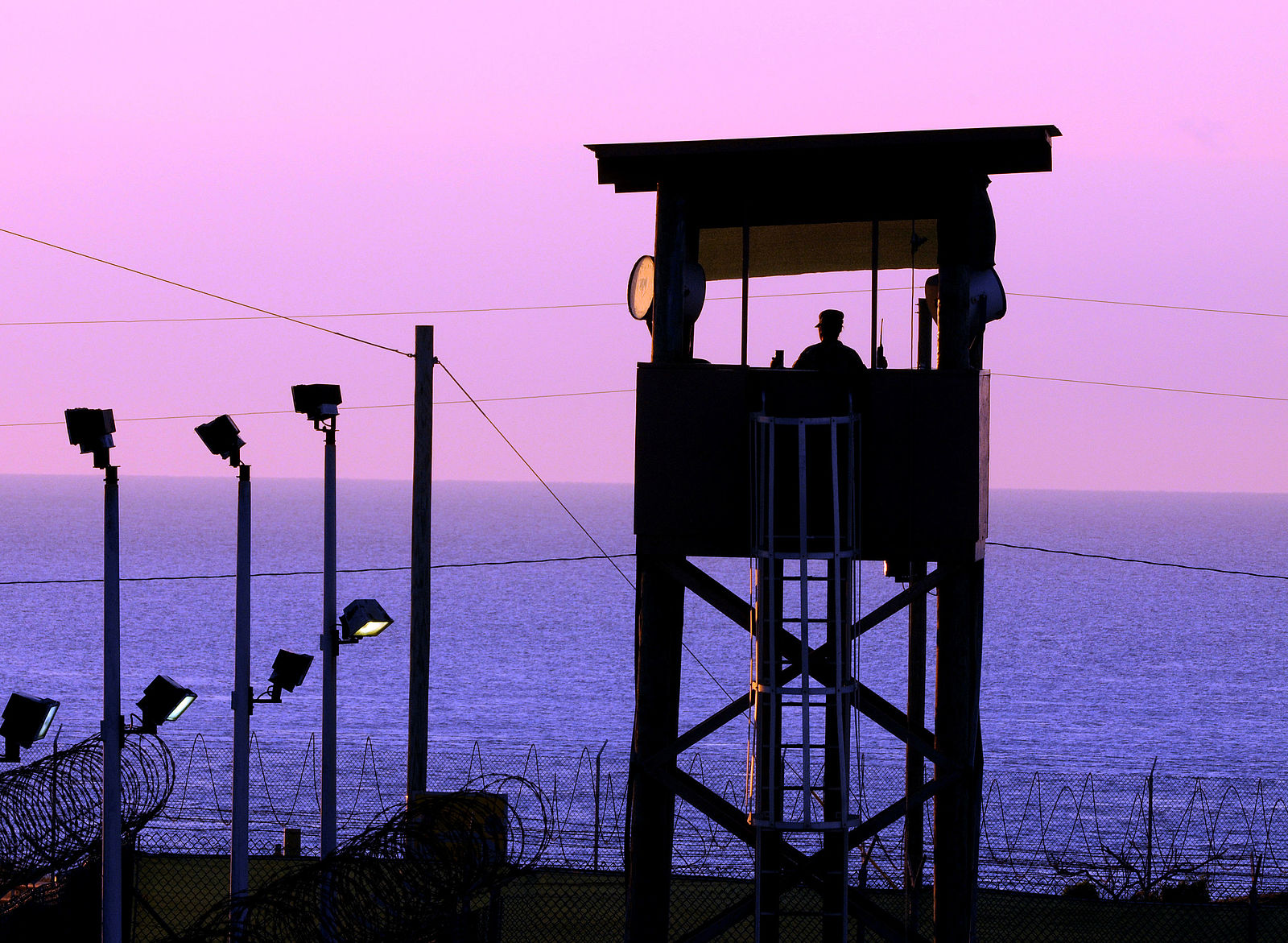
The Supreme Court denied certiorari in the case of Moath Hamza Ahmed al-Alwi, a Yemeni who has been held as an “enemy combatant” at Guantánamo since 2002. Al-Alwi was captured in Pakistan in late 2001, and the government concluded that he had fought in Afghanistan as part of a Qaeda-commanded unit. Al-Alwi denied this unsuccessfully during his original round of habeas corpus proceedings, and in 2015 initiated a new habeas case arguing that the nature of US involvement in Afghanistan had changed such that the use of military detention is no longer justified under the 2001 Authorization for Use of Military Force (AUMF). The US Court of Appeals for the DC Circuit disagreed, and the Supreme Court has now declined to review the appellate court’s conclusion. (Photo via Jurist)

Africa

Violence sweeps Mali-Burkina Faso borderlands

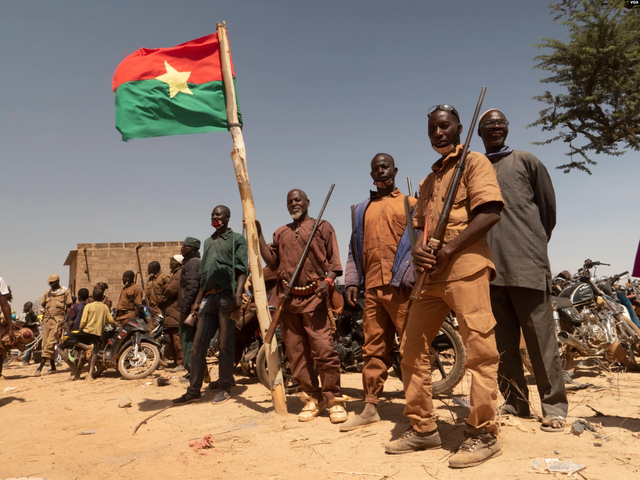
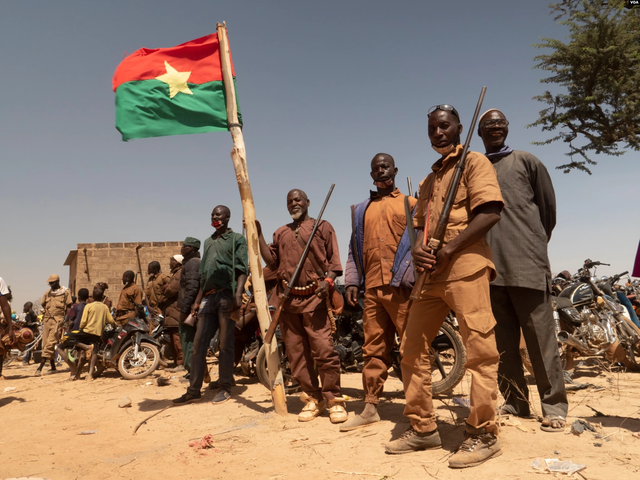
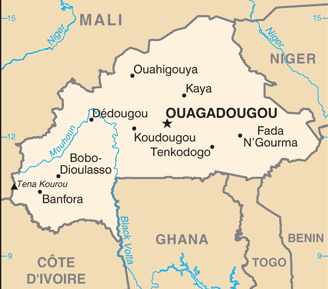
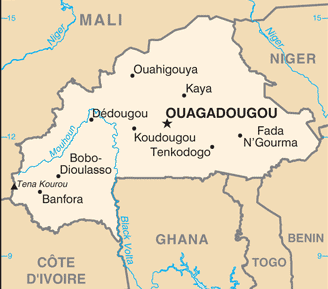
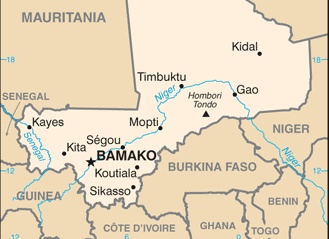
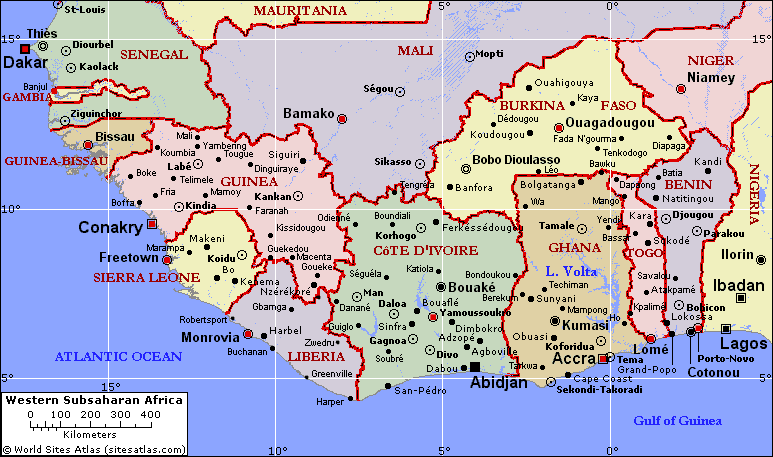
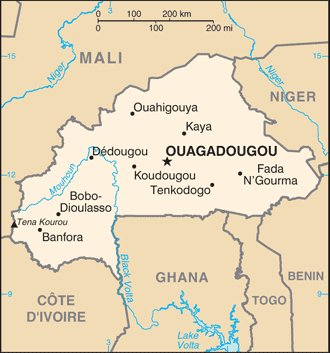
At least 38 were killed and many wounded in attacks on two ethnic Dogon villages in the Mopti region of central Mali—seemingly the latest in escalating reprisals pitting the Dogon and Fulani peoples against each other. The attacks targeted Dogon villages near the border with Burkina Faso. The following day, presumed jihadist fighters killed 17 civilians in a night-time raid on a village in the north of Burkina Faso. Authorities say a “massive” military operation is underway to hunt down the perpetrators of the attack. Although there was again no claim of responsibility, both the Group to Support Islam and Muslims (GSIM) and the Islamic State in the Greater Sahara are active in the area. (Photo of Fulani herders in Mali from KaTeznik/Wikimedia Commons via Defense Post)

Syria

Anarcho-fascist convergence at State of Union?

We’ve already noted the strange bedfellows in the Rojava Kurds’ political push to forestalll a US withdrawal from northern Syria, which would be a green light for Turkey to attack their autonomous zone. Well, they just got stranger with the arrival in Washington of Ilham Ahmed, co-president of the Syrian Democratic Council, civilian wing of the Kurdish-led US-backed Syrian Democratic Forces. She and her delegation met with Trump at the Trump International Hotel, where the prez reportedly told the group “I love the Kurds,” and promised that they are “not going to be killed” by Turkish forces. Making it even more surreal, Hawaii Rep. Tulsi Gabbard, best friend of fascist dictator Bashar Assad on Capitol Hill, brought Ahmed to the State of the Union address as her special guest. The Turkish newspaper Takvim ran a photo of Ahmed standing beside Trump at the SOTU. We wonder if Ahmed, who represents a radical-left Kurdish revolutionary movement that is influenced by anarchism, is aware that the presidential bid of her host Gabbard has been endorsed by David Duke—who shares Tulsi’s fondness for Assad.

Southeast Asia

Autonomy vote at issue in Sulu cathedral bombing?

Twin explosions left at least 20 dead and some 80 wounded at the cathedral in Jolo, capital of Sulu province in the restive southern Philippine island of Mindanao. The first blast went off inside the Cathedral of Our Lady of Mount Carmel as Sunday mass was about to start. This was followed seconds later by another blast in the cathedral's parking area. The attack came just days after the Bangsamoro Organic Law was approved by voters in the region, creating a new Muslim-led autonomous government. The new Bangsamoro autonomous region replaces the weaker Autonomous Region in Muslim Mindanao. Of the five provinces in the autonomous region, the only one to reject the BOL was Sulu. (Photo via PhilStar)

Syria

Idlib still threatened as Assad escalates genocide

Assad regime artillery struck areas of Syria’s opposition-held Idlib province after militants allegedly tried to infiltrate regime-held areas. The shelling was reportedly focused on the town of Tamanaa, which was seized from Turkish-backed rebels by jihadist forces earlier in the week. The was apparently part of a ceasefire agreement ending an internal conflict between rival opposition forces in Idlib, which saw jihadists taking over much of the province. These ominous developments may spell an end to Idlib’s reprieve from the threatened Assad offensiive on the province since establishment of a joint Turkish-Russian buffer zone there. To make this all more sobering still, the Assad regime appears to be escalating its campaign of genocide in the areas of Syria it has re-conquered, stepping up its mass extermination of detainees. The Syrian Network For Human Rights said in a year-end report that nearly a thousand died, presumably under torture, in regime prisons in 2018.  (Photo of hunger strikers at Syrian prison via Foreign Policy. Credit: Louai Beshara/AFP/Getty Images)

North Africa
JNIM

Al-Qaeda franchise claims Mali suicide blast

The Group for Support of Islam and Muslims (JNIM), al-Qaeda’s branch in West Africa and the Sahel, claimed its forces were responsible for a suicide bombing in the northern Malian city of Gao. The suicide truck-bomb detonated in a residential area of Gao, killing three (not counting the attacker) and wounding another 30. The JNIM statement claimed the target was a base of “Crusader invaders” from the United Kingdom, Germany and Canada. However, all of those killed were civilians and local Malians. Four of the wounded were foreign employees of the United Nation’s Mine Action Service, working to remove landmines in the area. A video later released by JNIM confirmed that the mine dismantling headquarters in Gao was the intended target. The video stated that “this operation demonstrates that the mujahideen are continuing upon their covenant, which they had made to their lord, until they achieve one of the two good ends, victory or martyrdom.”  (Image via Long War Journal)

Syria

Russian naval build-up ahead of Idlib offensive

The Russian Ministry of Defense released a statement explaining its unprecedented build-up of naval force in the Mediterranean as part of a week-long exercise would begin on 1 September. It said the exercise would involve 26 warships and naval vessels, including two submarines, with 34 aircraft, including missile-armed long-range bombers. But it is obvious that this build-up is timed to coincide (at least) with the planned Assad regime offensive on Idlib, the last Syrian province that remains under opposition control. Russia will certainly be massively backing the regime offensive, which the UN warns could spark a humanitarian catastrophe. With Turkey closing its borders to new refugees, it is unclear that civilians have any place left to flee. Many are already living in camps in Idlib under desperate conditions, with two million in need of humanitarian aid. (Photo: Syria News)

Syria

Did John McCain meet with jihadists in Syria?

Upon his death, many are reviving the discredited claim that John McCain met with ISIS on his Syria trip in 2013. But some are settling for the less ambitious, and perhaps plausible, claim that he met with jihadists who were implicated in atrocities. Ben Norton tweets: “John McCain was a staunch supporter of the CIA-backed, al-Qaeda-linked Salafi extremist opposition in Syria. In fact the late senator posed in a photo with a rebel who was involved in kidnapping 11 Lebanese Shia civilians.” But Norton is repeating as “fact” what are actually unproven claims—while he still equivocates about “alleged” chemical attacks by the Assad regime. It’s a bitter irony. McCain participated in war crimes in Vietnam. Two generations later, those who gloat at his death are covering up for equivalent war crimes by Assad and his allies. It fell to McCain, who was unapologetic about his Vietnam role, to try to drum up some support for the resistance in Syria. (Photo: John McCain Twitter feed)

Syria

Book review: Impossible Revolution

This book is a necessary corrective to the dominant perception—left, right and center—that the opposition in Syria are all jihadists and dictator Bashar Assad the best bet for “stability.” Long a left-wing dissident in Assad’s Syria, Saleh is a veteran of the dictator’s prisons. Here, he traces the origins of the Syrian revolution to agony caused by the regime’s “economic liberalization” (socialist phrases aside), describes the initially unarmed opposition’s popular-democratic nature, and discusses the struggle to keep the Free Syrian Army accountable to this grassroots base after it became clear a military dimension to the revolution was necessary. He makes the case that the Assad regime can be termed “fascist” even by the most rigorous definition, and has been making good on its pledge to “burn the country” before ceding power. (Image: Haymarket Books)

North Africa

‘Disaster’ seen as Libyan oil facility burns

Libya's National Oil Corporation is warning of an "environmental disaster" following clashes at the country's Ras Lanuf oil terminal that set storage tanks on fire. “Further damage to these oil sites could have a huge impact on the Libyan oil sector and the national economy.," the statement said. The Petroleum Facilities Guard launched an operation in Libya's "oil crescent" last week to take the Ras Lanuf and Sidra terminals from the Operation Dignity militia alliance, which they termed a “a terrorist entity.” Operation Dignity and the affiliated "Libyan National Army," led by commander Khalifa Haftar, are loyal to Libya's unrecognized eastern government. (Photo: Libya Observer)

Syria

Syria: new chemical attack in Eastern Ghouta

Estimates of the dead vary from 70 to 150 after the latest and worst chemical attack on the besieged enclave of Eastern Ghouta, in the Damascus suburbs. The number is likely to rise, as rescue workers are still reporting new casualties at the town of Douma, the last in the enclave that remains in rebel hands. The apparent strike by a “barrel bomb” filled with either sarin or chlorine gas targeted a building where displaced families were sheltering from the ongoing Assad regime and Russian air-raids. The victims are overwhelmingly civilians, and many are said to be children. Trump has pledged a US military response to the attack. (Image: Syria Solidarity Campaign)