
Southeast Asia

UN report: try Burma leaders for genocide

The UN Independent International Fact-Finding Mission on Myanmar issued a report urging the investigation and prosecution of Burma's top military generals for genocide, crimes against humanity and war crimes. The Mission "found patterns of gross human rights violations and abuses committed in Kachin, Rakhine and Shan States that undoubtedly amount to the gravest crimes under international law," adding that there is likely sufficient evidence to establish "genocidal intent." (Photo: European Commission via Flickr)

Mexico

Trump announces ‘termination’ of NAFTA

President Trump announced that the US and Mexico have reached an agreement on a new trade deal called the United States-Mexico Trade Agreement, which will ultimately terminate the North American Free Trade Agreement (NAFTA). Trump called Mexican President Enrique Peña Nieto from the White House to announce the new deal. Among a number of changes to NAFTA, both parties agreed to a provision that would require a significant portion of vehicles to be made in high-wage factories, a measure aimed to discourage factory jobs from leaving the US. Trump said he is in communication with Canada about a new trade deal, but is unsure if it will be part of the US-Mexico Trade Agreement. The Trump administration expects the new pact to be signed by the end of November. (Map: CIA)

Syria

Did John McCain meet with jihadists in Syria?

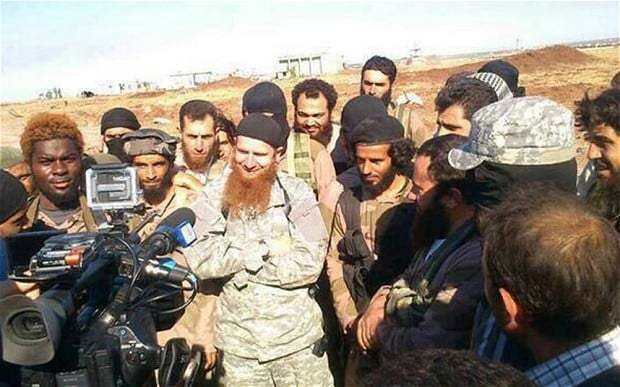
Upon his death, many are reviving the discredited claim that John McCain met with ISIS on his Syria trip in 2013. But some are settling for the less ambitious, and perhaps plausible, claim that he met with jihadists who were implicated in atrocities. Ben Norton tweets: “John McCain was a staunch supporter of the CIA-backed, al-Qaeda-linked Salafi extremist opposition in Syria. In fact the late senator posed in a photo with a rebel who was involved in kidnapping 11 Lebanese Shia civilians.” But Norton is repeating as “fact” what are actually unproven claims—while he still equivocates about “alleged” chemical attacks by the Assad regime. It’s a bitter irony. McCain participated in war crimes in Vietnam. Two generations later, those who gloat at his death are covering up for equivalent war crimes by Assad and his allies. It fell to McCain, who was unapologetic about his Vietnam role, to try to drum up some support for the resistance in Syria. (Photo: John McCain Twitter feed)

North America

Japanese-Peruvian veteran of US concentration camps dies waiting for justice

Isamu (Art) Shibayama, a rights advocate for Latin Americans of Japanese descent who were detained in prison camps in the United States during World War II, died July 31 at his home in San Jose, Calif. Born in Lima, Peru, in 1930, Shibayama was 13 when his family was detained and forcibly shipped to the United States. They were among some 2,000 Japanese-Peruvians who were rounded up and turned over to the US military for detention after the Pearl Harbor attack. Upon their arrival in New Orleans, the family was transported to the “internment camp” for Japanese-Americans at Crystal City, Texas. The family would remain in detention until 1946. Shibayama eventually won US citizenship, but was denied restitution for his wartime detention on the basis that he had not at the time been a US citizen or legal resident. He was still seeking justice from the Inter-American Commission on Human Rights at the time of his death. (Photo via the New York Times)

Greater Middle East

Woman activist faces execution in Saudi Arabia

Saudi rights advocates are warning of the possible imminent beheading of detained activist Israa al-Ghomgham, who has been provisionally sentenced to death by a Riyadh court. At a hearing before the Specialized Criminal Court in the capital, the Public Prosecutor recommended the death penalty for six defendants, including Ghomgham and her husband, Moussa al-Hashem, who have been held for nearly three years on charges related to anti-government protests in the Shi'ite-majority eastern region of Qatif. The charges include "participating in protests," "incitement to protest," "chanting slogans hostile to the regime," "attempting to inflame public opinion," "filming protests and publishing on social media," and "providing moral support to rioters." The prosecutor called for their execution based on the Islamic law principle of ta'zir, in which the judge has discretion over the definition of what constitutes a crime. A judge is expected to either confirm or reverse the death penalty recommendation at Ghomgham's next hearing in October. (Photo of Israa al-Ghomgham as a child, with her co-defendants, via Middle East Eye)

Iraq

Turkey bombs Yazidi territory in Iraq

Authorities in Ezidikhan, the self-declared Yazidi autonomous homeland in northern Iraq, issued a statement protesting a Turkish air-raid on their territory. The attack was apparently a targeted assassination of Yazidi leader Zeki ?engali, who is a representative of the Union of Communities in Kurdistan (KCK), the international body in the political orbit of the Kurdistan Workers Party (PKK). Four members of the Yazidi territorial militia, the Sinjar Protection Units (YBS), were also killed in the attack, and a home destroyed. The raid actually took place as Iraqi Prime Minister Haider al-Abadi was on an official trip to Turkey, sparking outrage from some Iraqi officials. (Photo: Kurdistan 24)

North America

Prisoners across US strike to protest conditions

Inmates across the US began a planned 19-day strike in protest of poor conditions, no-to-low pay for work, and racist prison administration practices. The strike, set to take place in 17 states, was organized by many groups, including Jailhouse Lawyers Speak. Those participating in the strike will not show up to their assigned jobs and will engage in sit-ins; some prisoners may elect to go on hunger strike. The strike is set to last until Sept. 9, coinciding with the start of the Attica Prison Uprising in 1971. Organizers planned the strike for August after seven inmates were killed during a riot at a South Carolina prison in April. (Photo: Bureau of Prisons)

Greater Middle East

Egypt: ‘cybersecurity’ law restricts social media

Egyptian President Abdel Fattah el-Sisi signed a cybersecurity law  that gives the government broad authority to block websites deemed to constitute a threat to national security or the economy, imposing prison terms for anyone found guilty of running or just visiting such sites. Amnesty International described the new law as giving "the state near-total control over print, online and broadcast media." More than 500 websites had already been blocked in Egypt prior to the new law being signed. There is another cybersecurity law before the president, which would places all Twitter accounts with more than 5,000 followers under government supervision. With street protests in Egypt all but banned, the Internet has been one of the last spaces left for dissent. (Photo: Egypt Daily News)

North Africa

Podcast: Toward Berber-Palestinian solidarity

In Episode 16 of the CounterVortex podcast, Bill Weinberg discusses how Berbers, Palestinians, Sahrawi Arabs and other subjugated peoples of the Middle East and North Africa are pitted against each other by the Great Game of nation-states. Berbers in North Africa and Palestinians in the Occupied Territories face identical issues of cultural erasure, yet the Arab states' support for the Palestinians and retaliatory Israeli support for the Berbers constitute an obstacle to solidarity. The Sahrawi Arabs meanwhile fight for their independence from Morocco in the occupied territory of Western Sahara. But the Arab-nationalist ideology of their leadership is rejected by the territory's Berbers—leading to Sahrawi-Berber ethnic tensions in Morocco. Yet there are also signs of hope. Arabs and Berbers were united in the 2011 "Arab Revolution" protests in Morocco, and greater Berber cultural rights were a part of the constitutional reform won by those protests. And the new protest wave in Morocco's Rif Mountains over the past year has again united Arab and Berber. Listen on SoundCloud, and support our podcast via Patreon. (Image of Berber flag via Kabylia Information Agency)

Europe

Russian repression mounts against Crimean Tatars

Four years after Russia's annexation of Crimea, repression is mounting against the peninsula's Tatar people—whose autonomous powers, officially recognized under Ukrainian rule, have been unilaterally revoked. The group Human Rights in Ukraine is demanding that Russian authorities provide details on the death at the hands of Russian agents of Vedzhie Kashka, an 83-year-old veteran of the Crimean Tatar national movement. Last November, a team of Russian National Guard troops  and FSB secret police carried out raids in which five Tatar leaders were detained while their homes were searched. Kashka was among those targeted, and died during the operation. An initial report said Kashka had died of natural causes, but an investigation carried out after her family had contracted a lawyer revealed that she had suffered several broken ribs. Kashka was a survivor of Stalin's 1944 deportation of the Crimean Tatars to Uzbekistan. She had been agitating for greater political rights for the Tatar people since they were allowed to return to Crimea in 1954. (Photo: Crimean News Agency)