


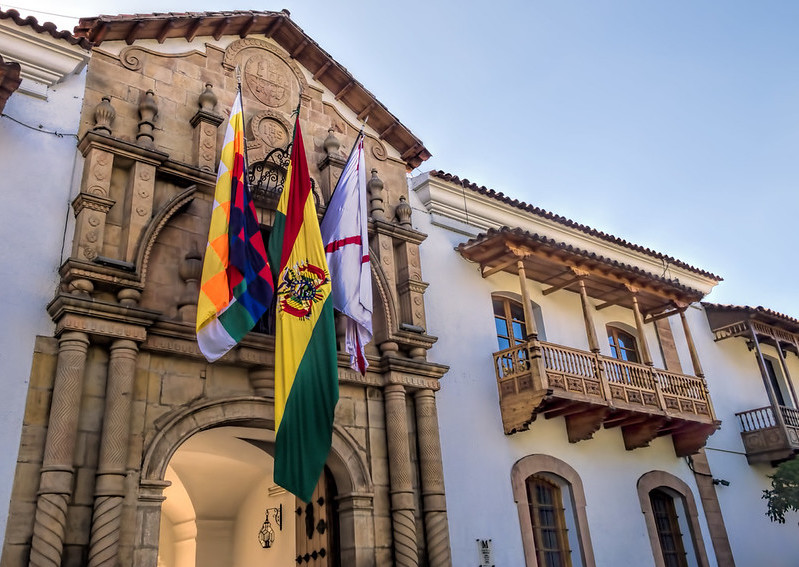
Rodrigo Paz, a center-right senator and son of a former president, won Bolivia’s run-off election on Oct 19. He defeated former far-right president Jorge “Tuto” Quiroga who ran on a more sweepingly conservative platform. For the first time since 1997, there was no candidate on the ballot from the Movement toward Socialism (MAS), the party of former president Evo Morales. A candidate from MAS, which had ruled all but one year since 2006, was eliminated in the first round in August.
The son of ex-president Jaime Paz Zamora, Paz scored a decisive victory over Quiroga, prevailing by a nine-point margin with 54% of the vote and winning in six of Bolivia’s nine departments. His victory capped a remarkable campaign in which Paz consistently defied the polls. In August, he stunned observers by finishing first in the first round of voting after months of polling towards the bottom of the eight-candidate field. The second-round result was another upset: despite trailing Quiroga in the days leading up to the vote by a similar margin as his eventual victory, Paz reversed the numbers comfortably.
Tuto’s far-right supporters took to the streets in several cities across the country to contest the results, despite no evidence of irregularities. On Oct. 21, his Libre party sent a letter to the country’s electoral body requesting an audit of 34,000 ballots, alleging a possible “inversion” of votes between Libre and Paz’s Christian Democratic Party. Tuto finally conceded his loss on the next day, as international observers from the European Union and other bodies rejected the allegations of fraud. Bolivia’s Electoral Tribunal called Tuto’s move “anti-democratic.”
Paz’s success is in part due to his more cautious approach to addressing Bolivia’s profound economic crisis. Quiroga had proposed dramatic economic reforms, including a massive IMF bailout and widespread privatization of state industries and natural resources. By contrast, Paz offered a more moderate reform agenda: preserving social programs, cracking down on corruption, and rejecting IMF dependency. His platform drew support from left-leaning voters who were uneasy about a full shift to the right.
Paz’s appeal also had much to do with his charismatic running mate, former police captain Edman Lara. A self-styled anti-corruption crusader and admirer of controversial Salvadoran President Nayib Bukele, Lara rose to fame on TikTok for exposing alleged police abuses. His outsider persona energized younger voters and loaned credibility to Paz’s campaign. Yet the strength of their alliance is unclear. After Paz’s first-round victory, Lara publicly warned that he would turn against Paz if he failed to deliver on his promises. On the campaign trail, Paz routinely had to walk back Lara’s populist pledges of universal income and higher pensions. Still, Lara’s popularity proved so strong that many Bolivians said they cast their votes as if it were Lara, not Paz, leading the ticket.
The results were celebrated by mainstream media around the world as a resounding defeat for a fractured Bolivian left weakened by years of infighting and economic turmoil. Nevertheless, Paz’s defeat of Tuto attests to Bolivians’ enduring attachment to the social and economic programs born from nearly two decades of leftist rule.
At the same time, Paz moved quickly to distance himself from a key pillar of MAS rule: its hostility toward the United States. Nearly 20 years after Evo Morales expelled the US ambassador, Paz pledged to restore warm relations with Washington. In a striking reversal of recent Bolivian diplomatic orientation, Paz received a congratulatory phone call from Venezuelan opposition leader María Corina Machado. He seized the opportunity to congratulate her on her recent Nobel Peace Prize and invite her to his inauguration on Nov. 8. Breaking with years of alignment with the Venezuelan governments of Hugo Chávez and Nicolas Maduro, Paz told Machado that Bolivia would “join in the fight” for Venezuelan democracy. In a post-election interview with El País, Paz re-affirmed his slogan “capitalism for all” and expressed his hope that “Bolivia returns to the world and the world returns to Bolivia.”
For Bolivia’s social movements and rural populations, deeply distrustful of the traditional party politics represented by Paz and his Christian Democrats, there is little cause for celebration. But in the words of Bolivian anarcha-feminist María Galindo: “The far right has been defeated.”
From NACLA Update, Oct. 24. Slightly edited. Internal links added.
Photo: Dan Lundberg/Flickr


End of Bolivia protests —for now
Weeks of roadblocks and massive protest came to a tentative end in Bolivia on Jan. 11 as the recently-installed right-wing government announced an agreement with labor unions and campesino organizations to repeal a decree that had cut crucial fuel subsidies. The announcement of the repeal of Decree 5503, which had sought to offset massive rises in fuel prices with a modest minimum wage bump and welfare payments, came after hours of negotiations between the administration of President Rodrigo Paz and the Central Obrera Boliviana (COB), the country’s largest labor federation.
Nevertheless, the path ahead remains unclear: while protesters began lifting some of the roadblocks that had successfully brought the country to a standstill, on Jan. 12, the COB accused the government of failing to honor its agreements by issuing a new decree without consulting with social movement representatives, a key part of the deal. The extent of the victory won by Bolivia’s popular movements, too, was unclear: though the new Decree 5516, issued on Jan. 12, comes with additional social spending and new credit programs, the fuel subsidy cuts remain in place. (NACLA Update)
Bolivia gripped by widespread protests
On May 11, workers in Bolivia held a nationwide strike and set up roadblocks in major cities as they called for the resignation of President Rodrigo Paz. Two weeks of road closures—spearheaded by the Bolivian Workers' Central, COB, peasant unions and miners—have emptied markets in La Paz. (HRRC, NPR)
Bolivia protests escalate
Weeks of anti-government protests have escalated in Bolivia, pushing the government of center-right President Rodrigo Paz onto its backfoot. Paz’s policies since taking office six months ago have angered a broad coalition of indigenous groups and unions, which in recent weeks have marched to La Paz, blockaded the roads leading into the city—leaving food shelves bare—and confronted police repression in the streets. On May 18, supporters of ex-president Evo Morales arrived in La Paz, bringing new recruits to the wider protest movement and clashing with police as they tried to enter a central plaza.
The demonstrations have only grown since indigenous protesters from the Amazon concluded a 27-day march to protest a controversial land law in the capital several weeks ago. Though the mobilization succeeded in forcing the law’s repeal, protesters soon linked up with striking transport workers angered by a rise in fuel prices and declining fuel quality as well as other trade unionists, effectively bringing the city to a halt. While Paz announced conciliatory gestures on May 20, including the shuffling of his cabinet, he has cast the protests as a “destabilization” campaign led by Morales. His government also expelled the Colombian ambassador after President Gustavo Petro expressed support for protesters. The Trump administration has backed Paz, with Secretary of State Marco Rubio accusing protesters of being “criminals and drug traffickers.” (NACLA Update)
Bolivia: Rodrigo Paz prepares to send in the troops
Bolivia's congress allowed the deployment of troops to quell protests, after demonstrators demanding higher wages, labor reforms, and President Rodrigo Paz's resignation detonated explosives near the presidential palace. Protests are expanding across the country as Bolivia faces its worst economic crisis in 40 years, with inflation reaching 14% in April. The social turmoil started a month ago with road blockades and strikes that have caused widespread shortages of essential supplies. (TNH)
On May 25, Paz announced that he and his cabinet would halve their salaries to demonstrate their "commitment to the country." The next day, however, lawmakers approved Law 1731, legislation that could pave the way for Paz to declare a "state of emergency" and deploy soldiers into the streets. Signed into law by Paz on May 27, the law rolls back guardrails on the executive's emergency powers that were instituted five years ago in response to the bloody crackdown carried out by transitional far-right President Jeanine Áñez, who came to power as part of an illegitimate coup regime. While Law 1731 does not itself declare a state of emergency, it places a powerful instrument of state repression back in the hands of the executive—one that Bolivia's many military governments have historically used to persecute political opponents. (NACLA Update)
Bolivia legislature clears way for escalated crackdown
Bolivia’s legislature has passed a law granting embattled President Rodrigo Paz the authority to use military troops to clear roadblocks set up by protesters, as the country enters its fifth week of nationwide anti-government demonstrations. The law was passed in Bolivia’s Chamber of Deputies on Sunday, following an overnight debate, and was signedinto law by Paz on June 8, local authorities reported.
The new Law Regulating States of Exception had already been passed by the Senate. The law gives the president a framework to declare an emergency and deploy the armed forces in operations intended to re-open highways and restore the movement of food, fuel and medical supplies.
Under the law, Paz must issue an executive declaration specifying where the emergency measures will apply and how long they will remain in force. The measure follows an earlier law, signed by Paz on May 27, that removed restrictions on the military’s involvement in putting down domestic unrest. (Jurist)
Bolivia’s state of emergency
After five weeks of nationwide blockades, Bolivia’s major highways have largely reopenedfollowing President Rodrigo Paz’s weekend declaration of a state of emergency. The decree, issued on June 20 and approved by the legislature the following day, prohibited the blocking of key transport routes and authorized the Armed Forces to aid the police in clearing roadblocks and restoring order. The protests were initially organized by a wide coalition of unions, miners, teachers, and Indigenous organizations demanding solutions to fuel shortages, surging prices, and land privatization. As the crisis deepened, those demands soon grew into calls for Paz’s resignation. For more than a month, protesters severely disrupted the delivery of food, fuel, and medicine, leaving shelves bare in cities including Cochabamba and La Paz. While the most acute phase of the mobilization has subsided for now, union leaders and allies of former President Evo Morales insist that the pause is merely temporary. At the same time, the government and its regional allies have sharply escalated their rhetoric. A joint statement issued this week by a coalition of governments, including the United States, warned that a “violent minority” constituted a “grave threat” to Bolivian democracy. Prominent critics of the protests, including former Bolivian defense officials and US Secretary of State Marco Rubio, have also sought to link the movement to drug trafficking. (NACLA Update)