


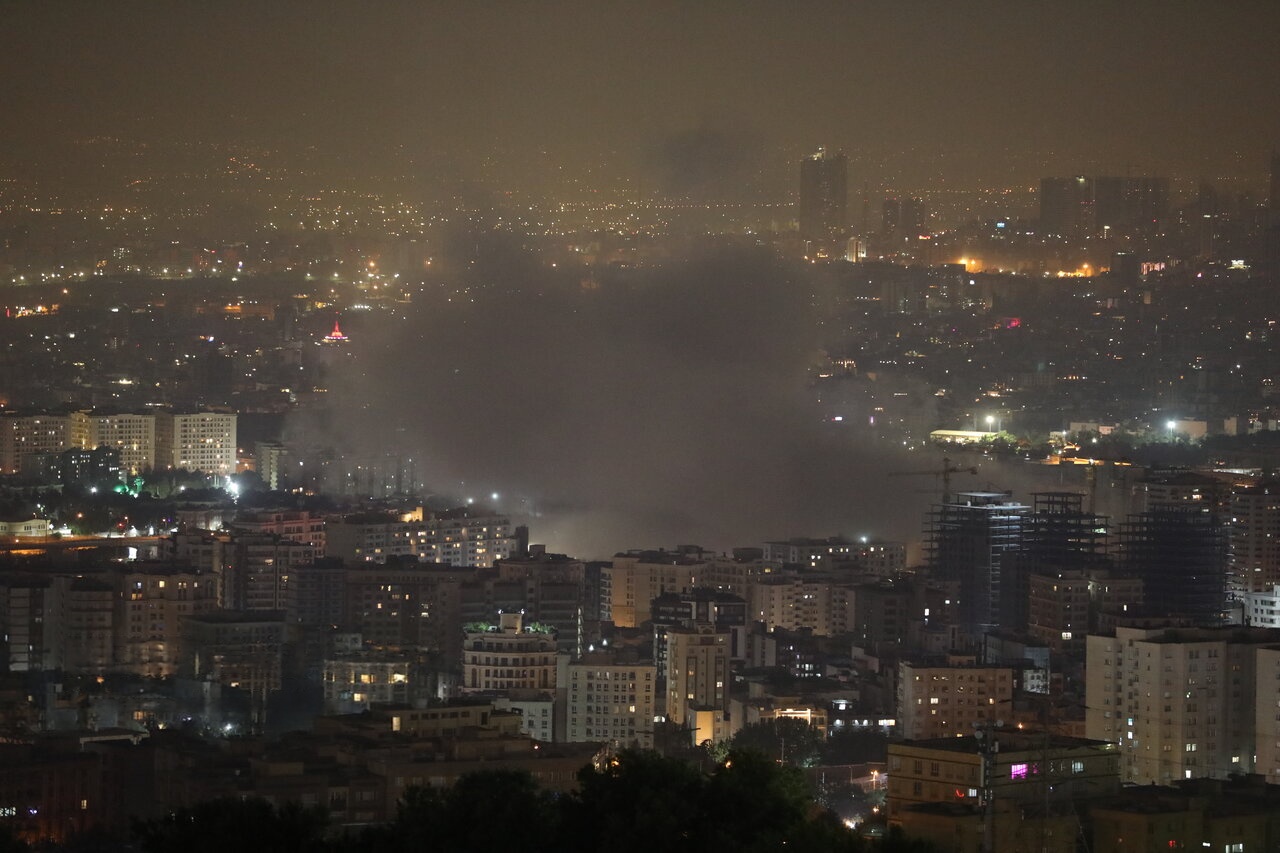
United Nations officials said on March 10 that US and Israeli airstrikes on fuel depots in Tehran have released large amounts of toxic pollutants, producing acidic “black rain” across parts of the capital.
A spokesperson for the Office of the United Nations High Commissioner for Human Rights, Ravina Shamdasani, said the attacks raise serious questions about whether the principles of proportionality and precaution were respected under international humanitarian law, noting that the oil depots struck “do not appear to be of military exclusive usage.”
Officials from the World Health Organization (WHO) warned that the burning of depots has released hydrocarbons, sulphur oxides, and nitrogen compounds into the atmosphere. The released pollutants have caused darkened skies in Tehran, prompting authorities to adviseresidents to remain indoors due to respiratory risks.
Israeli strikes on March 7 targeted roughly 30 fuel depots in Tehran. Washington was given advance notice, but US officials said the scale of the operation exceeded expectations, marking the first significant disagreement between the allies since the conflict began.
Tedros Adhanom Ghebreyesus, director-general of the WHO, said the agency has also verified 13 attacks on health-care facilities in Iran since the new conflict opened. The attacks have killed and injured first responders, including paramedics. WHO officials say the disruption has blocked access to approximately $18 million in humanitarian health supplies, with an additional $8 million in shipments unable to reach regional distribution hubs.
According to the UN Children’s Fund, supply routes for food and medical aid are already being disrupted as shipping lines divert around conflict zones. Aid officials say delays could worsen child malnutrition in vulnerable communities, including among Afghan refugees living in Iran.
The conflict is beginning to threaten the entire region’s energy infrastructure. Iranian drones struck oil storage tanks at the Port of Salalah in Oman, where civil defense crews are attempting to contain fires at the facility. Earlier attacks targeted fuel infrastructure at Oman’s Port of Duqm, another key export hub, actually outside the choke-point Strait of Hormuz. Iranian officials have warned that continued attacks on energy infrastructure could trigger retaliation across the region, including potential strikes on oil facilities belonging to other Gulf states.
Meanwhile, the direct human toll continues to grow. UNICEF reports that approximately 180 children have been killed since hostilities escalated, including dozens in a strike on a girls’ elementary school in southern Iran. UN agencies say the environmental damage, civilian casualties, and attacks on infrastructure could have long-term consequences for public health, humanitarian access, and regional stability as the conflict intensifies.
From JURIST, March 12. Used with permission.


UN rights chief alerts to global civilian harm from Iran war
The UN office of the High Commissioner for Human Rights published a press release March 10 on the impact that the conflict in the Middle East is having on the civilians globally, warning of direct and indirect harms created by continued military action.
“The strikes against vital civilian infrastructure in the Middle East—as well as the widening geographic spread of strikes—are further increasing risks for populations across the region, and beyond,” Human Rights Chief Volker Türk said.
Türk expressed concern for environmental and health impacts, especially due to oil fires. He called for legal scrutiny of attacks that have led to these “foreseeable” impacts. He also reminded nations that they are bound by the laws of war, which call for protection of civilians and civilian infrastructure during military conflict.
According to the Iranian Red Crescent Society’s published emergency appeal March 8, military action in Iran has killed at least 1,332 people, injured approximately 787, and airstrikes have damaged roughly 6,668 civilian structures. Transportation networks, communications systems, and health services have all been disrupted.
The World Health Organization (WHO) published a statement March 11 estimating that more than 100,000 people in Iran have relocated to other areas within the country to escape insecurity, while a total of 3.2 million are believed to be displaced. Additionally, 700,000 people in Lebanon have been internally displaced. The release stated that water desalination and fuel facilities in Iran were hit over the weekend, resulting in oil spills and fires in roadside drainage lines. At least 30 villages have experienced water access disruption.
The WHO also stressed that ongoing petroleum fires and smoke from damaged infrastructure have exposed civilians to pollutants—toxic hydrocarbons, sulphur oxides and nitrogen compounds—in air, food and water. The report warned of “black rain” or “acid rain” that reportedly covered skies over Tehran following strikes on oil depots. The Iranian Environmental Protection Organization urged people to remain indoors and to rinse skin immediately if it comes in contact with “black rain,” as it can cause chemical burns and severe lung damage.
In addition to the people who are directly affected by the strikes and environmental fallout, the UN release noted particular effects the conflict is having on migrant workers in the Gulf region, people who rely on commercial shipping activity across the Strait of Hormuz, and countries sensitive to oil price surges.
Türk additionally expressed concern for people who have been detained and charged over their expressions of opinions concerning the conflict in the Middle East. (Jurist)
UN resolution condemns Iran attacks on Gulf states
The UN Security Council (UNSC) adopted a legally binding resolution on March 12 that condemned Iran’s attacks on the Gulf states and demanded that Iranian forces immediately halt hostilities.
Sponsored by the Gulf Cooperation Council (GCC), an international organization composed of the United Arab Emirates, Bahrain, Saudi Arabia, Oman, Qatar and Kuwait, the resolution passed with 13 out of 15 votes. While there were no votes against the resolution, Russia and China abstained. Both countries notably decided against using their veto powers, allowing the resolution to pass.
The resolution had the “largest number of countries ever to cosponsor a Security Council draft resolution,” with 135 countries singing on alongside the GCC.
Iranian UN Ambassador Amir-Saeid Iravani referred to the UNSC resolution as a “manifest injustice” against Iran as “the main victim of a clear act of aggression,” referring to the cataclysmic US-Israeli attacks that re-ignited hostilities. While US-Israeli actions have also been accused of breaching international and domestic laws, the UNSC on March 11 failedto pass a resolution calling for an immediate halt to all military hostilities in the Middle East. The US voted against the resolution. (Jurist)
UN Human Rights Council condemns Iran strikes on Gulf states
The United Nations Human Rights Council (UNHRC) on March 25 adopted a resolution by consensus, condemning Iran’s ongoing military strikes against Gulf states and Jordan at its 44th meeting of the 61st session.
The UNHRC denounced the attacks as “egregious,” “unprovoked and deliberate,” and demanded that Tehran provide full and prompt reparations to victims. The decision came during an urgent session convened in Geneva as the regional conflict entered its fourth week, raising escalating humanitarian, legal, and economic concerns.
The 47-member Council endorsed a motion introduced by Bahrain, Kuwait, Oman, Qatar, Saudi Arabia, the United Arab Emirates and Jordan, which called on Iran to “immediately and unconditionally cease all unprovoked attacks.” The nations also expressed grave concerns over strikes targeting civilian areas and critical infrastructure, including ports, energy facilities and airports. The resolution also tasked the UN High Commissioner for Human Rights with monitoring the situation and reporting on developments.
Diplomats from affected states raised concerns about the impact of the attacks on regional and international security. Jordan’s permanent representative in Geneva, Ambassador Akram al-Harahsha, condemned the strikes as a “flagrant breach of international law” and an assault on state sovereignty, affirming solidarity among Arab states. Kuwait’s ambassador, Naser Abdullah Alhayen, similarly warned that Iran’s conduct undermines international legal order, while the United Arab Emirates accused Tehran of pursuing destabilizing “expansionist” policies.
Iran’s ambassador, Ali Bahreini, in response, framed the strikes as acting against a threat to the survival of the Iranian state, and warned that failure to confront this threat now would have wider consequences.
Additionally, the Human Rights Council agreed to hold a separate urgent debate regarding the airstrike on the Shajareh Tayyebeh Girls’ School in Minab, Iran. Requested by Iran, China and Cuba, the discussion will focus on the protection of children and educational institutions in armed conflict.
However, independent organizations such as the International Service for Human Rights cautioned against selective condemnation. It urged the Council to scrutinize violations by all parties, emphasizing that accountability must be applied consistently. (Jurist)
Iran using cluster munitions on Israel
Human Rights Watch (HRW) on March 30 reported that the Iranian government has repeatedly used “inherently indiscriminate cluster munitions” in ballistic missile attacks on Israel since the Iran-Israel conflict began on February 28. According to HRW, at least four civilians have been killed in the repeated strikes, which violate the Additional Protocol I to the Geneva Conventions 1949, Customary International Humanitarian Law (CIHL), and other international laws. (Jurist)