The Andes
Abelardo Liz

Colombia: indigenous journalist slain by army

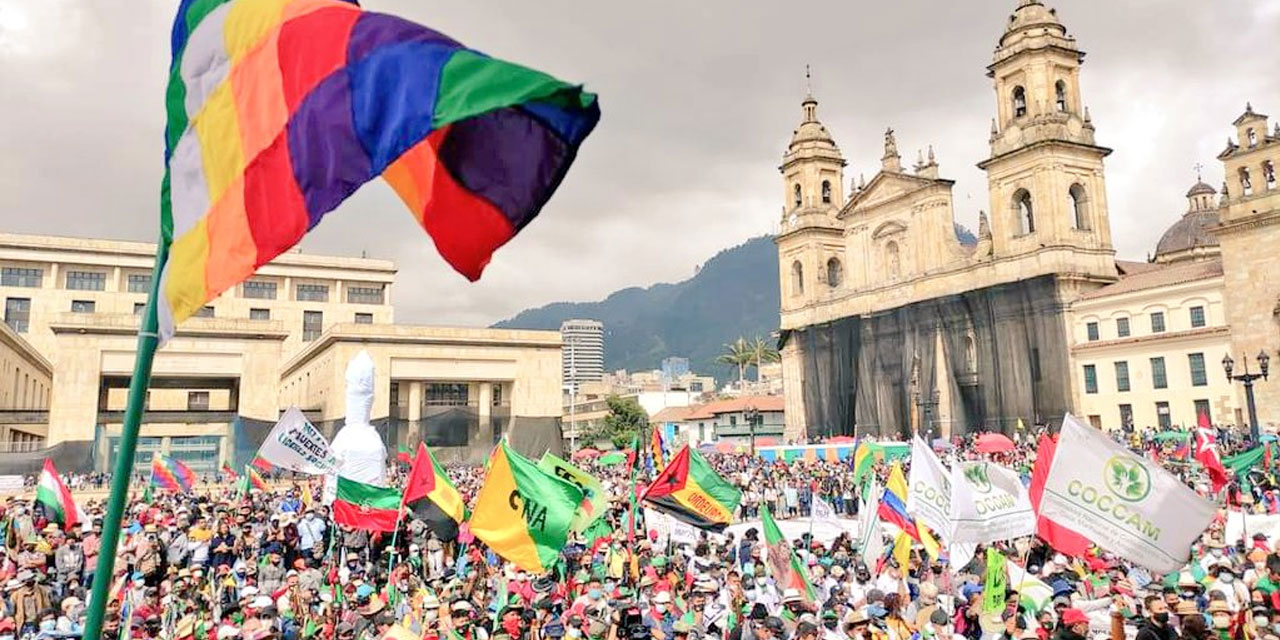
An indigenous journalist was among two killed when army troops were called in to evict a land occupation in Colombia’s southern Cauca region. The lands of three haciendas had been under occupation for months by Nasa indigenous campesinos at El Guanábano, Corinto municipality, as part of a land reclamation campaign dubbed “Liberación de la Madre Tierra.” The National Police riot squad was first mobilized to clear them, burning their huts and destroying crops. When the occupiers fought back, the army was sent in, and troops opened fire. Abelardo Liz, who was covering the confrontation for Nación Nasa community radio station, was shot in the abdomen, and died while being rushed to the hospital in Corinto. (Photo via RSF)

New York City
Verizon

Podcast: Verizon delenda est II

In Episode 55 of the CounterVortex podcast, Bill Weinberg exposes the hidden agenda behind Verizon’s abandonment of landline service. Far from being driven by public demand, the ubiquity of wireless has been instrumented by Verizon and imposed on the populace as a design to finally extinguish the public entitlement of telephone service. Verizon is the most recent inheritor of this public trust responsibility that goes back to the establishment of the New York Telephone Company as a state utility in 1896. But the trust responsibilities go with the old copper wires—once they are gone, Verizon no longer has legal obligations as a “carrier of last resort.” Weinberg calls for a public expropriation of Verizon, and making internet access as well as phone service a public entitlement. Those who are refusing to give up their landlines are, consciously or not, on the frontline of resistance to corporate rule—and the attendant digitization of all reality. Listen on SoundCloud or via Patreon. (Photo: IBEW)

Europe
Minsk protest

Net silence as Belarus explodes into protest

Long-ruling strongman Alexander Lukashenko cut off internet across most of Belarus as the country explodes into angry protests in the wake of contested presidential elections. Riot police are unleashing harsh repression, using rubber bullets, flash-bang grenades and water hoses against demonstrators. One person has been reported killed and many more wounded, including several police officers. According to preliminary results, Lukashenko won an unlikely 80% of the vote, with the main opposition candidate Svetlana Tikhanovskaya taking only 10%. Tikhanovskaya was a surprise replacement for her husband Sergei, a popular blogger who was arrested after he attempted to launch his candidacy. She held large rallies in Minsk and other cities, riding a groundswell of discontent with Lukashenko. (Photo: Meduza)

The Andes
Mamani

US court rules against Bolivian ex-prez in rights case

The US Court of Appeals of the Eleventh Circuit in Miami vacated a lower court judgment that had exonerated former Bolivian president Gonzalo Sánchez de Lozada and his defense minister Carlos Sánchez Berzaín of responsibility for the killing of protesters during the 2003 “Gas War.” The pair fled to exile in the United States after repression failed to put down the protests. In 2018, surviving relatives of eight killed in the repression brought suit against the two exiled leaders in a US district court under the Torture Victims Protection Act. The case, Mamani et. al v. Sánchez de Lozada, marked the first time a former head of state was brought to trial for human rights violations in a US court. The jury found the two liable under the TVPA and awarded plaintiffs $10 million in damages. But in an unusual move, Judge James I. Cohn set aside the jury verdict and entered its own judgment, holding the defendants not liable based on insufficient evidence. The Eleventh Circuit has now reversed Cohn’s ruling, and remanded the case to the district court. The lower court is instructed to weigh whether the jury verdict should be reinstated or if a new trial should be held. (Photo of plaintiffs Eloy and Etelvina Mamani, center, and legal team via Harvard Law Today)

The Andes
Bolivia protest

Mass protests paralyze Bolivia

Protesters have launched blockades across main roads through Bolivia over the past days, effectively cutting of La Paz and other cities, to oppose the government’s postponement of new presidential elections. The blockades have raised fears of food and gasoline shortages, with throngs of La Paz residents lining up outside markets and petrol stations. Chancellor Karen Longaric portrayed the protests as being masterminded from exile by ousted president Evo Morales, saying “Ex-president Morales and groups aligned with the Movement Toward Socialism have initiated violent and inhuman acts.” (Photo: Página Siete)

Southern Cone
curacautin

Chile: Mapuche mobilize after racist mob attacks

Chile’s Mapuche indigenous people are holding emergency community meetings in their territory to discuss how to respond to a wave of racist attacks. The most serious incident occurred in Curacautín, Araucanía region, where a group of Mapuche protesters were holding an occupation of the municipal building. The protest had been called in solidarity with Celestino Córdova, a Mapuche leader imprisoned in relation to a conflict over land rights, and now on hunger strike to demand his freedom. The protesters were set upon by a mob, who ejected them from the municipal building before beating them in the street and setting several of their vehicles on fire. The attackers used racist slurs and slogans such as “¡Querían terrorismo, acá tienen terrorismo!” (You wanted terrorism, now you have terrorism!). The Carabineros looked on but did not interfere, only acting afterwards to remove remnant protesters from the building. (Photo: Resumen, Concepción)

North Africa
JNIM

Mali: now a three-way war —or four?

Jihadist militants continue to wage a low-level insurgency in Mali, targetting government troops and their French allies. Last week, the Group for Support of Islam & Muslims (JNIM) claimed responsibility for a suicide attack on French forces. But internecine fighting between jihadist factions also takes an increasing toll. Since an apparent truce broke down this year, there have been repeated clashes between JINM, an al-Qaeda affiliate, and the self-declared Islamic State in the Greater Sahara. Amid all this, the National Movement for the Liberation of Azawad (MNLA), seeking self-rule for the Tuareg people in the desert north, maintains a precarious independence from both the jihadist and government forces. In a statement, the MNLA accused the government of fomenting conflict in the region as a strategy to avoid ceding autonomy to the Tuaregs, as mandated by a 2015 peace accord. The statement warned that the MNLA will not surrender its arms until terms of the accord are instated. (Photo of JNIM militants via Long War Journal)

Greater Middle East
al-bokari

Saudi Arabia imprisons Yemeni dissident blogger

A court in Saudi Arabia sentenced a Yemeni blogger to 10 months in prison, a fine of 10,000 riyals ($2,600) and deportation for a social media post supporting equal rights for people in same-sex relationships. Mohamad al-Bokari was arrested in Riyadh in April, after posting a video on social media, which authorities said contained “sexual references” and “violated public order and morals.” This was apparently a reference to the line: “Everyone has rights and should be able to practice them freely, including gay people.” Sources told Human Rights Watch that al-Bokari was subjected to a forced anal exam, an internationally discreditedpractice used to seek “proof” of homosexual conduct. HRW says the practice has no scientific basis, violates medical ethics, and constitutes cruel, degrading, and inhuman treatment that may rise to the level of torture. Al-Bokari was charged with “violating public morality” and “imitating women.” (Image: Amnesty International)

East Asia
Tony Chung

Hong Kong elections postponed amid repression

Hong Kong authorities announced they will postpone Legislative Council elections originally scheduled for September by one year, citing a resurgence in COVID-19 cases. The postponement comes after several opposition candidates had been barred from running, and several democracy activists were detained under the new National Security Law. Tony Chung, 19, of the pro-independence group StudentLocalism, became the first political figure to be arrested under the controversial law. (Photo of Tony Chung: HKFP)

Africa
Central African Republic

CAR: accused war criminal runs for president

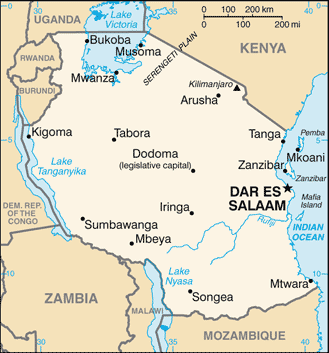
Amid rising tensions and insecurity in the Central African Republic, deposed former president François Bozizé has announced his candidacy for the upcoming presidential elections, scheduled for December. Bozizé is currently under UN sanctions and subject to an arrest warrant issued by the government for “crimes against humanity and incitement to genocide.” He is accused of having backed a brutal rebel movement after his ouster in 2013, fueling a civil war that has left millions displaced. However, authorities show little sign of moving to execute the warrant, and Bozizé has been openly working for a political comeback since returning to the country last year. (Map via Perry-Castañeda Library Map Collection)

Africa
Sudan rebels

Troops to Darfur as war re-escalates

The Sudanese government is sending more forces to the restive Darfur region, following a new escalation in violence there. Prime Minister Abdalla Hamdok said the troops are to protect people during the farming season. Dozens have been killed and several villages destroyed in Darfur over the past weeks, even as the UN Security Council discusses an “exit strategy” for the peacekeeping force. Ironically, efforts to instate the peace implementation process in Darfur may have contributed to the new surge in violence. With government encouragement, those displaced by the conflict finally started returning home in time for this year’s planting season. But this has led to new disputes between returnees and people who took over their lands in the intervening years. (Photo: Libya Observer)

The Andes
COB cabildo

Bolivia: general strike to protest postponed elections

A thousands-strong march through the Bolivian highland city of El Alto was followed by a cabildo, or mass meeting, in which unions and popular organizations agreed to immediately begin an “indefinite” general strike, demanding that new elections be held on schedule. The country’s first elections since the ouster of president Evo Morales last year were slated for Sept. 6, but the government of interim president Jeanine Añez has postponed them to Oct. 18, citing the COVID-19 pandemic. The cabildo was called by the Bolivian Workers Central (COB), the country’s main trade union bloc, and included representation from campesino organizations and El Alto’s powerful alliance of working-class neighborhood organizations. COB leader Juan Carlos Huarachi affirmed: “If we join together as miners, campesinos, the middle class and El Alto, we can be dynamite.” (Photo: ERBOL via Opinión)