


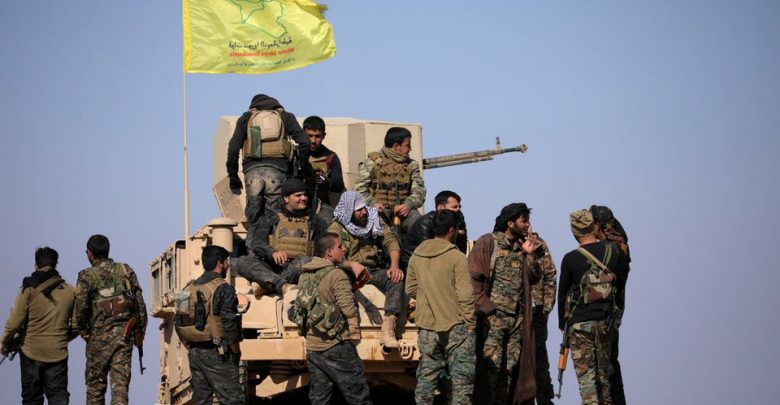
The Kurdish-held border town of Kobani in northern Syria is under siege again, as it was by ISIS in 2014—but this time by forces of the Syrian central government, which has cut off water and power to the town in the dead of winter, with snow on the ground. Since the start of the year, the Kurdish forces in northeastern Syria have lost almost all of the territory they controlled to a new offensive by the central government. Kobani with Hasakah and Qamishli are the last besieged strongholds of the reduced Rojava autonomous zone. And both the US and Russia, which have backed the Kurdish-led Syrian Democratic Forces (SDF) against ISIS, now appear to be cutting them loose—effectively green-lighting the government offensive against them. The US special envoy for Syria, Tom Barrack, has already warned that US support for the SDF is coming to an end. And in the midst of the offensive, Russia has withdrawn its forces from Qamishli, its principal military outpost in Rojava.
This development came to light this week as Syrian interim president Ahmed al-Sharaa was on his second trip to Moscow to meet with Vladimir Putin. As during his last one in October, the chief issue on the table was Russia maintaining its two major military bases in Syria, on the Mediterranean coast at Khmeimim and Tartous.
Speaking at a press conference before their meeting on Jan. 28, al-Sharaa thanked Putin for the “historic” role Russia has played in the “stability of the region”… a strange euphemism for the years of savage bombardment of Syria to keep al-Sharaa’s own rebel forces from taking power! Kremlin spokesman Dmitry Peskov, for his part, said before the meeting that “the presence of our soldiers in Syria” would be discussed. (PRI, Al Jazeera, NYT)
Abdulkarim Omar, a senior Syrian Kurdish official, told The Telegraph in Qamilshi as the Russians withdrew that Moscow had sacrificed its outpost in Rojava in order to a secure a continued presence on the government-controlled coast. “Russia wants to retain its base on the Mediterranean,” he said.
In some tentative good news, Damascus and the SDF agreed Jan. 30 to a “permanent ceasefire” that would see Kurdish-led forces and institutions gradually integrated into the structures of the interim government. The speed and completeness of this integration has been the critical factor at issue between the two sides, and has led to ceasefires repeatedly breaking down over the past weeks. In welcoming this latest deal, SDF commander-in-chief Mazloum Abdi said: “There was a threat of genocide against our people.” (Rudaw, Rudaw)
Photo: SOHR


UN welcomes ceasefire agreement in northeast Syria
The UN Commission of Inquiry on Syria welcomed the ceasefire agreement between the Government of Syria and the Syrian Democratic Forces (SDF) on Jan. 30, while urging the return of displaced populations and access to aid in Northeastern Syria.
Paulo Pinheiro, the chair of the Commission of Inquiry, stated: “We welcome efforts to bring stability to the region and now hope for a complete end to hostilities and a sustainable resolution, including to the humanitarian crisis, with needs for stable food supply, water, and electricity being met.”
The commission reiterated the urgent need for unimpeded delivery of humanitarian assistance and safe civilian passage. It warned that cold winter conditions, compounded by shortages of electricity, water, food and heating, could prove catastrophic for vulnerable populations. Reports have already emerged of infants dying from cold in displacement camps in Ain al-Arab (Kurdish: Kobani) and in nearby Idlib.
The agreement includes an immediate ceasefire, with the withdrawal of military forces from the contact lines. Security forces under the Ministry of Interior will replace military units within the city centers of Hasakah and Qamishli.
According to an SDF statement, the agreement provides for the formation of a military division comprising three SDF brigades, in addition to a brigade from the Kobani self-defense forces under a division affiliated with Aleppo province. Institutions of the Kurdish-led Autonomous Administration will integrate into the Syrian state institutions, while maintaining the status of the current civilian employees. The agreement also addresses the civil and educational rights of the Kurdish community and guarantees the return of displaced persons to their areas.
“The agreement aims to unify Syrian territory and achieve the process of full integration in the region by strengthening cooperation between the parties concerned and uniting efforts to rebuild the country,” the SDF emphasized in its statement. (Jurist)