Africa
Darfur

Sudan: ‘roadmap’ to peace —amid escalation to genocide

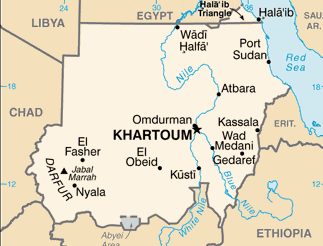
After months of US-led negotiations, the United States, Saudi Arabia, Egypt and the United Arab Emirates (the “Quad“) issued a “roadmap to peace” in Sudan, starting with a push for a three-month “humanitarian truce.” However, despite the agreement with the main regional backers of the two sides in the war, fighting continues between the Sudanese armed forces and paramilitary Rapid Support Forces (RSF). Since the “roadmap” was announced, the RSF has continued to close its ring around El Fasher, the besieged capital of North Darfur state. UN officials have condemned the assault and warned of catastrophic consequences for civilians under siege, facing severe shortages of food, clean water, and medical services. When the RSF offensive was launched earlier this year, a coalition of aid organizations and human rights groups issued a statement finding: “Genocide and atrocity crimes are being committed now in North Darfur. The RSF is engaged in the mass killing of civilians and will likely continue this if/when they reach El Fasher.” (Map via Radio Tamazuj)

Syria
SDF

Syria: clashes follow al-Sharaa ultimatum to SDF

Fighting broke out in the village of Um Tineh, in Syria’s Aleppo province, between the Kurdish-led Syrian Democratic Forces (SDF) and forces aligned with the Damascus regime, leaving at least seven civilians dead. The SDF said the clashes began with a drone attack on the village, followed by artillery bombardment, damaging local homes. The violence came three days after President Ahmed al-Sharaa warned that the SDF’s failure to integrate into the Syrian Armed Forces could provoke Turkish military intervention by year’s end. Planned talks in Paris on how to incorporate the Kurdish autonomous zone into the new government were broken off by the transitional regime last month. Turkey has repeatedly bombed SDF-held territory in Syria over the past months, as the threat of Arab-Kuridsh ethnic war looms larger on the ground. (Photo: SOHR)

Europe
Armata

Belarusian political prisoners as pawns in power game

NATO launched a new exercise dubbed Eastern Sentry in response to the ongoing joint Russia-Belarus military exercise dubbed Zapad (West), which involves thousands of troops, naval maneuvers in the Baltic Sea, and simulated nuclear strikes. Yet two US military observers were invited to Belarus to observe the Zapad exercise, standing on a viewing platform to review forces from the same Russian army that is fighting in Ukraine. This appears to be part of a US rapprochement with Belarus, coming days after 52 Belarusian political prisoners were released in a US-brokered deal. However, the dissidents protest that they were expelled to Lithuania and not given the choice of remaining in their own country. One, former Belarusian presidential candidate Mikola Statkevich, has already been returned to a penal colony after refusing to accept exile. (Photo of Russian T-14 Armata tank via National Security Journal)

Greater Middle East
Freedom Flotilla

Israeli strikes target Hamas in Qatar —and Greta Thunberg in Tunis?

Unprecedented Israeli air-strikes on buildings in Qatar’s capital Doha apparently targeted senior members of Hamas’ external leadership—precisely those involved in ceasefire negotiations. The Israel Defense Forces confirmed the operation, with Prime Minister Benjamin Netanyahu saying that the attack was “a wholly independent Israeli operation.” He added: “Israel initiated it, Israel conducted it, and Israel takes full responsibility.” However, the White House quickly confirmed that it was informed of the operation beforehand. On the same day as the Qatar strikes, organizers of a flotilla carrying aid for Gaza said their lead ship was hit by a drone while anchored at the port of Sidi Bou Said, Tunisia. A video posted by the Global Sumud Flotilla appears to show a lit projectile falling from the sky onto the vessel before flames erupt on the front deck. The ship sustained some damage, according to later footage posted on social media. One day later, a second vessel in the flotilla was evidently struck, causing similar damage. The Global Sumud Flotilla’s most prominent member is Greta Thunberg, internationally known for her climate activism and now a leading figure in the Freedom Flotilla Coalition. (Photo: FreeGaza via Wikimedia Commons)

The Caribbean
Cherizier

US mercenaries to fight gangs in Haiti

The US indicted Jimmy Chérizier AKA “Barbecue,” leader of the gang coalition in control of most of the Haitian capital Port-au-Prince, and offered a $5 million reward for information leading to his arrest. Chérizier and an alleged stateside collaborator, Bazile Richardson, are charged with sanctions violations related to arms sales. Meanwhile, private military contractor and Trump ally Erik Prince told Reuters he has signed a 10-year deal with the Haitian government to fight armed groups and help collect taxes—a move some observers fear could further weaken the Haitian security forces and lead to rights violations. Prince’s new security firm, Vectus Global, has been operating in Haiti since March. (Photo: Haiti Liberte)

Europe
russian alaska

Podcast: Alaska 2025 = Munich 1938?

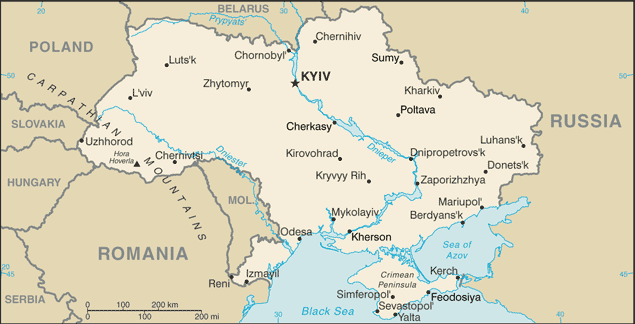
Russia’s irredentist claims on its former holding Alaska have provided fodder for comedians, but the stakes at the Trump-Putin meeting in the Last Frontier are no laughing matter. Despite the escalating mutual nuclear threats between Washington and Moscow, Trump’s call for a Russia-Ukraine “land-swap” obviously means Kyiv being forced to accept Moscow’s annexation of much of its territory in exchange for the return of other pieces its own territory illegally occupied by Russia. Meanwhile, Moscow sends drones to threaten NATO member Lithuania, which sits on the critical corridor to the Russian exclave (and tactical missile outpost) of Kaliningrad. Germany has responded by sending troops to the Baltic country—its first post-war foreign deployment. Appeasement of aggression failed to win peace at Munich in 1938, and there’s no reason to hope it will in Alaska today. But the difference is that the contending powers today have nuclear weapons. In Episode 291 of the CounterVortex podcast, Bill Weinberg takes an unflinching look. (Map via Wikipedia)

Iraq
KRG

Iraq: mysterious drone strikes on Kurdistan oil-fields

Three days of drone attacks on oil-fields in Iraq’s autonomous Kurdistan region have brought operations at several facilities to a halt and slashed crude output. The targeted sites include fields at Zakho, operated by Norway’s DNO; the Sarsang field, operated by US-based HKN Energy; and the Ain Sifni field, operated by Hunt Oil, all in Dohuk governorate. Kurdistan authorities also said a drone was downed near Erbil airport, which hosts US troops. Nobody has claimed responsibility for the attacks, but Kurdish authorities blamed the Hashd al-Shaabi, or Popular Mobilization Units, a paramilitary network aligned with the Baghdad government and backed by Iran. The attacks come amid renewed dispute between Baghdad and the Kurdistan Regional Government over whether the KRG may enter into hydrocarbon contracts with foreign firms. In May, the central government filed a complaint against the KRG for signing gas contracts with two US companies, including HKN Energy, asserting that all oil and gas deals must go through Baghdad. (Map: UNHCR via ReliefWeb)

Europe
Spiderweb

Operation Spiderweb: Russia responds with nuclear threats —of course

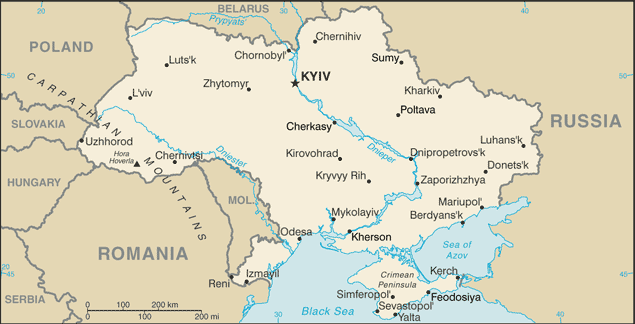
In a  covert operation dubbed “Spiderweb,” the Security Service of Ukraine (SBU) destroyed or damaged 41 Russian warplanes at four air-bases across the Russian Federation—Belaya (Irkutsk oblast, Siberia), Olenya (Murmansk oblast, in the Arctic), Dyagilevo (Ryazan oblast, near Moscow) and Ivanovo (in the eponymous oblast, also near Moscow). Kyiv claims it has disabled 34% of Russia’s strategic bomber fleet in the operation, carried out with over 100 drones launched from trucks hidden across Russian territory. While the Kremlin’s top officials, including President Vladimir Putin, have not commented on the Ukrainian operation at all, Russian pro-war propagandists are calling it “Russia’s Pearl Harbor,” and demanding vengeance. Prominent state TV personality Vladimir Solovyov said on his program that the Ukrainian operation is “grounds for a nuclear attack,” and called for retaliatory strikes on the Ukrainian president’s office in Kyiv and airfields in NATO members Poland and Romania allegedly used by Ukrainian aircraft. (Image via Kyiv Independent)

Europe
Ruslan Sidiki

Russia: anti-war saboteurs face military trials

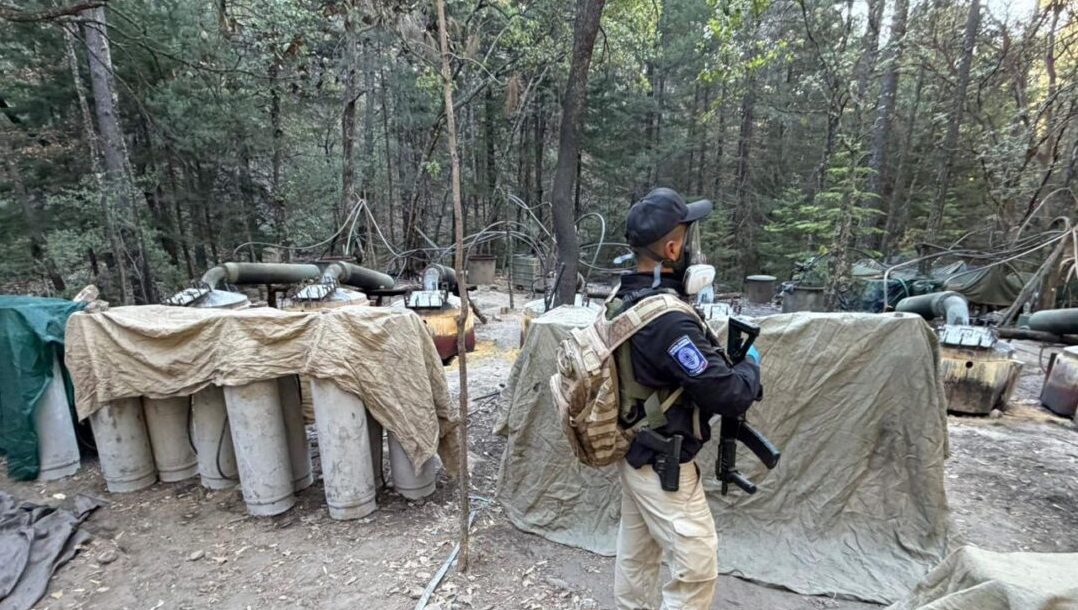
A Russian military court in Yekaterinburg sentenced 27-year-old anarchist Alexey Rozhkov to 16 years in prison for what prosecutors classified as a “terrorist act”—throwing Molotov cocktails at a military recruitment office in March 2022, causing minor damage. The incident, which occurred shortly after the start Russia’s full-scale invasion of Ukraine, was one of the earliest in a brief string of such actions across Russia in protest against the war. Meanwhile, another young anarchist, Ruslan Sidiki, took the stand in his trial at a military court in Ryazan, accused of destroying railway tracks, leading to the derailment of 19 carriages of fertilizer. Sidiki is also accused of the attempted destruction of military aircraft, on both occasions using GPS-guided drones. He said he undertook the actions to halt the movement of munitions toward the border with Ukraine, and that he took measures to avoid harming humans. He said he rejected the “terrorism” charge, since his “goal was sabotage, not the intimidation of the population.” (Image of Ruslan Sidiki: Mediazona via Meduza)

Africa
Sahel

Human rights crisis deepens under Sahel juntas

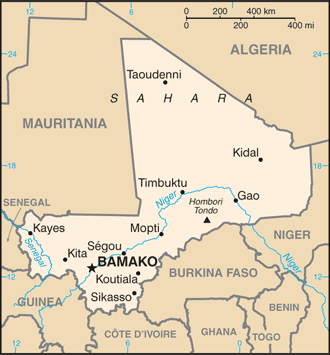
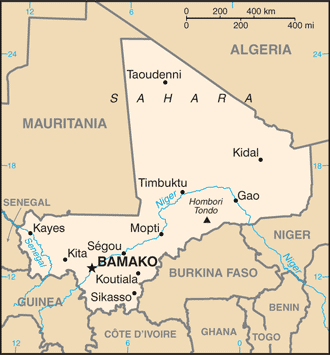
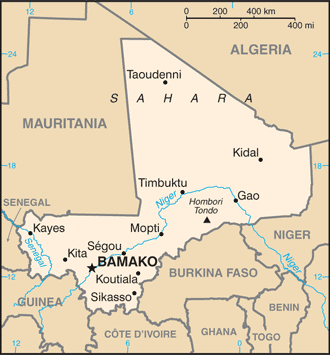
Two attacks on “defenseless civilian populations” along Niger’s border with Burkina Faso left some 40 dead, authorities said. Niamey’s defense ministry said 21 were killed in Libiri village and 18 in Kokorou, both in Tillabéri region. The statement blamed “criminals,” but the borderlands are a stronghold of jihadist insurgents. An even worse attack was reported days earlier, but is being denied by Niger’s ruling junta. Authorities suspended the operations of the BBC in Niger after it reported that jihadists had killed 90 soldiers and upwards of 40 civilians at Chatoumane, also in Tillabéri. According to the monitor Armed Conflict Location & Event Data (ACLED), at least 1,500 have been killed in jihadist attacks in Niger in the past year—more than double the 650 killed from July 2022 to July 2023. Human Rights Watch meanwhile released a report detailing killings of civilians and other serious abuses committed by Mali’s armed forces in collaboration with Russian mercenaries of the Africa Corps following the withdrawal of a UN peacekeeping mission last year. (Map: Wikivoyage)

Palestine
settlement

Annexation agenda escalates West Bank conflict

The Israel Defense Forces killed four Palestinians in an air-strike on the village of Siir, in Jenindistrict of the occupied West Bank. The Palestinian Red Crescent reported that Israeli forces “prevented our teams from reaching the bombing site,” declaring it a “closed military zone.” Two days later, an IDF drone strike near the village of Aqaba in the Jordan Valley left two dead. The IDF again reportedly prevented ambulances from reaching the site. Two days after that, fire-fights erupted in Jenin as Palestinian Authority security forces responded to the theft of military equipment. A PA statement said “a group of outlaws opened fire on the headquarters of the security services” and stole two vehicles. Despite the designation of “outlaws,” the vehicles were reportedly paraded through the streets by a band flying the flags of Islamic Jihad and Hamas. Sen. Tom Cotton (R-AR) has meanwhile introduced legislation to bar use of the term “West Bank” by the US government in favor of the official Israeli designation “Judea & Samaria.” (Photo: delayed gratification via New Jewish Resistance)

South Asia
Kurram

Pakistan: truce follows weeks of sectarian clashes

A ceasefire agreement was reached between two warring tribes in Pakistan’s restive Khyber Pakhtunkhwa province following weeks of clashes that left 130 people dead in Kurram district, along the border with Afghanistan. A Grand Jirga of tribal leaders was called to mediate the truce. The violence exploded when a convoy of Shi’ite pilgrims traveling to a shrine in Peshawar was ambushed by armed assailants, killing at least 42. The ensuing clashes pitted members of the mostly Shi’ite Bagan tribe against their Sunni neighbors, the Alizai, with shops and homes ransacked and whole villages displaced. A land dispute between the two tribes had also caused clashes that led to 50 fatalities in September, and ended when some 100,000 local residents marched for peace. (Map: USAID via ReliefWeb)