

East Asia
Danjo

Escalation in East China Sea

Japan scrambled fighter jets after a Chinese Y-9 surveillance plane “violated the territorial airspace” of the Danjo Islands in the East China Sea, Tokyo’s Ministry of Defense said, calling the breach “utterly unacceptable.” The incident constituted the first intrusion of Japanese airspace by a People’s Liberation Army aircraft “since we began anti-airspace incursion measures,” Tokyo said. Beijing’s Foreign Ministry responded that the PLA had “no intention of invading the airspace of any country,” and that the incident is under review. The apparent breach follows a series of accusations by Tokyo over the past months that China Coast Guard ships have entered waters around the Senkaku Islands, some 1,000 kilometers to the southeast of the Danjo. The Senkaku Islands, under Japanese control, are also claimed by China, which calls them the Diaoyu Islands. Like the Danjo, the Senkaku/Diaoyu are uninhabited, but are believed to hold potentially lucrative oil and gas reserves. (Map: Google)

East Asia
Guangdong

Nuclear power and the struggle in Guangdong

In Episode 240 of the CounterVortex podcast, Bill Weinberg discusses China’s hubristic plans for massive expansion of its nuclear power sector—and notes that some of the new plants are slated for the southern province of Guangdong, which in recent years has seen repeated outbursts of protest over land-grabs and industrial pollution as well as wildcat labor actions (and was, in fact, the site of a nuclear accident in 2021). China’s expropriated peasant class has been left behind by the breakneck industrialization of the past decades, and may prove a source of resistance to the new thrust of nuclear development that would further accelerate it—despite the current crackdown on dissent. Listen on SoundCloud or via Patreon. (Map via ResearchGate)

East Asia
China

US shifts nuclear posture to confront China

President Biden approved in March a highly classified nuclear posture document for the first time reorienting US deterrent strategy to focus on China’s rapid expansion in its nuclear arsenal. The shift comes as the Pentagon believes China’s stockpiles will rival the size and diversity of those of the United States and Russia over the next decade. The new “Nuclear Employment Guidance” is highly classified, but a copy was just obtained by the New York Times. Beijing reacted angrily to the report. “The US is peddling the China nuclear threat narrative, finding excuses to seek strategic advantage,” a Chinese Foreign Ministry representative said. (Map: PCL)

Planet Watch
Nairobi

World war or world revolution?

In Episode 239 of the CounterVortex podcast, Bill Weinberg provides an overview of the protest waves and uprisings going on across the planet—in Kenya, Uganda, Nigeria, Bangladesh, India, China, Serbia, Venezuela, and in Israel. This as worldwide protests in solidarity with the Palestinians of Gaza continue. Amid ongoing protests against Netanyahu in Israel, there have also been protests against Hamas in Gaza. Despite internal dangers and contradictions in all these upsurges, there is a sense that we could be approaching a revolutionary moment such as that seen in 2011—the year of the Arab Spring and Occupy Wall Street. And with the planet on an accelerating trajectory toward world war, the linking of these upsurges through conscious solidarity and the infusion of anti-war content to their demands is urgently mandated. Listen on SoundCloud or via Patreon. (Photo via Twitter)

Palestine
Beijing Declaration

Fatah and Hamas sign unity declaration in Beijing

Meeting in the Chinese capital, senior leaders from Fatah and Hamas as well as 12 other Palestinian factions signed a joint statement, the “Beijing Declaration to End the Division & Strengthen Palestinian National Unity,” calling for establishment of an “interim government of national reconciliation” with a focus on post-conflict reconstruction of Gaza. Chinese Foreign Minister Wang Yi described the event as an “historic moment for the cause of Palestine’s liberation.” Asserting that “‘Palestinians governing Palestine’ is the basic principle for the post-conflict governance of Gaza,” Wang called for an international peace conference to advance a two-state solution. Israel quickly rejected the agreement, with Foreign Minister Israel Katz saying that Hamas’ rule in Gaza “will be crushed.” (Photo: PRC MFA)

Africa
west africa

Uranium at issue in Great Game for West Africa

The ruling junta in Niger revoked the operating license of French nuclear fuel producer Orano at one of the world’s largest uranium mines. Russian companies have meanwhile indicated interest in picking up the lease for the giant Imouraren mine. However, exports are stalled by closure of the border with Benin, the vital sea corridor for landlocked Niger, as tensions mount between the two countries. The uranium dispute comes as French and US troops have been forced to withdraw from Niger, and Russian forces have moved in. The Pentagon’s AFRICOM commander Gen. Michael Langley has acknowledged that the US is seeking to establish new bases in neighboring West African countries, including Benin. (Map: World Sites Atlas)

Southeast Asia
South China Sea

Maritime collision escalates South China Sea tensions

Manila accused Chinese military vessles of engaging in “dangerous manoeuvres, including ramming and towing” a Philippine ship in an effort to disrupt a “routine” resupply mission to an outpost on Second Thomas Shoal (known to the Philippines as Ayungin Shoal) in the the disputed Spratly Islands (known to the Philippines as the Kalayaan Islands). By Philippine media accounts, the craft was fired upon with water cannon and boarded by Chinese troops, with several Filipino soldiers injured in the ensuing confrontation. The skirmish came amid escalating tensions over the South China Sea—much of which Manila calls the West Philippine Sea, but nearly all of which is claimed by Beijing. The chief of staff of the Armed Forces of the Philippines, Romeo Brawner Jr., stated that the military and other maritime law enforcement agencies are prepared to defend Filipino fishermen from China’s newly announced “anti-trespassing policy.” (Map via IDSA)

East Asia
Legislative Yuan

Protesters surround Taiwan parliament

Some 30,000 Taiwanese demonstrators surrounded the Legislative Yuan, the island’s parliament, one day after Lai Ching-te of the Democratic Progressive Party (DPP) was sworn in as president. They were protesting against the legislative majority’s attempts to enact new laws they say would unconstitutionally limit the power of the executive. Three days before the inauguration, physical conflict broke out among lawmakers on floor of the Legislative Yuan, with five briefly hospitalized. The DPP, while winning the presidency, failed to maintain a legislative majority in the January election, leaving the opposition Kuomintang to form a majority coalition. The Kuomintang favors closer ties with China, while the DPP upholds Taiwan’s de facto independence. Beijing responded to Lai’s inauguration with menacing naval maneuvers, completely surrounding Taiwan with warships. The protest at the Legislative Yuan evokes memories of the 2014 Sunflower Movement, when activists occupied the parliament chamber for 24 days to oppose a free trade agreement with China being pushed by the then-Kuomintang government. (Photo: Kanshui0943 via WikimediaCommons)

South Asia
Pakistan

Chinese interests targeted in Pakistan terror

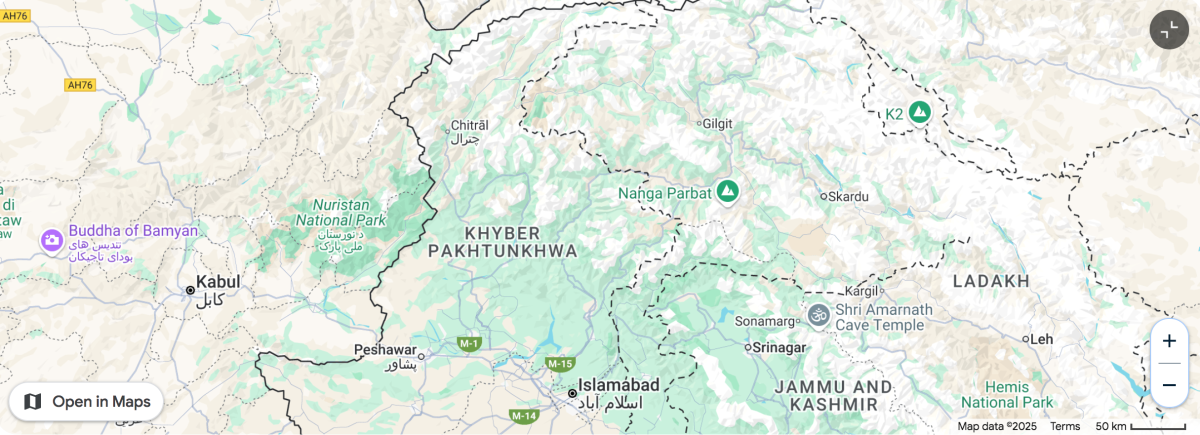
At least five Chinese nationals and one Pakistani were killed in a car bombing in Pakistan’s northwest Khyber Pakhtunkhwa province. The victims, employees of Wuhan-based engineering firm Gezhouba Group, were en route to the Dasu hydropower project on the Indus River. It was the third attack on Chinese interests in Pakistan in a week. No group has claimed responsibility for the car bombing, but the two previous attacks were claimed by the separatist Baloch Liberation Army (BLA)—including an assault on the Chinese-funded strategic port of Gwadar. (Map: PCL)

Planet Watch
anthropocene

2023: ‘bonkers year’ for global climate

Records were once again broken last year for greenhouse gas levels, surface temperatures, ocean heat and acidification, sea level rise, and retreat of glaciers, according to a new global report issued by the World Meteorological Organization (WMO). The WMO State of the Global Climate 2023 report finds that on an average day in 2023, nearly one third of the ocean surface was gripped by a marine heatwave, harming vital ecosystems and food systems—far beyond the already inflated levels seen in recent years. Antarctic sea ice reached its lowest extent on record—at one million square kilometers below the previous record year of 2022, an area equivalent to the size of France and Germany combined. One leading oceanographer wryly stated: “The scientific term is bonkers year.” (Photo: CounterVortex)

Palestine
Tibetan Uprising Day

Podcast: for Tibet-Palestine solidarity

The 65th anniversary of Tibetan Uprising Day immediately follows Tibetan protests against plans to flood ancestral lands for mega-hydro development to power the cities and industrial zones of China’s east—a clear parallel to the struggle of the Cree and Inuit indigenous peoples of the Canadian north to defend their territories from mega-hydro schemes to power the megalopoli of the US Northeast. The illegal Chinese occupation of Tibet since 1959 also has a clear parallel in the illegal Israeli occupation of the Palestinian Territories since 1967. Yet the Tibetan and Palestinian leadership have long been pitted against each other in the Great Power game. In a significant sign of hope, Students for a Free Tibet responded to the criminal bombardment of Gaza by issuing a statement in solidarity with the Palestinians, and some leading figures in the Tibetan exile community have drawn the connection between the two peoples’ struggles. Bill Weinberg explores in Episode 217 of the CounterVortex podcast. Listen on SoundCloud or via Patreon. (Photo: Central Tibetan Administration)