


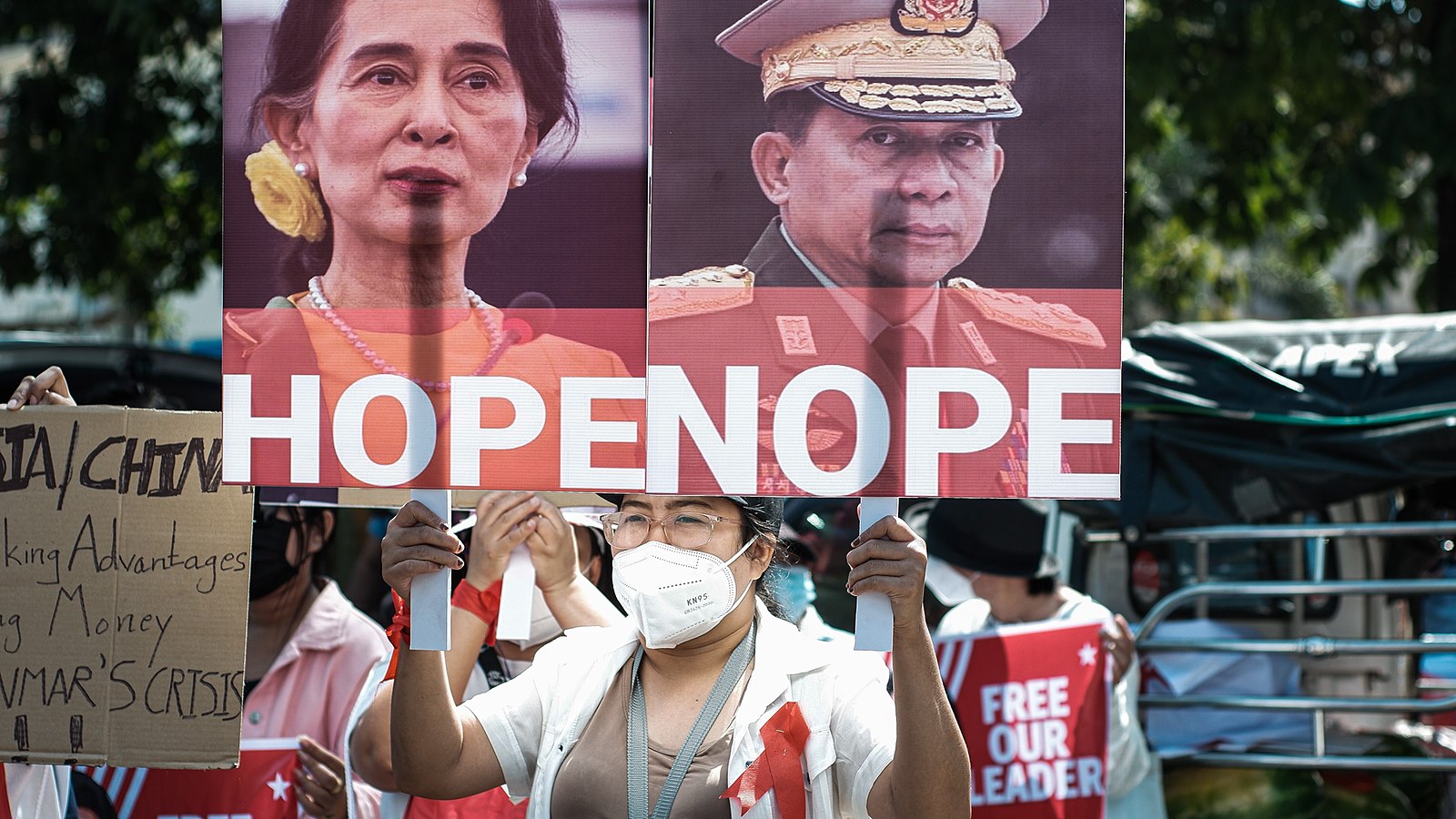
by Nava Thakuria, CounterVortex
Trouble-torn Burma (also known as Myanmar or Brahmadesh) is heading for the first general elections since the military coup of February 2021 that ousted a democratically elected government. The seating of a new parliament will mark the re-opening of the bicameral body which was suspended when the military junta seized power. However, several prominent political parties will be barred from the three-phase polling to start on December 28— including Aung San Suu Kyi’s National League for Democracy (NLD), which won the last general elections held in November 2020. The new elections, with only those parties approved by the military junta participating, are rejected by the opposition as a “sham.” Results are expected by the end of January.
The Buddhist-majority Southeast Asian nation of nearly 55 million people is in the midst of a civil war, with the Tatmadaw, or national army, under junta leader Gen. Min Aung Hlaing fighting a network of popular militias—resulting in thousands killed, some hundred thousand detained, and millions displaced. In “Operation 1027,” launched in October 2023 by an alliance of rebel groups, junta forces have faced humiliating defeats, and by now half of the Burmese national territory is outside of the military’s control. Voting in rebel-held localities will be in most cases impossible; hence a free, fair and comprehensive election in the Land of Golden Pagodas still remains elusive.
Indeed, the junta-appointed Union Election Commission (UEC) is preparing polls only for 274 of the country’s 330 townships. Local authorities have pledged not to participate in the polls in substantial parts of Sagaing, Mandalay, Ayeyarwady, Tanintharyi, Shan, Kachin, Kayah, Kayin, Mon, Rakhine, Chin and other states and territories. Additionally, millions of Burmese nationals have fled the country and are now living abroad, with some four million reportedly taking shelter in Thailand in alone.
The UEC has de-registered a number of political parties, citing failure to fulfill necessary criteria such as meeting a certain number of members and maintaining functional offices. Nearly 40 political parties, including the NLD, did not even re-register with the electoral authority, as the crackdown on pro-democracy resistance continues. There are over 22,000 political prisoners, including U Win Myint, the presdient overthrown in the 2021 coup, who faces a multi-year prison sentence for allegedly violating restrictions on public gatherings by calling demonstrations. Nobel peace laureate Suu Kyi, who had been imprisoned or held under house arrest for some 15 years for her pro-democracy activities before the political opening of 2010, was also detained after the 2021 coup and convicted on dubious charges, such as violating the Official Secrets Act by speaking with journalists. She was likewise sentenced to a lengthy term, which will amount to a life sentence given her age. She was officially transfered to house arrest for health reasons last year, but rights monitors are skeptical that the transfer in fact took place.
The state-run Global New Light of Myanmar news agency recently reported that the State Administration Council (as the military regime is officially dubbed) has enacted a new election law imposing harsh penalties of up to seven years imprisonment for any speech, incitement, protest, or distribution of literature against the electoral process. The newly enacted repressive law also imposes heavy punishments for damaging ballot papers, vandalizing polling stations, or “intimidating” candidates, election workers or voters. Burmese citizens who criticized the electoral process on social media have been sentenced to years in prison.
A Yangon-based political activist, who spoke on condition of anonymity, discussed the conditions that make a credible election impossible: “Civilian casualties exceed 7,500 and 3.6 million people have been displaced since 2021 as the government forces exercised indiscriminate repression, including air-strikes on crowded places, hospitals and even schools. Many pro-democracy leaders have left for the neighboring countries like Thailand, China, Bangladesh and India to escape the military atrocities…. The country is reeling under a severe economic crisis because of the financial mismanagement of the military rulers.”
Nevertheless, military dictator Hlaing and his associates are attempting to showcase the exercise as a successful venture, with an aim of winning legitimacy for what the opposition calls their unlawful power-grab. A recent editorial in Mizzima newspaper—once among the country’s most highly circulated and influential, but now published only online and from exile—stated that the junta is seeking “to consolidate its rule through a veneer of electoral legitimacy.”
Only six political parties have been allowed to field candidates in the parliamentary polls: the Tatmadaw-aligned Union Solidarity & Development Party (USDP), the National Unity Party, the People’s Party, the People’s Pioneer Party, the Myanmar Farmers Development Party and the Shan & Nationalities Democratic Party. Some 50 other smaller political entities are taking part in regional assemblies.
Critics and observers both within and outside Burma argue that any election held under the current circumstances cannot be inclusive or credible. Since the 2021 coup, thousands of political activists, journalists, and ordinary citizens have been arrested, and many have been tortured or killed. A parallel National Unity Government (NUG), primarily formed by the elected representatives ousted in 2021, has urged the international community to denounce the junta’s “sham” election and not to send poll-watchers to the country. Association of Southeast Asian Nations (ASEAN) leaders, often criticized for their feeble voices against the Burmese junta, has decided not to send election observers from the member countries.
The group ASEAN Parliamentarians for Human Rights (APHR) has urged ASEAN leaders to reject the elections entirely.
The Geneva-based global media rights body Press Emblem Campaign (PEC) has urged the military regime to release all detained media professionals, and called for abolition of the new election interference law that allows prosecution of journalists and social media users. The PEC finds that over 200 journalists have been detained since the 2021 coup, with nearly 40 media professionals still behind the bars across the country. The junta has also cancelled the permits of some 15 media outlets, compelling them to either shut down or work from hideouts, and the foreign media have largely been restricted.
Last month, the junta granted a mass amnesty to a group of 3,085 political prisoners, freeing the way for their release, and dropped charges against 5,580 more wanted opposition supporters who were still at large. The released prisoners were, however, were warned not to repeat the offense—which often meant speaking out against the dictatorship and proposed elections. To date, no report has surfaced as to whether ailing octogenarian Suu Kyi, the daughter of Burma’s independence hero Aung San, is among those covered by the amnesty.
All Burma’s neighboring countries—including India, which has a major investment in the under-construction Kaladan riverine mega-project—have expressed their concern over the continued instability on their borders and the ongoing influx of Burmese migrants and refugees.
Political observers in Burma and outside believe that the forthcoming elections will hardly install a real civilian government, but that the military will continue enjoying absolute political power. The current military chief, Min Aung Hlaing, may emerge as the new president of Burma with a victorious USDP. Under the military-drafted 2008 constitution, 25% of parliament seats were reserved for military personnel. This still allowed for an effective opening that brought the NLD to power seven years later. This time, it is clear, the Tatmadaw will be ceding far less control—if any.
———
Photo of 2021 pro-democracy protest: MgHla via Wikimedia Commons

From our Daily Report:
UN: Burma election plans entrench repression
CounterVortex, Dec. 6, 2025
Audio:
Podcast: the Burmese struggle in the Great Game
CounterVortex, Dec. 30, 2023
Podcast: Orwell and the crisis in Burma
CounterVortex, Sept. 16, 2023
See also:
MYANMAR: CRISES SPIRAL ONE YEAR AFTER COUP
by Irwin Loy, The New Humanitarian
CounterVortex, February 2022
BURMA: A NEW DEMOCRATIC UPRISING
by Nava Thakuria, CounterVortex
CounterVortex, February 2021
Also by Nava Thakuria:
CHINA’S MEGA-HYDRO SCHEME SPARKS OUTCRY IN INDIA
by Nava Thakuria, CounterVortex
CounterVortex, August 2025
—————————-
Special to CounterVortex, Dec. 22, 2025
Reprinting permissible with attribution

