


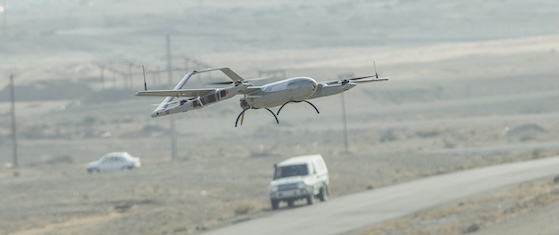
UN humanitarian chief Tom Fletcher on Aug. 29 warned that the recent rise in the use of drones poses a risk for aid operations in multiple conflicts around the world. He emphasized that international humanitarian law, which prohibits attacks on humanitarian workers and civilians, continues to apply to drone warfare regardless of how sophisticated or autonomous the weapons become.
Fletcher, the UN Under-Secretary-General for Humanitarian Affairs and Emergency Relief Coordinator, spoke during a visit to Ukraine for World Humanitarian Day. After two days in Kherson, he described the city as “saturated by the use of drones against civilian areas.” He said that humanitarian workers as well as civilian residents live under the constant peril of these weapons.
Fletcher observed that as remote pilots move farther from their victims, so do accountability and justice. He also recounted a visit to a hospital where 70% of wounded patients were drone survivors, and how he witnessed the aftermath of a drone strike on Kherson Hospital.
In a video posted to X while driving the road from Mykolaiv to Kherson—known locally as the “Road of Death” because of the frequent Russian drone strikes—the UN official remarked that “easily available means to kill are outstripping accountability.”
Data from the UN Human Rights Monitoring Mission in Ukraine shows a sharp rise in civilian harm. In July 2026, the estimated 437 civilians killed and 2,610 injured made up the highest monthly toll since May 2022. Missiles and drones accounted for 38% of the casualties, with drones alone responsible for more than a fourth of causalities.
While not the deadliest weapons in terms of overall toll, drones have contributed disproportionately to the recent surge in non-combatant casualties. Drones are cheap and flexible, allowing strikes both near and far from the front lines.
Although drone technology is changing “every week” on both sides of the conflict, Fletcher stressed that “what doesn’t change or must not change each week is international humanitarian law.”
Russia has used drones extensively against Ukrainian energy infrastructure and civilian areas since the start of the full-scale war in February 2022. Ukraine has also conducted large-scale drone strikes deep into Russian territory, reflecting an expansion of its own drone capabilities, mostly targeting military and infrastructure sites inside Russia.
While the situation in Ukraine is particularly acute, Fletcher noted that armed drones are transforming warfare in multiple conflicts, citing Sudan, Somalia, Gaza, Lebanon and Colombia. In these places, drones have become a major cause of civilian casualties and threat to humanitarian work. Pursuant to Article 36 of Additional Protocol I to the 1949 Geneva Conventions, new weapons must be evaluated to ensure that they are in compliance with international humanitarian law and ensure full civilian protection.
From JURIST, Aug. 21. Used with permission.
See our last report on Russian war crimes in Ukraine.
27).jpg”>Wikimedia Commons


Autonomous weapons prompt renewed push for binding global rules
The growing use of autonomous and AI-guided weapons on the battlefield prompted the UN and International Committee of the Red Cross (ICRC) on Aug. 25 to call for a legally binding international agreement governing their manufacture and deployment. (Jurist)
Russian bombs kill at least 43 in attack on Ukrainian aid center
Russian guided bombs struck a former school serving as a humanitarian aid distribution centre in Ukraine’s southeastern Zaporizhzhya region Nov. 2. Ukrainian officials say subsequent attacks targeted an underground shelter where civilians had sought refuge, killing at least 43 people in total and trapping dozens under rubble. Russia claimed it was targeting Ukrainian military units, while the head of the UN human rights monitoring mission in the country said the attacks “seems to have violated the most fundamental principles of international humanitarian law.”
The attacks came one day after the expiration of a six-day humanitarian ceasefire facilitated by US First Lady Melania Trump. The ceasefire was limited to the town of Oleshky, in the Kherson region. On Nov. 5, two days after Republicans lost control of both chambers of Congress in the midterm elections, Melania hosted Russian and Ukrainian officials in a rare in-person meeting, urging them to build on the Oleshky ceasefire. (TNH)