


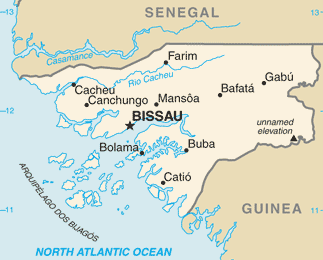
UN Secretary-General António Guterres condemned the military coup in Guinea-Bissau that took place just days after national elections, saying that it gravely violates constitutional order and democratic principles. The African Union Commission similarly condemned the coup, while the Economic Community of West African States (ECOWAS) suspended Guinea-Bissau from the organization’s decision-making bodies until there is a full restoration of constitutional order.
The presidential election, pitting incumbent Umaro Sissoko Embaló against his main rival Fernando Dias, took place on Nov. 23. Three days later, both Embaló and Dias declared victory before the release of official results. The military then announced that it had taken “total control” of the country in the name of a “High Military Command for the Restoration of Order,” just a day before the National Elections Commission was scheduled to release the official results.
Embaló was arrested at his presidential office ahead of the military announcement. On Nov. 27, Maj-Gen. Horta Nta Na Man was sworn in as transitional president for a one-year term after the military formally removed Embaló from his position. The ousted Embaló later arrived in Senegal, with Senegalese Prime Minister Ousmane Sonko calling the military coup a “sham.”
This latest military takeover reflects a pattern of instability in Guinea-Bissau since the country gained independence from Portugal in 1974. It follows a long string of coups and coup attempts, most recently in 2023.
Guinea-Bissau also ranks first among African countries in the cocaine trade. Experts have argued that “the deep-rooted involvement of Guinea-Bissau’s political-military elite in this illicit market has been a critical factor driving Guinea-Bissau’s repeated cycles of political turmoil.” In his inaugural speech, transitional president Nta Na Man justified the military takeover as necessary to thwart a plot by “narco-traffickers” to destabilize the country.
From JURIST, Nov. 29. Used with permission.
Note: Government efforts to crack down on the narco trade are believed to have prompted previous coups d’etat in Guinea-Bissau.
See our last reports on the coups d’etat and consolidating dictatorships in West Africa.
Map: PCL


UN protests repression in Guinea-Bissau
The UN Office of the High Commissioner for Human Rights (OHCHR) on Dec. 26 released a statement calling upon authorities in Guinea-Bissau to bring an immediate end to arbitrary detentions and growing instances of intimidation in the country, warning that the reported abuses undermine fundamental freedoms and may in some cases amount to enforced disappearance. The call followed the authorities’ decision to release six opposition figures from government custody on Dec. 23, which the OHCHR called an “encouraging step” while remaining adamant that “more needs to be done.”
Among those released by the High Military Command (HMC), which led the Nov. 26 coup d’état and seized control of the West African country, are Nhossa Vítor da Silva, Vítor António Oliveira, Paulo Pier Có, Ernesto Ié, António da Costa, and Januário Gomes Betunde. The individuals were close associates of Domingos Simões Pereira, the head of the African Party for the Independence of Guinea & Cape Verde (PAIGC), and had been detained for 28 days in the cells of a local police station. A communiqué released by the HMC asserted that their release serves as proof of the military junta’s “irrevocable commitment” to an orderly transition process, that “prioritises the supreme interest of the Guinean nation.”
Other detainees currently still being held in the same facility include leaders Pereira, Octávio Lopes, and Marciano Indi from the PAIGC, and Roberto Mbesba from the Social Renewal Party (PRS). According to the HMC communiqué, further releases will occur gradually, based on “national reconciliation” and in accordance with preserving the greater interests of peace, security, and the maintenance of public order in the country.
he OHCHR insisted, however, that the release ought to be followed by concrete action to be considered as “moving the needle” in a significant manner. The UN’s warning also echoes the shared sentiments from the broader international community, with regional bodies such as the African Union and foreign partners impressing upon Guinea-Bissau’s acting authorities the importance of restoring the rule of law. (Jurist)