


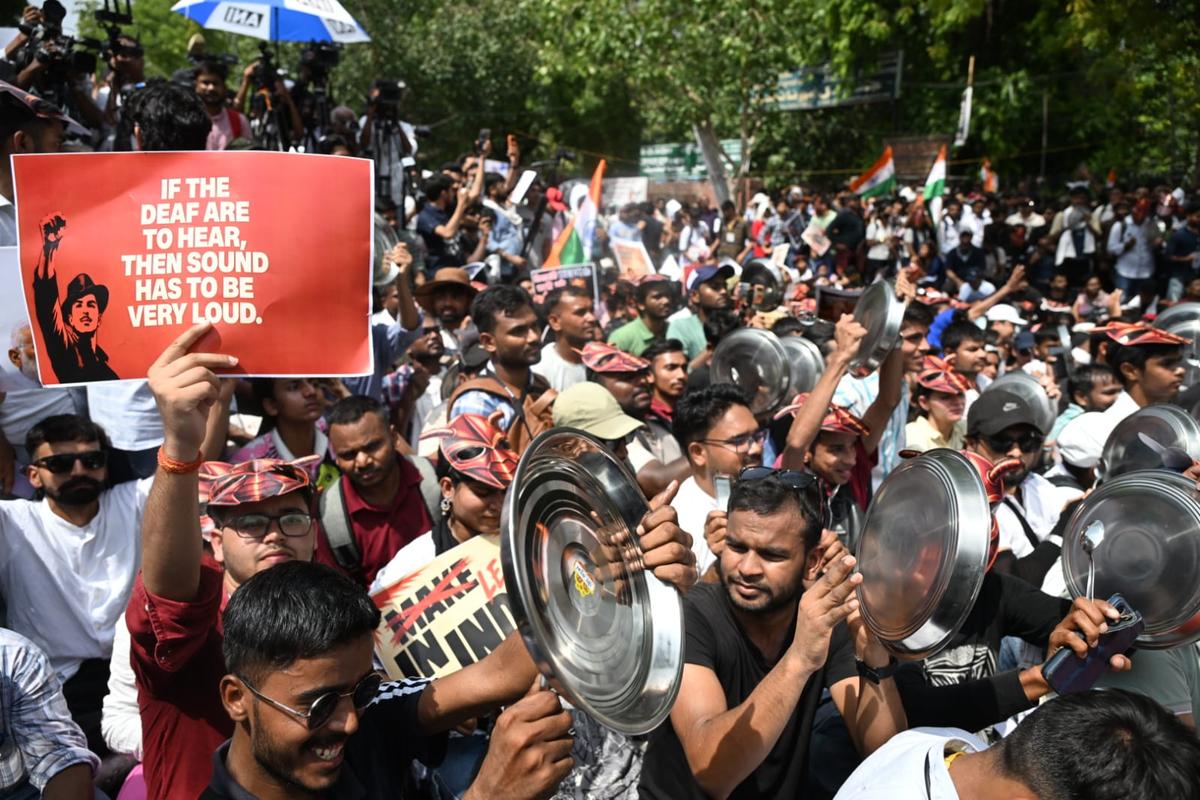
Amnesty International condemned the July 15 decision of Delhi’s lieutenant governor to invoke Section 3(2) of India’s National Security Act (NSA), which effectively grants police the power to hold individuals in administrative detention without procedural guarantees.
The decision to invoke this section of the NSA comes amid mass youth protests in India, led by the Cockroach Janta Party (CJP), demanding accountability over apparent examination paper leaks that affected millions of students. The protests began in May after the answers to India’s medical school entrance exam, known as the National Eligibility cum Entrance Test—Undergraduate (NEET-UG), were leaked, leading to more than 2 million students needing to re-take the test.
Following extension of the invocation of Section 3(2) of the NSA until Oct. 18, Aakar Patel, chair of Amnesty International India, stated:
This deeply concerning move is an affront to human rights that risks enflaming the situation in Delhi even further. It grants the police a host of discretionary powers to detain people for entirely arbitrary reasons for up to 12 months. Fair trial rights guaranteed under international human rights law are essentially suspended, as detainees are denied legal representation and do not have to be informed of the grounds of their detention for up to 15 days.
Delhi police claim that this a routine administrative measure, but Patel pointed to previous times Indian police have abused this power, such as during the protests against the Citizenship Amendment Act in 2020 and the 2026 workers’ protests in Noida. The examination paper leaks have resulted in extreme distress among test-takers who had spent years preparing for the grueling exam, leading to at least 20 students committing suicide.
The CJP protests ultimately forced the government to accede to their demands, including a five-point exam reform charter and adequate compensation to the affected families. At the height of the protests on July 20, Delhi police used tear-gas and batons against protestors as they attempted to march towards India’s parliament.
The movement emerged after the Chief Justice of India, Surya Kant, made derogatory remarks about student protesters, dismissing them as “unemployed youths…who attack the legal system,” and even going so far as to call them “cockroaches.”
Under the NSA, police can detain persons without charge based on the suspicion that they might carry out an activity that undermines public order or national security. Once detained, such individuals have no right to legal representation before the three-member Advisory Board that reviews the grounds on which their detention was ordered.
The NSA has been widely criticized as a contravention of Article 9 of the International Covenant on Civil & Political Rights (ICCPR), which guarantees the right to liberty and security of person, as well as Article 14 of the ICCPR, which guarantees the right to fair trial.
From JURIST, July 27. Used with permission. Internal links added.
See our last report on the Gen Z revolutions.
Photo: Pelph Hoters via Wikimedia Commons


