

HAITI: HIDDEN COSTS OF THE INDUSTRIAL ZONE

by David L. Wilson, World War 4 Report

On Oct. 22 Haitian president Michel Martelly hosted the official opening of the Caracol Industrial Park, a 617-acre tax-exempt factory complex in Haiti’s rural northeastern corner that promoters say will bring as many as 65,000 jobs to the country.

The Haitian president was joined by an array of foreign officials and celebrities. The United States, which invested $124 million in the project, was represented by Secretary of State Hillary Clinton, Labor Secretary Hilda Solis, and Senator Patrick Leahy (D-VT). Another guest, former US president Bill Clinton, now the United Nations special envoy for Haiti, was a major promoter of the Caracol facility.

Continue ReadingHAITI: HIDDEN COSTS OF THE INDUSTRIAL ZONE 

YEAR TWO OF THE ARAB REVOLUTIONS

by Kevin Anderson, US Marxist-Humanists

Beset by the twin dangers of Islamism and nominally secular authoritarianism, the Arab revolutions continue to shake up the region as they move through their second year. This essay, which first appeared in Logos, Vol. 11, Issues 1-2 (Spring-Summer 2012), is based upon a presentation to a Convention of the International Marxist-Humanist Organization in Chicago on July 14, 2012 — Editors

Continue ReadingYEAR TWO OF THE ARAB REVOLUTIONS 

THE BABAR AHMAD CASE: DO U.S. PRISONS VIOLATE EUROPEAN HUMAN RIGHTS LAW?

An interview with Hamja Ahsan and Aviva Stahl

by Angola 3 News

On April 10, the European Court of Human Rights (ECHR) issued judgement in the case of Babar Ahmad and Others v The United Kingdom, making a landmark ruling on the legitimacy of solitary confinement, extreme isolation and life without parole in US supermax prisons. The ECHR denied the appeal filed jointly by six appellants, consisting of four British nationals (Babar Ahmad, Haroon Rashid Aswat, Syed Talha Ahsan, and Mustafa Kamal Mustafa AKA Abu Hamza), an Egyptian national (Adel Abdul Bary) and a Saudi Arabian national (Khaled Al-Fawwaz), who have been imprisoned in the United Kingdom, pending extradition to the United States for alleged terrorism-related activities.


Continue ReadingTHE BABAR AHMAD CASE: DO U.S. PRISONS VIOLATE EUROPEAN HUMAN RIGHTS LAW? 

INDIGENOUS NASA RESIST MILITARIZATION IN CAUCA, COLOMBIA

by Gina Spigarelli, FOR Colombia

On July 11, the indigenous Nasa of Cauca, Colombia began confronting armed groups face to face and peacefully asking them to leave Nasa territories. They removed police trenches from the urban center and disassembled homemade FARC missiles found on their lands. Four hundred Nasa members occupied and observed army soldiers on the sacred indigenous site of El Berlin outside of Toribío, where the army is protecting private cell phone company towers.

On July 16, when the military had yet to retreat from indigenous lands by the proposed deadline of the previous day, the Nasa forcibly removed troops from El Berlin’s mountaintop base. Dramatic photos of the event splashed across national and international news, some featuring members of the Nasa indigenous community surrounding several soldiers, picking them up, and moving them away from their posts and others featuring crying Colombian officer Sergeant Garcia, retreating from the encampment.

Continue ReadingINDIGENOUS NASA RESIST MILITARIZATION IN CAUCA, COLOMBIA 

THE WAL-MART CORRUPTION CASE: INNOCENTS ABROAD?

by David L. Wilson, World War 4 Report

On April 22 the New York Times ran a major article by reporter David Barstow revealing that Wal-Mart’s Mexican subsidiary paid more than $24 million in bribes to fuel the remarkable growth of its stores—and that top Wal-Mart executives in the United States tried to cover up the criminal activity.

The US media were quick to provide “context” for the scandal. Corruption is endemic in Latin America, we were told; Transparency International rated Mexico number 100 out of 183 countries in its 2011 index on perceived levels of corruption. “The scandal tells you that doing business in the world’s fastest-growing markets can be fraught with peril,” Time magazine wrote. “[G]raft is not necessarily perceived as a serious crime in some places. It’s more a way of doing business.” The Times downplayed its own excellent investigative reporting by explaining that in Mexico “bribery and other forms of corruption are taken in stride.”

Continue ReadingTHE WAL-MART CORRUPTION CASE: INNOCENTS ABROAD? 

TIBET & ASSAM: PAWNS IN INDIA-CHINA GAME

by Nava Thakuria, World War 4 Report

Tibetan exiles in India’s restive northeast have become increasingly vocal, with a series of recent public meetings and protests in Assam state, demanding liberation for their homeland just across the Sino-Indian border to the north. But Assam itself is home to a separatist movement, with the United Liberation Front of Asom (ULFA) waging a sporadic insurgency that has brought waves of harsh repression from New Delhi over the years. While the Tibetan exile leadership remain silent on Delhi’s crackdowns in Assam, the ULFA increasingly looks to China as a patron and supports Beijing’s position on Tibet—with movements for autonomy across the disputed border pitted against each other.


Continue ReadingTIBET & ASSAM: PAWNS IN INDIA-CHINA GAME 

SYRIA: THE MYTH OF PALESTINIAN NEUTRALITY

by Budour Hassan, Ma’an News Agency

On July 14, thousands of Palestinian refugees marched in a funeral procession for 11 unarmed protesters shot dead by Syrian security forces in the al-Yarmouk refugee camp. Raucous and seething with rage, mourners chanted for Syria and Palestine, called for the downfall of Bashar Assad’s regime, and sang for freedom.

Whether this burgeoning civil disobedience movement will grow into an open, durable rebellion remains to be seen, but the significance and the potential influence of the latest wave of protests that has swept Syria’s largest Palestinian camp cannot be overlooked.


Continue ReadingSYRIA: THE MYTH OF PALESTINIAN NEUTRALITY 

ISRAEL AND IRAN: PROTESTERS UNITE FOR PEACE

Enmity From Above, Amity From Below

by Richard Abernethy, US Marxist-Humanists

On one level, the threat of war between Israel and Iran is a real conflict, a struggle between two state powers for dominance in the Middle East. On another level, each set of rulers finds in the other a “useful enemy,” an external threat that appears to validate its ideology, and consolidate its rule at home.

In both countries, there is a body of enlightened opinion that opposes the rulers’ drive toward war. In an extraordinary new development, Israeli and Iranian dissidents have come together, first over the Internet and more recently in person in Berlin, to oppose the drive to war.


Continue ReadingISRAEL AND IRAN: PROTESTERS UNITE FOR PEACE 

QUEBEC INNU PROTEST PLAN NORD

by Alexis Lathem, Toward Freedom

On the morning of June 10, a group of Innu people from the community of ManiUtenam, near the Quebec city of Sept Isle, set out on a 360 kilometer march towards a Hydro Quebec dam construction site on the Romaine River. Dressed in florescent vests, they departed from an encampment at the entrance to the reserve, beside Route 138, the only major road in the region, where the group has maintained a continual protest since the end of April.

Impossible to miss as vehicles pass along the route, the encampment strikingly asserts the presence of the Innu—who have been consistently ignored by governments and developers as they continue to encroach upon Innu territory.


Continue ReadingQUEBEC INNU PROTEST PLAN NORD 

The Change is Coming…

Dear Readers:

We’ve been holding out our big redesign for months now, but it really is going to happen this summer. We also need to find a new host, so if any readers can recommend one, please get in touch.

After the redesign, we will be holding another fund-drive to pay for it. If any readers wish to give us a head start, you know what to do. We will point out that our winter fund drive goal of $5,000 was dropped to $2,000 just to get it over with. So if anyone wants to help make up the difference now, that would be a big help.

As you may have noticed, World War 4 Report was in Peru in March, covering the peasant struggle against mea-scale mining projects. The world is paying little note, but angry peasant and indigenous protests in defense of land, water and autonomy are spreading across the Andes now, from Chile to Colombia. World War 4 Report is providing the most consistent, in-depth coverage of these struggles available in English. If you think this work is important, please let us know.

Since we will probably be switching to a more web-friendly ongoing feature roll, this should really be the last “issue” of our e-magazine. Do you think this is a good move? Even if you can’t make a monetary donation, be in touch with your ideas and criticisms on our work and direction.

We need your support, and your feedback.

Thank you, shukran and gracias,

Bill Weinberg

Send checks payable to World War 4 Report to:

World War 4 Report
121 Fifth Ave. #172
Brooklyn, NY 11217

Or donate by credit card:

Write us at:

feedback (a) ww4report.com

Continue ReadingThe Change is Coming… 

INDIA: PASSIVE RESISTANCE TO MEGA-HYDRO IN ASSAM

by T Navajyoti, World War 4 Report

In Northeast India, which has faced decades of unrest, energy has emerged as a critical issue for the region’s popular movements. The state of Assam particularly has witnessed a series of sustained demonstrations against large river dams, with farmers’ associations, student organizations and civil society groups campaigning tirelessly. But lobbying for big dams is also going on in full pace.

The recent hunger strike by the popular anti-dam activist Akhil Gogoi in Guwahati, Assam’s major city, won much public support. The Indian government’s plans to build some 150 large dams on tributaries of the Brahmaputra River in Arunachal Pradesh, bordering Assam on the north. The tributaries flow down from the Himalayan foothills of Arunachal Pradesh into the plains of the Brahmaputra Valley in Assam. The government hopes to generate 60,000 mega-watts from these dams—a dramatic increase over the 1,700 mega-watts now generated. But Assam’s farmers fear the downstream impacts.

The protesters argue that the geo-seismic situation, and the fragile state of the eastern Himalayas’ erosion-prone mountains and silt-laden rivers should be taken into consideration before approval of these mega-hydroelectric projects. Akhil Gogoi— general secretary of Krishak Mukti Sangram Samity (KMSS) peasants’ organization, and a close comrade of Anna Hazare, the social activist who held a hunger strike against corruption in Delhi last year—started his indefinite hunger strike on May 19 at Lakhidhar Bora Kshetra, the central government building in Guwahati, demanding the immediate halt in construction of all mega-dams. Gogoi was transferred by the authorities to Gawahati Medical College Hospital on May 25 as his health condition deteriorated. He maintained his fast in the hospital bed till May 28 but finally broke his fast following the request of Anna Hazare. Speaking to Gogol by phone in the hospital, Hazare argued that his health was more important than his martyrdom for the anti-dam movement across the country.

Another leading Team Anna member, Arvind Kejriwal, addressed a huge public rally in the city, where he slammed both Assam and Arunachal Pradesh governments for what he called an anti-people attitude, caving to the big dam lobbies to exploit the region’s hydroelectricity potential without accountability. He also condemned the Delhi government for its insensitive approach to the livelihood of millions of indigenous people in the country.

Kejriwal clarified that he is not against river dams. But the projects must not be at the cost of the local people and ecology of any region. The government must not impose such projects without peoples’ participation and consent. Kejriwal received support from National Alliance of People’s Movements (NAPM). In a statement issued with 20 other local organizations, NAPM hailed “Akhil’s brave struggle for life with dignity and against unjust destructive capitalist development thrust upon people against their will.”

The statement said “NAPM supports all demands raised by KMSS including in halting the construction of all mega dams till an agreement is formalised with the people living in the downstream, releasing all the detained activists unconditionally and also allowing the protesters to pursue their democratic agitations.”

However, addressing a seminar on May 25 in the State capital, T Norbu Thongdok, parliamentary secretary to Arunachal Pradesh Public Works Department, argued that “the dams for producing hydro-power are constructed using best of scientific technologies to maximise power production and minimise its hypothetical negative impacts that is being spread throughout the State and neighboring Assam.”

Delivering his inaugural address in the seminar, organised by Indian Chamber of Commerce (ICC) in association with Arunachal Pradesh Energy Development Agency (APEDA) and North Eastern Electric Power Corporation Limited (NEEPCO), the parliamentary secretary also stressed the criticality of energy for the sustainable growth of the nation.

The bureaucrat-turned-politician Thongdok stated that “power is the most important contributing factor of a developed state, so…we should explore all possible avenues to produce power. Since the deposits of fossil fuels are depleting alarmingly, we must conserve energy by making optimum use of it for the future of our nation.” He asserted that harnessing solar, hydro and wind energy is the best option for clean, cheap power.

The seminar emphasised that Arunachal should be energy-efficient by producing adequate power through multiple ways. However, a few speakers also advocated for preserving the state’s natural bio-diversity.

In Assam, KMSS with a number of peasant groups, ethnic organizations and student associations are engaged in a prolonged protest campaign to prevent the National Hydroelectric Power Corporation from carrying construction materials to the 2,000-megawatt Subansiri hydro-electric project site at Lakhimpur on the Assam-Arunachal border, the first of the planned dams. The protests have been ongoing in the area since December 26, 2011.

KMSS claims that the indigenous people of the region must have the right to use of its natural resources, including the rivers. It charges that the government seeks to exploit these resources for the selfish interests of big companies—without any consultations with the people.

Assam’s chief minister Traun Gogoi insists that work on dams will go on irrespective of protests. He even ruled out any
dialogue with Akhil Gogoi during his hunger strike, terming it “anti-development.”

There is no denying of the fact that the ongoing resistance to large river dams has turned into a popular movement in Assam. The activists and their sympathizers are unanimous in their views that the proposed mega hydro-electricity projects in Assam and Arunachal Pradesh would leave a devastating impact on the region, as well as in Bangladesh. They charge that several large hydropower projects were granted “green clearance” without any prior downstream impact assessment by the environment ministry in New Delhi.

—-

From our Daily Report:

Hydro-hubris threatens peace efforts on India-Burma borderlands
World War 4 Report, April 27, 2012

Arunachal Pradesh: pawn in the new Great Game
World War 4 Report, Oct. 17, 2009

Bangladesh Rifles mutiny militarizes India border
World War 4 Report, Feb. 28, 2011

See also:

GUATEMALANS RESIST MEGA-MINES, HYDRO-DAMS
by Nathan Einbinder, Environment News Service
World War 4 Report, December 2008

WHO IS BEHIND THE ASSAM TERROR?
Converging Conflicts in Northeast India
by Nava Thakuria, World War 4 Report
World War 4 Report, April 2009

——————-
Special to World War 4 Report, June. 20, 2012
Reprinting permissible with attribution

Continue ReadingINDIA: PASSIVE RESISTANCE TO MEGA-HYDRO IN ASSAM 

LEFT-LIBERTARIANS: THE LAST OF AN ANCIENT BREED

by Bill Weinberg, The Villager

Last year, I was approached by Peter Lamborn Wilson—the elusive underground intellectual who is a refugee from the Lower East Side—who beseeched me to revive the Libertarian Book Club.

Revolution was shaking the Arab world, although the wave had not yet come to Europe, Wall Street and Oakland. At this propitious time, New York City’s oldest anarchist institution could not be allowed to die, I was implored.

We had worked together in the LBC for years, before Peter left the city and the Book Club became moribund. Old members were getting older, and we lost our longtime office at 339 Lafayette Street, the notorious “Peace Pentagon” run by the pacifist AJ Muste Institute. But more significant, ultimately, was our identity crisis.

The LBC was founded (to the best of anyone’s reckoning) in 1946, by anarchist exiles from fascist Europe, mostly Jews and Italians. At that time, the word “libertarian” was basically synonymous with “anarchist” or “anti-authoritarian”—although with a more intellectual and perhaps slightly euphemistic ring. One of the founders, Jack Frager, had actually known Emma Goldman, so we could claim an unbroken lineage back to the “classical” era of revolutionary anarchism.

Jack was gone before my time, but I did know Valerio Isca—the last of the old-timers. Walking with a cane, in his trademark black beret, he rarely said a word. But I was privileged once to hear him boast in broken English, his face beaming, about how he had fought followers of Mussolini’s Black Shirts in the streets of Brooklyn in the ’30s. He died in 1996. (The words of these heroes can be read in the classic of oral history, Anarchist Voices, by the late Paul Avrich of Queens College, himself a longtime friend of the Book Club.)

I gravitated to the Book Club as a young aspiring radical seeking a sense of heritage and continuity with my forebears, back in the ’80s. I was on the tail end of a “second wave” of New Left types, neo-hippies and anarcho-punks who were revitalizing the LBC at this time. With Workers Solidarity Alliance, a sibling organization dedicated to the principles of anarcho-syndicalism, we moved into the office at 339 Lafayette. Peter Wilson, then producing the Moorish Orthodox Radio Crusade on WBAI, became our new leading light.

Although the Book Club had actually printed a few books over the years, its primary activity was by then a monthly discussion series, hosted by the lefty Jewish fraternal organization Workmen’s Circle in the rec room of one of the Penn South houses.

It was also at about this time that some of the younger members (myself included) began protesting that the word “libertarian” had been appropriated by the free-market right, and sent the wrong message about who we were. Eventually, we decided on a compromise: the ongoing discussion series would be dubbed the Anarchist Forum, while—in stubborn deference to the past—the organization holding the event would continue to be the Libertarian Book Club.

The years of my involvement with the LBC saw the 1988 Tompkins Square Park riot, and subsequent backlash of squatter evictions and gentrification on the Lower East Side; the 1989 revolutions in Eastern Europe, shortly followed by capitalist restoration; the 1994 Zapatista rebellion in Mexico, which I witnessed first-hand as a journalist; the 1999 Seattle protests against the World Trade Organization, and ensuing anti-globalization campaigns. Despite the hopes represented by Chiapas and Seattle, the general trajectory of society worldwide was to the right—and there was a growing sense that anarchism, especially, was an irrelevant ideological artifact.

Not surprisingly, the LBC’s real decline began after 9-11, with its unleashing of paranoia and war fever. By then, we had lost our meeting space as Workmen’s Circle moved out of the Penn South complex. For a while, we met at the Brecht Forum (a.k.a. the New York Marxist School) in the West Village, and at the Living Theater on Clinton Street. But sometime around five years ago, the Anarchist Forum sputtered out. The Muste Institute, facing the prospect of expensive repairs on the old building at Lafayette Street, rightly requested that we vacate the office.

Last year, at Peter’s urging, the Anarchist Forum rose from the ashes (now office-less, in the age of social media). I organized three discussions, back at the Brecht Forum space. I spoke about anarchist perspectives on the Libyan war and the Arab Spring; Peter gave a talk on the poignant question, “Does Anarchism have a Future in the 21st Century?” And we gave a focus-group screening for Wall Street Occupiers of the soon-to-be-released film Who Bombed Judi Bari?—on the 1990 terror attack in California on ecological defenders struggling to protect some of the last old-growth redwoods from the timber barons.

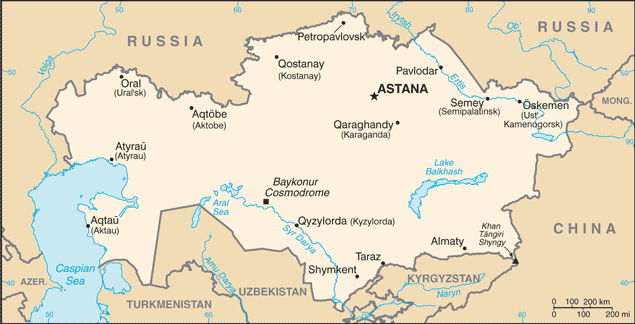
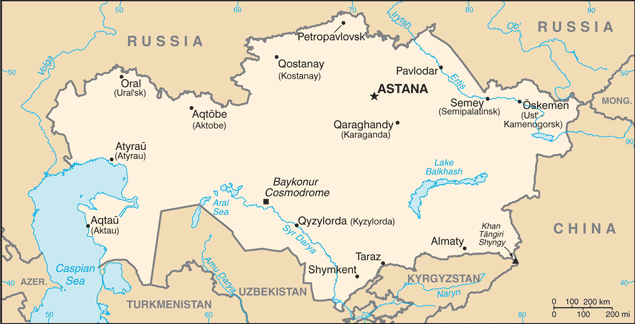
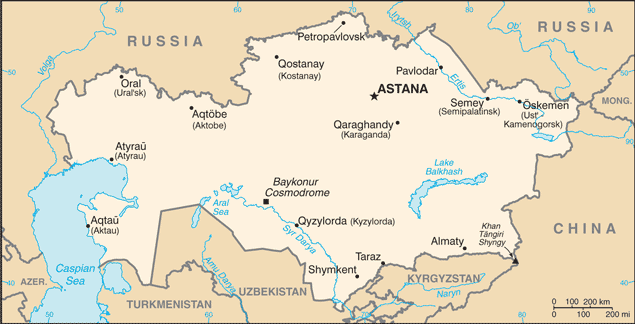
Today, when I look at the generic masked protester featured as “Person of the Year” on the cover of Time magazine, I see the anarchist instinct—if not quite the ideology—re-emerging on the world stage. Even anti-capitalism—officially anathema since the fall of the Soviet bloc—is back in popular discourse. Economic grievances (despite the best efforts of the Western media and politicians to obscure this) animated the protests in the Arab world; the wave that began in Tunisia a year ago has swept through Athens, Madrid and Barcelona, London and Birmingham, and finally Manhattan, Oakland and nearly every city in the US. Industrial actions and peasant protests rocked China’s Guangdong province, police massacred striking oil workers occupying a public square in Kazakhstan, and rent protesters erected a street encampment for weeks in downtown Tel Aviv. Students protesting budget cuts repeatedly shut down Santiago and Bogotá. At year’s end, mass protests over contested elections broke out in Russia. And, with several Arab dictators overthrown, the uprisings continue in Syria, Yemen, Egypt and Bahrain. Nigeria appears to be next.

This made it all the more frustrating to see partisans of the “libertarian” Republican presidential hopeful Ron Paul maintaining a prominent (if, one hopes, unrepresentative) presence at Zuccotti Park. On the Net, Paul won enthusiasm from leftist talking heads for his anti-war and civil libertarian rhetoric.

There is, of course, a legitimate right-libertarian tradition that takes its tip from Friedrich Hayek and Ludwig von Mises rather than Emma Goldman and Alexander Berkman. But Ron Paul’s positions aren’t even as progressive as those of the Libertarian Party on issues like abortion and immigration. The Libertarian Party at least has a consistent position on personal freedoms, while Paul says he wants to see Roe v. Wade overturned and birthright citizenship expunged from the Constitution. If Paul and his supporters don’t believe in fundamental freedoms like reproductive rights and birthright citizenship, they shouldn’t call themselves “libertarian.” They give the word a bad name.

They seek to restrict rights for women and immigrants, and it makes little difference if the oppressor is Arizona or Alabama rather than the federal government in their “state’s rights” utopia. (Paul has even said he would overturn the Civil Rights Act!) Their “freedom” too often means the “freedom” of the states to deny others their freedom. For those outside the propertied, disproportionately white elite, their utopia would be completely dystopian.

Apart from the inconsistencies on civil liberties issues, the economic prescriptions of the Paulistas would be utterly oppressive for the fabled 99%—the dismantling of OSHA and the EPA; the abolition of the federal minimum wage, Medicare, Medicaid, welfare and public education; the sale of the national parks to oil companies. Et cetera.

Left-wing anarchists—libertarian socialists, in the more polite formulation—make no distinction between authoritarian power exercised by state or federal bodies, through governmental or economic means. A landlord, banker or industrialist owns the lives of his wards (tenants, debtors, employees) no less than a public-sector bureaucrat. The state is an entity of capitalism, and you can’t struggle against one without struggling against the other. An unheeded lesson of the Cold War is how state “socialism” inevitably degenerates into capitalism.

We seek inspiration in such historical episodes as the Zapatistas in Mexico (1910-19), Makhnovists in the Ukraine (1917-21), Spanish anarchists in Catalonia (1936-7), and Zapatistas in Mexico again (1994-date)—peasants and workers who took back the land and the factories, building socialism from below, without commissars or politburos.

But nor (we hope) are we mere history buffs or impractical dreamers. Contrary to the right-wing libertarians, we recognize that as long as we live under capitalism, individual liberties are best served by massive public restraints on its workings. This need not be seen as reformism or an abdication of revolutionary aspirations. The British Marxist historian EP Thompson wrote of a principle of “moral economy“—the pressure that common people can bring to wrest a better deal from the system. New York tenants certainly understand this about rent control laws—or they should, anyway.

There can be unity between left and right libertarians around issues of personal freedom—opposing the surveillance state, Internet censorship, the war on drugs. In fact, a few right-libertarians (albeit, the long-haired, cannabis-smoking type) did gravitate to the LBC in the ’80s. And some of the books the LBC published were written by co-founder Enrico Arrigoni, an Italian veteran of the Spanish Civil War, who became an “individualist” in reaction against Stalinism.

But politicians like Paul shouldn’t be allowed to usurp the “libertarian” label—and the left-libertarian tradition shouldn’t be erased from history. The memory of fighters like Valerio Isca should not be allowed to die.

More than that—can the left reclaim the libertarian legacy from the right? With Occupy Wall Street, the left has very effectively taken back the populist imperative from the right, which had cornered the political protest market with the Tea Party. Now its challenge is to take back the libertarian imperative—to reclaim the mantle of freedom.

A part of the problem is that the face of the “left” in New York City (and much of the country) has long been dominated by neo-Stalinist and utterly authoritarian outfits like the Workers World Party (operating through front groups like the International Action Center), which avidly cheer on dictators who affect an anti-US pose, and cynically use popular movements for party-building. (They are making a particular play for OWS right now through an “Occupy 4 Jobs” campaign.) Not surprisingly, they are thoroughly compliant with the increasingly draconian NYPD control of street protests behind metal barricades.

A libertarian left movement wouldn’t have to adhere rigidly to 19th century anarchist dogmas. But it would have to be fundamentally serious about freedom—rooting for the protesters, not the despots, in Syria and Iran and China and Russia; unequivocal on “libertine” or “lifestyle” issues like (yes) cannabis legalization; testing the limits of police control rather than acquiescing in it; and functioning (as OWS does) with an ethic of internal democracy.

I don’t know if the Libertarian Book Club’s Anarchist Forum series will resume in 2012. But, for the sake of humanity’s future, the libertarian left tradition deserves a political renaissance. And now, for the first time in my conscious life, I think it stands a fighting chance to get one.

—-

This story first ran, in slightly edited form, Jan. 19 in New York’s The Villager.

From our Daily Report:

Left media establishment lords it over Occupy movement
World War 4 Report, Feb. 8, 2012

“Anonymous” hack of neo-Nazi A3P reveals Ron Paul link!
World War 4 Report, Feb. 1, 2012

OWS: Yes, we are anti-capitalist!
World War 4 Report, Nov. 6, 2011

——————-

Reprinted by World War 4 Report, Feb. 1, 2012
Reprinting permissible with attribution

Continue ReadingLEFT-LIBERTARIANS: THE LAST OF AN ANCIENT BREED