


The UN Office of the High Commissioner for Human Rights (OHCHR) warned Nov. 28 that the Burma military junta’s planned elections could only worsen repression and instability rather than restore democracy. OHCHR spokesperson Jeremy Laurence described the elections, scheduled for Dec. 28, as a military-controlled process conducted in an environment “rife with threats and violence.” He stated: “Far from leading a political transition from crisis to stability or restoring democratic and civilian rule, this process will almost certainly deepen insecurity, fear, and polarization throughout the country.”
James Rodehaver, the head of OHCHR’s Myanmar (Burma) team, highlighted the dilemma facing civilians, noting that the military pressures citizens to vote while armed opposition groups threaten retaliation for participating. Although the junta claims to have pardoned 4,000 individuals convicted of sedition, Rodehaver said that only around 550 have been verified as released, with many subsequently rearrested. Authorities have detained over 100 individuals under new “election protection rules,” including three youths sentenced to 49 years in prison for displaying posters featuring a bullet-pierced ballot box.
Rodehaver also raised concerns about the electronic-only voting system, which relies on AI and biometric surveillance, further eroding trust in the electoral process. Large parts of the country remain beyond military control, making credible elections infeasible. Elections will not occur in 56 townships under martial law, and in 31 townships, voting will not take place at all. Discrimination also looms large in the electoral process, with Rohingya, Tamils, Gurkhas and Chinese, among other minorities, effectively excluded from voting.
The UN Special Rapporteur for Myanmar, Tom Andrews, labeled the elections a “charade” in his October report, urging the international community to “unequivocally reject” them. Andrews criticized the junta’s reforms as merely “cosmetic” and aimed at preserving military dominance. Since the February 2021 coup, the junta has detained over 30,000 political opponents, including former leader Aung San Suu Kyi. Authorities have dissolved at least 40 parties, including Suu Kyi’s National League for Democracy (NLD).
Burma’s electoral framework spurs concerns for international law. Article 25(b) of the International Covenant on Civil and Political Rights (ICCPR) guarantees every citizen the right “to vote and to be elected at genuine periodic elections” conducted by universal and equal suffrage, by secret ballot, and in an atmosphere of free expression.
Last month Human Rights Watch also urged global leaders to denounce Burma’s military junta and its planned elections, describing the process as a “sham.” HRW further recommended that states intensify diplomatic isolation of the nation’s military rulers and increase humanitarian and refugee assistance.
Critics of the electoral process in Burma have been arrested and sentenced to hard labor. Elections initially scheduled for August 2023 were postponed, with the junta instead extending the state of emergency.
From JURIST, Nov. 29. Used with permission. Internal links added.
Note: This report originally used the country’s new rendering of Myanmar. We changed it to Burma in conformity with our style, which we explain here.
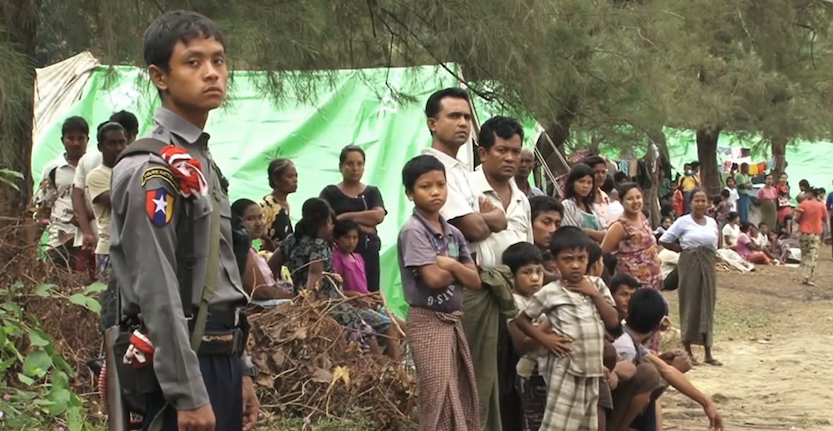
Photo: Burmese Border Guard officer with IDPs in Rakhine state. Credit: Daniel Schearf & Zinlat Aung/VOA via Wikimedia Commons


Burma junta pardons thousands of prisoners —including Suu Kyi?
The state-run Myanmar Radio & Television service reported on Jan. 4 that Gen. Min Aung Hlaing, head of the military government, officially pardoned 6,134 prisoners, as well as at least 52 foreigners. Other prisoners received reduced sentences.
The pardons marked the 78th anniversary of Burma’s independence from Britain, gained on Jan. 4, 1948. The act was described as a measure toward “pacifying the hearts and minds of the people and respecting humanity.”
Maj-Gen. Zaw Min Tun, spokesperson for the military government, told journalists that approximately 600 of those released had been imprisoned under Section 505 of Myanmar’s Penal Code. The section criminalizes any comments that may cause “fear or alarm to the public” or incite offenses against the state or “public tranquility.”
It is unclear whether 80-year-old former leader Aung San Suu Kyi is among those pardoned.
The Burmese government customarily releases prisoners to commemorate holidays and other significant occasions. All pardons come with a warning that if the freed detainees violate the law again, they will be required to serve the time remaining on their original sentences as well as any new sentences.
Gen. Soe Win, deputy prime minister, delivered a speech at the Independence Day celebration, calling on armed rebels to “put down their weapons” and “resolve the political issue through peaceful means.”
Elaine Pearson, Asia director for Human Rights Watch, said:
(Jurist)
Southeast Asian bloc refuses to recognize Burma elections
The Association of Southeast Asian Nations (ASEAN) stated Jan. 28 that it will not recognize the elections recently held in Burma, reflecting a growing rejection of the junta-led process that many have described as “sham elections.” (Jurist)
Burma junta announces amnesty for 10,000 prisoners
Burmese state media announced March 2 that the ruling military junta has granted amnesty to more than 10,000 prisoners to commemorate a national holiday. The announcement reads that the amnesties were issued for the “peace of mind of the public” and to celebrate the Full Moon Day of Tabung, a major religious holiday marking the final month of the Burmese lunar calendar. It also coincides this year with the annual Peasants’ Day.
According to the state broadcaster, Myanmar Radio & Television, 10,162 prisoners have been granted amnesty on the condition that if those released re-offend, they will be required to not only serve the new sentence, but also serve the remaining portion of the relieved sentence. A total of 7,337 of those prisoners were sentenced under the Counter Terrorism Law sections 50(J), “terrorist bombing,” and section 52(A), “organizing or participating within” a terrorist group.
Additionally, the state broadcaster announced the closure of cases for 12,487 individuals accused of offenses under the same laws. In effect, this clears legal proceedings against them.
According to the Associated Press, about a dozen buses carrying prisoners were outside the gate of Burma’s largest prison, the Insein facility outside Yangon. Speaking to the Associated Press, freed prisoner Tinzar Aung stated, “I am very happy. I pray that all those who are still in prison will be released.”
The Assistance Association for Political Prisoners keeps statistics on those detained in Burma since the 2021 coup. On Feb. 27, they reported that 22,819 people remain in detention due to their activities during and since the “Spring Revolution,” the initial protest wave against the coup in early 2021. It is unclear how many of those claimed to have been released by the government are people detained due to their participation in political activity since the 2021 coup.
There is no indication that former leader Aung San Suu Kyi is among those granted amnesty. (Jurist)
Burma: controlled parliament reconvenes
Burma’s parliament convened for the first time in five years on March 16, marking a formal restoration of legislative proceedings in the country following widely contested national elections held by the military junta government.
The reopening of the legislature has raised important legal questions regarding the constitutional framework of governance, the legality of the elections held under military rule, and the resulting composition of the parliamentary body.
The Committee Representing Pyidaungsu Hluttaw—the bi-cameral legislature established under the nation’s 2008 constitution—has claimed it is the country’s sole legitimate parliament. An opposition shadow parliament, formed by elected lawmakers who were removed from their seats after the military seized power in a 2021 coup, also held an online session on Monday refusing to recognize the newly seated Pyidaungsu Hluttaw.
Burma’s 2008 constitution grants the military a significant institutional role in the country’s political system. Under this charter, 25% of parliamentary seats are reserved for military officers appointed directly by the commander-in-chief. The arrangement ensures that the armed forces maintain a guaranteed presence in the legislature with the ability to block constitutional amendments, which require approval from over 75% of the legislature.
The recent national elections were widely criticized, having been conducted under electoral rules introduced by the junta government. Several opposition parties, including those linked to the former governing National League for Democracy (NLD), were dissolved, barred from participation, or chose to boycott the vote. As a result, military-aligned parties secured a large share of the contested seats in the election, which, when combined with the constitutionally reserved military seats, produced a legislature dominated by junta-aligned actors.
The junta seized power in February 2021, ousting the elected civilian government led by the NLD. The military detained several senior officials, including State Counsellor Aung San Suu Kyi and President Win Myint, and declared a nationwide state of emergency. Military leaders justified the coup by alleging widespread fraud in November 2020 general elections, which the NLD won by a large margin. However, the country’s election commission rejected these claims, and critics maintain that the military’s actions violated the rule of law.
The coup ended a decade-long period of limited civilian rule and effectively returned Myanmar to direct military control, triggering widespread protests, violent repression, and ongoing political conflict. While the nation now sees a formal return to legislative proceedings after years of disruption, the coup, questionable elections and the junta’s continued political dominance raise unresolved questions about the legitimacy of the new legislature. (Jurist)
Myanmar junta leader ‘elected’ president
Min Aung Hlaing, Myanmar’s military chief who led the 2021 coup that triggered mass protests and civil war, has been elected president by an overwhelmingly loyalist parliament—seated following the recent elections widely condemned as neither free nor fair. In November 2024, the International Criminal Court (ICC) prosecutor requested an arrest warrant for Min Aung Hlaing for alleged crimes against humanity against the nation’s Rohingya Muslim minority. (TNH)