


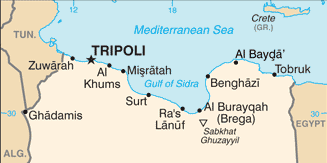
The Libyan Attorney General’s Office on Jan. 16 announced the discovery of a mass grave containing the remains of 21 bodies. A prosecutor in Benghazi charged an individual identified by the initials “MFH” with human trafficking in connection with the discovery.
A joint investigation by the Internal Security Agency and Battalion 166 led to the unearthing of the mass grave. The investigators ordered that DNA samples be collected from the remains to identify the deceased and that full autopsies be carried out to determine causes of death. The suspect (MFH) had been previously charged with three offenses related to the murder of migrants and additional human trafficking offenses.
Refugees in Libya, a Libyan-run organization registered in Italy that provides support for refugees, urged the International Criminal Court (ICC) prosecutor, Karim Khan, to “assess this case within the Court’s mandate.” The group further stated: “The killings…occurred within a system where people are blocked, intercepted, returned, and abandoned in Libya after being denied safe pathways to protection. This demands accountability beyond Libya.”
Seawatch International, an NGO that saves migrants in distress in the Mediterranean Sea, condemned EU policies for endangering migrant lives: “Horrifying news: In Libya, a mass grave with at least 21 persons was discovered. Their deaths are a direct consequence of EU migration politics. Libya is not a safe place for people on the move!”
Libya has emerged in recent years as a key route for human trafficking. Mass graves of presumed migrants who had been detained and killed by armed groups have been uncovered repeatedly—from 2022 to February and June of last year. Libya is also now serving as a starting point for flights trafficking migrants to Nicaragua, with an intended final destination of the United States.
Article 426 of the Libyan Penal Code prohibits the trafficking of enslaved people, and imposes a punishment of imprisonment not exceeding ten years. Furthermore, Article 428 criminalizes the deprivation of another’s liberty by a period of imprisonment not exceeding five years. A US State Department report identifies the lack of a functioning judiciary, endemic corruption, and the strength of non-state armed groups as causes behind the surge of human trafficking in Libya.
From JURIST, Jan. 18. Used with permission. Internal links added.
Note: This case evidently invovled some coordination between Libya’s two rival governments, as Battalion 166 appears to be aligned with the breakaway regime in the east, yet seemingly cooperated with authorities from the internationally recognized Government of National Unity based in Tripoli. The Internal Security Agency appears to be a holdover agency from the Qaddafi dictatorship, and it is unclear which faction it is aligned with.


Libyan authorities raid ‘secret prison’
Libyan authorities rescued more than 220 people from an underground prison operated by human traffickers in the southeastern town of Kufra on Jan. 18. Those freed were primarily from Somalia and Eritrea and included women and children. (TNH)
UN report documents abuse of migrants in Libya
A new report from the UN’s human rights office documents the accounts of migrants, refugees, and asylum seekers who have faced abduction, arbitrary detention, and extreme abuse in Libya. The report details “an exploitative model…that has become ‘business as usual'” in Libya, where various groups are profiting from the systematic abuse. (TNH)
Deadly start to 2026 for Mediterranean migrants
At least 606 people have died trying to cross the Mediterranean Sea to Europe already in 2026, making it the deadliest first two months of a year since the UN migration agency (IOM) began keeping track in 2014. In a little over a decade, at least 34,266 people have died or gone missing in the Mediterranean while trying to reach Europe. Italy’s right-wing government recently approved a bill allowing authorities to impose a “naval blockade” on ships carrying asylum seekers and migrants trying to enter Italian waters. European anti-migration policies have long fuelled a cycle of death, detention, and abuse at sea. (TNH)