


Mexico
michoacan

Mexico: narco-massacre in militarized Michoacán

As many as 17 people were killed in a massacre in Mexico’s west-central state of Michoacán, with video of the grisly incident going viral on social media. The victims were lined up along the outer wall of a house and shot dead execution-style after armed men forced them out of a wake they were attending in the pueblo of San José de Gracia. The perpetrators removed the bodies in trucks and took them to an unknown location. It appears to be the worst massacre in Mexico under the presidency of Andrés Manuel López Obrador, who came to office in 2018 pledging to de-escalate violence in the country. Michoacán, where the Jalisco New Generation Cartel is fighting regional rivals, has been particularly hard hit by recent violence. Contrary to his promises to eschew military solutions, López Obrador has responded by flooding the state with army troops. (Photo via RedMichoacán)

Africa
lake victora

Pipeline project threatens Lake Victoria

More than 260 organizations issued an open letter to banks and financial institutions involved in the construction of the East African Crude Oil Pipeline (EACOP), which would carry oil from fields in western Uganda to a port on the northern coast of Tanzania, passing near critical wetlands in the Lake Victoria basin. The human rights and environmental organizations say the line’s construction poses “unacceptable” risks to communities in the immediate 1,445-kilometer (898-mile) path of the project and beyond. They are calling on banks not to fund the $3.5 billion project, and asking government leaders to shift funding from infrastructure for fossil fuels to renewable energy. (Photo: Wikimedia Commons via Mongabay)

Syria
Idlib ruins

Syria: endgame or escalation?

Amid all the recent talk about how the war in Syria is approaching an imminent end, it suddenly looks set for international escalation. With Turkish forces resisting the Assadist advance into Idlib province, the last rebel-held territory, there is clear potential for direct combat between a NATO member and the Damascus regime or its Russian backers. The humanitarian catastrophe is worsening in Idlib, with over half a million displaced and pouring into camps along the Turkish border. Regime forces this week recaptured Kafranbel, an important symbolic victory, as the town was among the first to rebel against Assad and was long a symbol of the revolution. Regime and Russian aerial bombardment continues to take a horrific toll, with schools and hospitals intentionally targeted.  (Photo: White Helmets)

BURMA: SCRIBE’S MURDER TESTS DEMOCRACY

by Nava Thakuria, CounterVortex

Killings of media workers on the Indian subcontinent are nothing unusual. The subcontinent annually losses around 10 journalists to assassins. India, Pakistan and Afghanistan often top the list of victims, with additional inputs from Bangladesh and Burma. Despite its still-tentative democratic opening after generations of dictatorship, Burma (also known as Myanmar or Brahmadesh) as a whole witnesses fewer incidents of journo-killing, with only five regsitered over the past one-and-a-half decades. But the recent murder of a young reporter in Burma’s northwestern region, adjacent to India’s conflicted states of Nagaland and Manipur, exposes the vulnerability of writers who dare to cover critical issues—in this case threats to the environment by rampant resource exploitation in the region.

Ko Soe Moe Tun, 35, of Monywa, a town in northern Sagaing region, was found dead near his home on December 13—clearly targeted for his extensive investigations and reportage on timber-smuggling and illegal logging and mining in northwest Burma. The reporter, employed by national newspaper Daily Eleven, also posted few details on his Facebook page about the figures involved in the illegal timber trades. The autopsy report revealed that Soe’s skull was fractured. He leaves behind a young wife and a son. The family source claimed that he was popular in his locality, with no enmity toward anyone.

Continue ReadingBURMA: SCRIBE’S MURDER TESTS DEMOCRACY 
Inner Asia

Anti-terror ‘security state’ in Xinjiang

The Uighur people of China's Xinjiang province are coming under unprecedented surveillance and militarization amid official fears of terrorism in the far-western region.

Europe

Migrant resistance —from Calais to Macedonia

Riots broke out as French police moved to evict the Calais migrant camp, while Macedonian security forces fired tear-gas at migrants who tore down the fence on the Greek border.

The Andes

Peru: anti-TPP protests rock Lima

Protesters opposed to the Trans-Pacific Parternship marched through downtown Lima and clashed with police, as a break-away group vandalized political party headquarters.

The Andes

Caracazo recalled in polarized Venezuela

Official commemorations of the 1989 popular anti-austerity rebellion come amid new protests over economic agony in Venezuela—and regime accusations of a coup conspiracy.

The Andes

Peru: Sendero harass pipeline project

A worker was wounded when presumed Sendero Luminoso guerillas fired on a camp of the Camisea pipeline consortium in the rainforest of Peru's Cuzco region.
THE FAR RIGHT IN UKRAINE: A NEW ORDER?

by Cas Mudde, openDemocracy

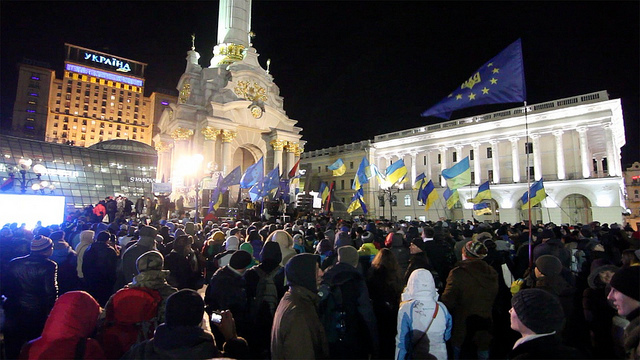
The Euromaidan “revolution” will undoubtedly remain one of the key political events of 2014. Most domestic and foreign observers were completely taken by surprise by the events that followed President Viktor Yanukovych’s decision not to sign an integration treaty with the European Union (EU) in November 2013. While the initial demonstrations in downtown Kiev were somewhat expected, few had ever thought that they could spiral so out of control that, just three months later, a democratically elected government with one of the most popular politicians in the country was forced out of power.

Euromaidan has also been interesting in terms of the propaganda battle that has been fought in the traditional and social media. As is now standard for “revolutions” in the twenty first century, activists were quick to set up several Facebook pages, Twitter accounts, and other websites to provide their own positive view of the ‘revolution,’ countering the negative reports from the official Ukrainian media and, particularly, the largely Kremlin-controlled Russian media. They were very successful in disseminating their message, in part through networks of sympathizers in the west (including Ukrainian émigré communities in North America and post-Soviet scholars across the globe).

One of the main struggles has been over the importance of “fascists” in the Euromaidan. Almost from the beginning the pro-Kremlin media emphasized the importance of “Ukrainian fascists” among the anti-government demonstrators, and within days the whole uprising was to be portrayed as “fascist.” This was to be expected, as both Soviet and post-Soviet Russian elites have tended to equate Ukrainian nationalism with fascism, linking any and every anti-Soviet or anti-Russian movement to the infamous Organization of Ukrainian Nationalists (OUN) of Stepan Bandera, which (temporarily) collaborated with Nazi Germany in a misguided attempt to gain Ukrainian independence from Stalin’s brutal Soviet regime.

At the same time, most domestic and foreign sympathizers of “Euromaidan” have minimalized the importance of the far right, arguing that Euromaidan was a genuine democratic and pro-European uprising in which far right elements were insignificant.

Continue ReadingTHE FAR RIGHT IN UKRAINE: A NEW ORDER?