Africa
DRC

DRC: accused war criminal becomes defense chief

Democratic Republic of Congo President Felix Tshisekedi appointed former warlord Jean-Pierre Bemba as defense minister and deputy prime minister in a cabinet reshuffle. Bemba, who served as vice president from 2003 to 2006, was convicted by the International Criminal Court (ICC) in 2016 of crimes against humanity over atrocities allegedly committed by rebels under his command when they intervened in the conflict in the neighboring Central African Republic in 2002. He was sentenced to 18 years in prison, but the court overturned his sentence on appeal in 2018. However, five defendants were convicted on charges related to obstruction of justice in the Bemba case. (Photo: MONUSCO via Defense Post)

Africa
Somaliland

Oil contracts at issue in Somaliland conflict?

Fighting continues in Somalia’s northern breakaway state of Somaliland, where three administrative regions—Sool, Sanaag, and Aynaba—have taken up arms in a bid to rejoin the internationally recognized Mogadishu government. Somaliland accuses the government of Ethiopia (which is officially attempting to broker a dialogue in the conflict) of intervening on the side of the re-integrationist rebels, headquartered in the town of Las Anod, Sool region. Somaliland has been effectively independent since 1991, and has seen a more stable and secular social order than the regions controlled by the Mogadishu government. But now Mogadishu is asserting its right to grant oil contracts to foreign companies within Somaliland’s territory. Local media note that the new conflict erupted just after Mogadishu announced the issuing of an exploration lease to Turkish Genel Energy in Somaliland—indeed, within Aynaba, one of the contested regions. The move was protested as “illegal” by the Somaliland government, based in the city of Hargeisa. (Map: Siirski via Ethiopia Insight)

Africa
ivory coast

French forces out of Burkina Faso, into Ivory Coast

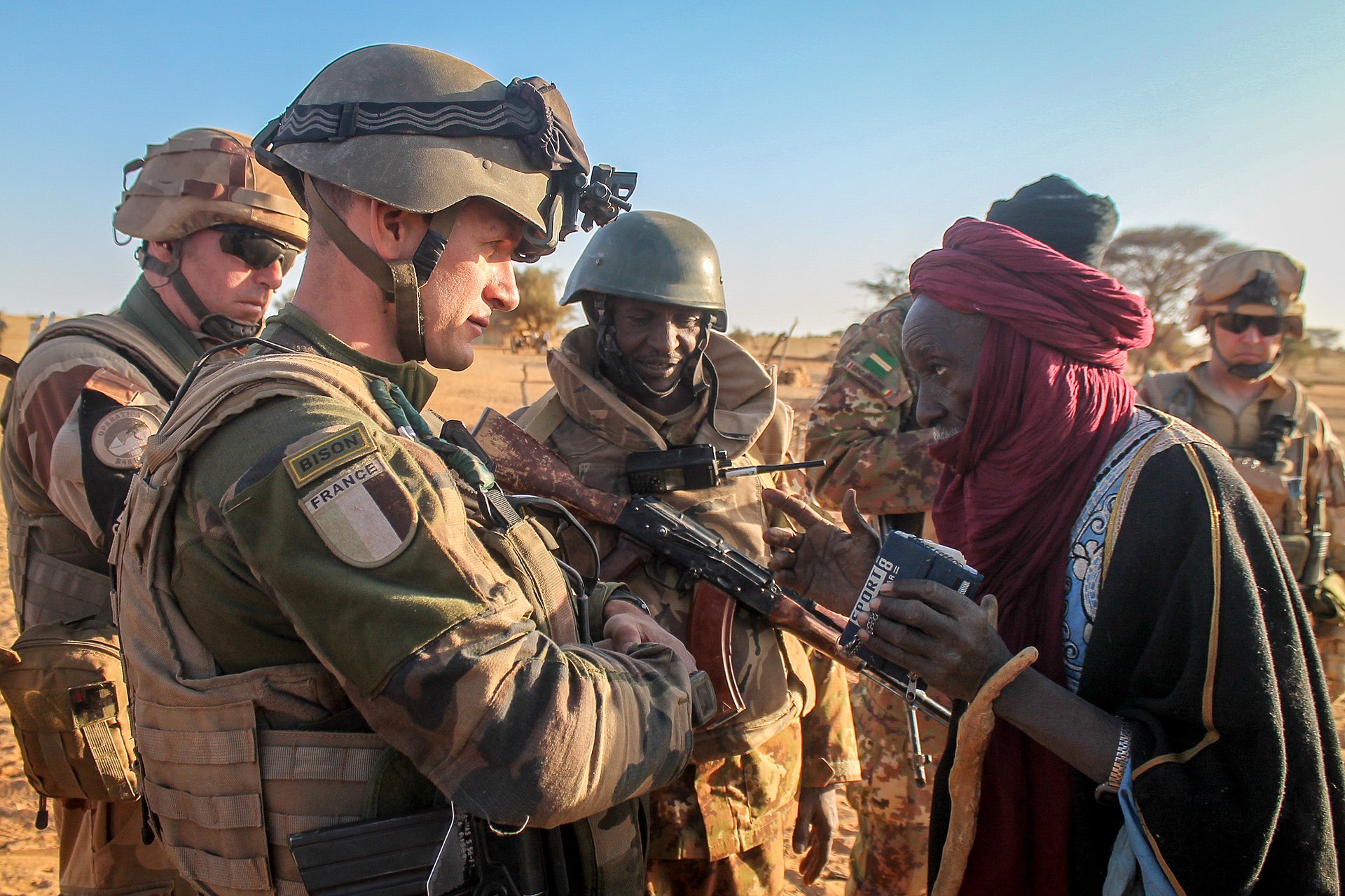
France has officially ended its operations in Burkina Faso a month after the ruling junta there terminated a military accord that allowed the former colonial power to fight jihadists. French forces remain in the greater region, however. The move came as French Defense Minister Sebastien Lecornu visited Côte d’Ivoire, pledging to boost military support as jihadist attacks hit coastal West African states. (Map: Perry-Castañeda Library Map Collection)

Africa
Fulani

Podcast: West Africa’s forgotten wars

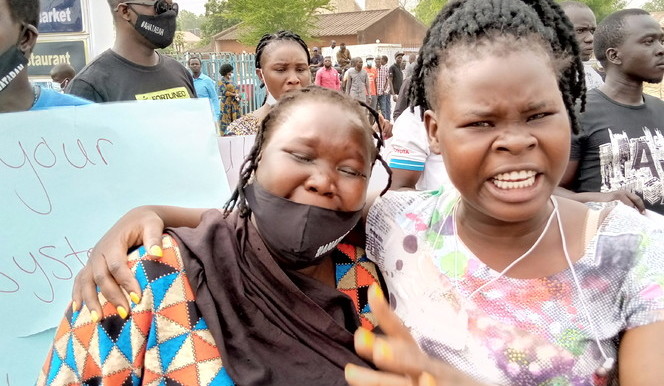
In Episode 161 of the CounterVortex podcast, Bill Weinberg provides an overview of the under-reported conflicts in West Africa, where government forces and allied paramilitary groups battle multiple jihadist insurgencies affiliated either with ISIS or al-Qaeda on a franchise model. Horrific massacres have been committed by both sides, but the Western media have only recently started to take note because of the geopolitical angle that has emerged: both Mali and Burkina Faso have cut long-standing security ties with France, the former colonial power, and brought in mercenaries from Russia’s Wagner Group. In both countries, the pastoralist Fulani people have been stigmatized as “terrorists” and targeted for extra-judicial execution and even massacre—a potentially pre-genocidal situation. But government air-strikes on Fulani communities in Nigeria have received no coverage in the Western media, because of the lack of any geopolitical rivalry there; Nigeria remains firmly in the Anglo-American camp. Listen on SoundCloud or via Patreon. (Photo: Sahara Reporters)

Africa
Somalia

Somalia: US raids on ISIS stronghold

A US special forces raid in Somalia ordered by President Joe Biden killed a key regional ISIS leader, Bilal al-Sudani, the Pentagon said in a statement. Sudani apparently died in a gun-battle after US troops descended on a cave complex in a mountainous area of northern Somalia. The statement did not specify the location of the raid, but the announcement followed reports in Somali media describing a US drone strike on a stronghold of the self-declared Islamic State-Somalia in the Cal Miskaad mountains of the autonomous northern region of Puntland. The raid came as the US military has been stepping up attacks on the Qaeda-aligned Shabaab rebels in central Somalia, in conjunction with Somali government and African Union forces. (Map via Wikimedia Commons)

Africa

Massacres mount in eastern DRC

Fighters from the ISIS-aligned Allied Democratic Forces (ADF) and the CODECO ethnic miitia have each carried out multiple massacres of villagers in Ituri and North Kivu provinces of the eastern Democratic Republic of Congo over the past weeks. The M23 rebel group, said to be backed by Rwanda, has meanwhile captured new territory in North Kivu, further closing the ring around Goma, the largest city in the DRC’s east. Regional tensions rose after Rwanda fired on a Congolese fighter jet, claiming it had breached its airspace. Kinshasa denied the accusation and called the shooting “an act of war.” (Map: CIA)

Africa
Rift Valley

African dissent from biodiversity protocol

The UN Biodiversity Conference, or COP15, concluded in Montreal with what is being hailed as a landmark agreement to address the current unprecedented loss of species, now termed the planet’s sixth mass extinction. The centerpiece of the Kunming-Montreal Global Biodiversity Framework, conceived as a match to the Paris Agreement on climate change, is the so-called “30×30” pledge—with countries committing to protect 30% of their territory for habitat preservation by 2030. The deal earmarks $30 billion per year to flow from wealthy countries to poor ones to assist in conservation programs. But the financial commitments are not binding, and were assailed by countries in the developing world as inadequate. After an all-night session, the gavel was brought down on the deal minutes after the delegation from the Democratic Republic of Congo pressed outstanding criticisms. This was decried by the DRC, Uganda and other African delegations. A representative from Cameroon protested: “What we saw was a force of hand.” (Photo of Kenya’s Great Rift Valley via Pixabay)

Africa
wagner group

African intrigues over Wagner Group

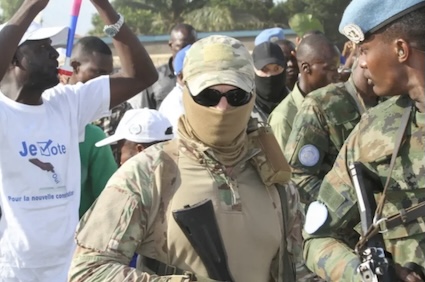
Burkina Faso’s ruling military authorities summoned Ghana’s ambassador over accusations that they have hired Russian mercenaries from the Wagner Group to help fight jihadists. Speaking alongside US Secretary of State Antony Blinken at the US-Africa Leaders Summit in Washington, Ghana’s President Nana Akufo-Addo said: “Today, Russian mercenaries are on our northern border. Burkina Faso has now entered into an arrangement to go along with Mali in employing the Wagner forces there.” Calling the mercenaries’ presence “distressing,” Akufo-Addo also alleged that Burkina Faso had offered Wagner control of a gold mine as payment. Meanwhile, a Russian national said to be closely linked to the Wagner Group was injured in an apparent assassination attempt in the Central African Republic. Wagner Group’s parent company Concord named French agents as behind the attack. Burkina Faso, Mali and the CAR alike have recently broken long-standing security ties with France, their former colonial ruler—with Russian mercenaries moving in as French soldiers go home. (Photo of CAR army troops wearing the Wagner Group insignia via Corbeau News Centrafrique)

Africa
kordofan

Sudan: regime spurring Kordofan violence?

At least 30 people were killed and dozens injured in armed clashes between members of the Hamar and Misseriya pastoralist groups in Sudan’s West Kordofan state. ​​​​A Hamar militia that had been organized to protect against cattle rustlers was apparently ambushed by Misseriya gunmen in the locality of Abu Zabad, setting off the violence. Hamar leaders charge that state authorities and the paramilitary Rapid Support Forces (RSF) are protecting Misseriya bands that raid their lands with impunity. In Khartoum, the pro-democracy Resistance Committee is meanwhile calling for continued protests despite the new pact for a transition to civilian rule, saying that any deal must include provisions for transitional justice and reform of the security forces. (Photo: Tim Freccia/Enough Project via Dabanga)

Africa

Massacre claim overshadows DRC peace talks

A third round of peace talks between the Democratic Republic of Congo and rebel movements opened in Kenya. More than 50 armed and civil society groups are present at the dialogue. Rwanda, accused of backing the M23 rebels, has also been invited to this round—but not the M23 themselves. And the talks are overshadowed by accusations of a massacre of 50 civilians by the M23 in the town of Kishishe, Noth Kivu province. In a statement, the M23 rejected the claims and accused the DRC government of preparing a “genocide” against Congolese Tutsi. The M23 meanwhile continue their advance on the provincial capital of Goma. (Map: CIA)

Africa
Togo

Qaeda franchise claims deadly assault in Togo

The Group for Support of Islam & Muslims (JNIM by its Arabic rendering), al-Qaeda’s West African franchise, claimed credit for an assault on Togolese forces that left at least 17 soldiers dead near the border with Burkina Faso. Togolese media reported that fighters in large columns of vehicles mounted with heavy machine-guns raided a military outpost at Tiwoli village, in northern Savanes region. This is the second such claim of responsibility for an attack within Togo by JNIM in the last two weeks, and the third this year. The attacks are raising fears of insurgency spreading from conflict-torn Burkina Faso into West Africa’s littoral states. (Map: Togo Department of Health)

Watching the Shadows
Kremlin

Wagner Group revelations expose Kremlin lies

Russia’s heretofore secretive private mercenary force, the Wagner Group, has opened its first official headquarters, in an office building in the city of Saint Petersburg—with a stylized W logo and the words “Wagner Center” in Russian emblazoned on the glass door facing the street. Putin-allied oligarch Yevgeny Prigozhin last month also publicly confirmed for the first time that he is the founder of the mercenary outfit. These are amusing developments after years of claims that the Wagner Group—which is accused in a string of horrific human rights abuses both in Ukraine and across Africa—doesn’t actually exist. (Photo: Wikipedia)