


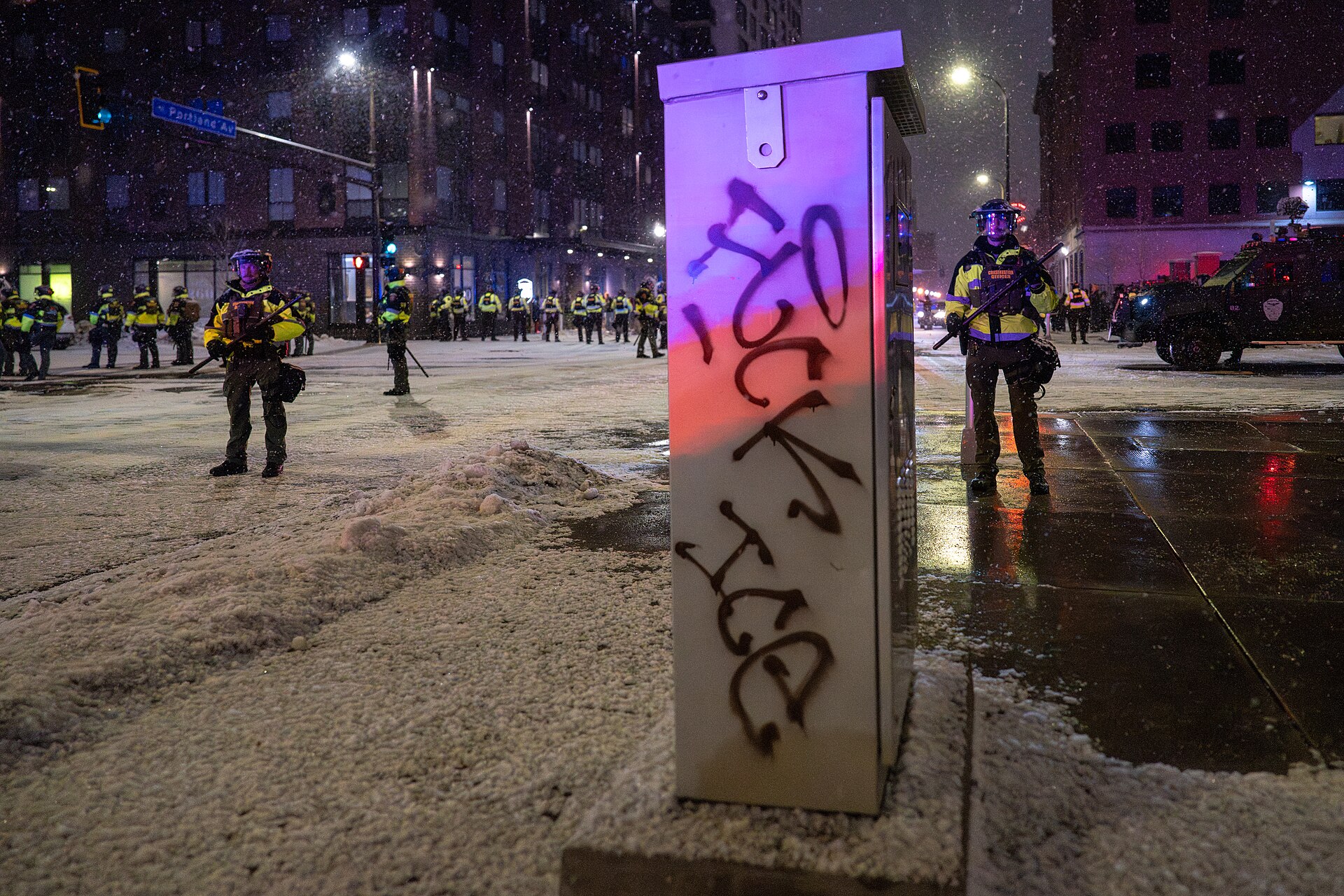
President Donald Trump on Jan. 15 warned that he may invoke the Insurrection Act to deploy troops in Minnesota to quell protests over the massive deployment of Immigration & Customs Enforcement (ICE) agents to the Twin Cities.
The protests escalated following the Jan. 7 fatal shooting of Minneapolis resident Renee Good, 37, by an ICE agent during “Operation Metro Surge,” a large-scale immigration enforcement operation that has seen thousands of Department of Homeland Security (DHS) personnel mobilized to the Twin Cities. Good was serving as a legal observer monitoring the enforcement operation when she was killed. DHS characterized her as a “domestic terrorist” following the shooting—a designation the NAACP Legal Defense Fund called “a shameful and cowardly effort to deflect its own responsibility for this indefensible killing,” noting that available video footage did not appear to show Good posing any threat that could justify use of deadly force. Minnesota, along with the cities of Minneapolis and St. Paul, filed a federal lawsuit Jan. 12 challenging the operation as unconstitutional.
On Jan. 15, Trump posted via social media:
If the corrupt politicians of Minnesota don’t obey the law and stop the professional agitators and insurrectionists from attacking the Patriots of I.C.E., who are only trying to do their job, I will institute the INSURRECTION ACT, which many Presidents have done before me, and quickly put an end to the travesty that is taking place in that once great State.
The Insurrection Act—originally enacted in 1792—allows the president to “call into Federal service such of the militia of the other States” in order to suppress insurrection or rebellion. The Insurrection Act has not been significantly updated in over 150 years, and the last time a US president invoked the Act was in 1992, when President George HW Bush received a request from then-California Gov. Pete Wilson to help address riots in Los Angeles.
Trump has broached invoking the Act before, and has since been met with reversals in the courts over his efforts to mobilize National Guard troops under the executive’s constitutional “authority to suppress rebellion.” Just last October, he attempted to deploy the National Guard to Portland, Ore., but a federal district judge deemed the attempt unlawful, finding that the requisite “rebellion” did not exist.
The US Supreme Court in December rejected Trump’s attempt to deploy the National Guard in Illinois, finding: “[T]he Government has failed to identify a source of authority that would allow the military to execute the laws in Illinois. The President has not invoked a statute that provides an exception to the Posse Comitatus Act.” The one-sentence 1878 Posse Comitatus Act prohibits military personnel from participating in civilian law enforcement unless doing so is expressly authorized by a statute (e.g., the Insurrection Act) or the Constitution.
In response to questions outside the White House Jan. 15, Homeland Security Secretary Kristi Noem said that there were “no plans to pull out of Minnesota,” and added that what’s happening on the ground in the Twin Cities is “violent” and “a violation of the law in many places.” She also claimed that President Trump “certainly has the constitutional authority to utilize” the Insurrection Act.
From JURIST, Jan. 15. Used with permission. Internal links added.
Note: Trump’s Inauguration Day executive order declaring a state of emergency on the southern border also set a deadline of April 20, 2025 for a joint Pentagon-Homeland Security recommendation on whether to invoke the Insurrection Act. The report, handed in two days early, failed to recommend invocation of the Act. (CNN)
Days later, on April 28, Trump issued Executive Order 14287, “Protecting American Communities from Criminal Aliens,” which stated that city and state sanctuary policies constitute “a lawless insurrection against the supremacy of Federal law and the Federal Government’s obligation to defend the territorial sovereignty of the United States.”
Photo: Chad Davis via Wikimedia Commons


Trump’s immigration crackdown gets deadlier
Federal agents shot a man in the leg during an immigration raid in Minneapolis on Jan. 14, one week after an Immigration and Customs Enforcement (ICE) officer killed Renee Nicole Good. In the wake of Good’s killing, tensions between the local community and federal security forces conducting immigration raids have skyrocketed, with the second shooting further inflaming the situation.
In recent days, ICE officers have also detained dozens of Somali refugees–including children–who were legally resettled to the US. The administration said it was targeting around 5,600 refugees in Minnesota who have not yet been granted permanent residency.
Meanwhile, at least four people died in ICE custody in just the first 10 days of 2026. In its first year in office, the Trump administration has essentially ended all humanitarian immigration pathways to the US and launched a draconian mass deportation campaign that has embraced white supremacist rhetoric and goals, and seen the deployment of masked federal agents using aggressive tactics to cities across the country. Legal immigration has not been spared: On Jan. 14, the administration announced it was suspending immigrant visa processing from 75 countries. (TNH)
Judge partially blocks ICE tactics against protesters in Minnesota
The US District Court for the District of Minnesota on Jan. 16 granted in part a motion for a preliminary injunction brought by six individuals who say federal immigration agents unlawfully arrested, stopped, threatened and/or used chemical irritants against them while they observed, recorded, and protested immigration enforcement activity in the Twin Cities of Minneapolis and Saint Paul.
The court order prohibits agents from retaliating against individuals engaged in “peaceful and unobstructive protest activity” and from arresting or detaining such persons “in retaliation” absent probable cause or reasonable suspicion that the person committed a crime or interfered with covered officers. The court also barred the retaliatory use of pepper spray or similar tools against peaceful, unobstructive protesters and observers.
The ruling further restricts vehicle stops in the context of protests, holding that the “act of safely following” federal agents “at an appropriate distance” does not, by itself, provide reasonable suspicion to justify a stop. The order requires defendants to disseminate the injunction broadly to covered agents by distributing it to all covered federal agents within 72 hours and to newly deployed agents who arrive in Minnesota to participate in the operation.
The plaintiffs sued Department of Homeland Security (DHS) Secretary Kristi Noem and senior officials from Immigration and Customs Enforcement (ICE) and its Enforcement and Removal Operations (ERO) arm, alleging that the government’s Operation Metro Surge has produced “an unprecedented increase” in federal law enforcement presence in Minnesota. The plaintiffs also claimed that agents have responded to community observers with intimidation, force and detention. (Jurist)
US Justice Department subpoenas Minnesota Gov. Tim Walz
US media outlets reported Jan. 20 that Minnesota Gov. Tim Walz, along with Minneapolis Mayor Jacob Frey and three others, received subpoenas from the US Department of Justice (DoJ) over alleged interference with the Trump administration’s controversial immigration enforcement actions in that state. Others subpoenaed include St. Paul Mayor Kaohly Her, Minnesota Attorney General Keith Ellison, and Hennepin County Attorney Mary Moriarty. The documents did not mention a criminal statute, according to the New York Times.
The subpoenas come after Walz put Minnesota’s National Guard on alert following demonstrations over a US Immigration & Customs Enforcement (ICE) agent’s shooting of US citizen Renee Good. Both Walz and Frey have been critical of the Trump administration’s deployment of ICE in Minnesota, with Frey publicly telling ICE to “get the fuck out of Minneapolis.” Critics of the administration’s actions allege that the immigration crackdown is racially and politically motivated, and subverts due process. Both Minnesota and Illinois have sued Trump over alleged violations of states’ rights in response to the ICE mobilization.
Walz addressed Trump and the investigation directly on X, saying in part:
This latest DoJ move comes just over a week after the Federal Reserve received grand jury subpoenas from the DoJ over Chair Jerome Powell’s June statements about renovations to the central bank’s buildings. Trump has previously been critical of Powell and has engaged in a campaign of trying to lower interest rates.
Two of the president’s other political opponents, former FBI director James Comey and New York Attorney General Leticia James, beat DoJ prosecution efforts after a judge dismissed charges against them after finding that the prosecutor in the case was unlawfully appointed. A grand jury also refused to indict James on an additional false statements charge. (Jurist)
Appellate court removes injunction on ICE tactics in Minnesota
A US federal appellate court on Jan. 26 declined to reinstate an lower court injunction on federal agent tactics at protests in Minnesota.
The Court of Appeals for the Eighth Circuit refused to extend a trial court’s preliminary injunction that prohibited agents from retaliating against individuals engaged in “peaceful and unobstructive protest activity.” The injunction came on Jan. 17 in response to a suit filed by a Minnesota man who alleged ICE officers disproportionately and unnecessarily escalated a traffic stop encounter.
“For at least two reasons, the government has made ‘a strong showing’ that its challenge to the injunction ‘is likely to succeed on the merits,'” the appellate court wrote in its unsigned opinion.
The court found the requested relief for “such a broad uncertified class” was “just a universal injunction by another name.” In June 2025, the Supreme Court ruled that federal district courts cannot issue universal injunctions. The court also found that enjoining restrictions on “peaceful and unobstructive protest activity” was overly vague, noting that it did not adequately restrain the trial court from enjoining a wide range of agent action.
“A wrong call could end in contempt, yet there is little in the order that constrains the district court’s power to impose it,” the opinion stated.
The ACLU, as part of a legal team representing Minnesota residents using over immigration officer-tactics, pushed to reinstate the injunction following a second killing of a US citizen by federal agents in Minnesota on Jan. 24. Plaintiffs claimed the fatal shooting of Alex Pretti demonstrated “escalating, imminent risks.” In a release, Deepinder Mayell, executive director of ACLU of Minnesota, wrote:
The court did, however, grant the plaintiffs’ request for expedited merits briefing. (Jurist)
US judge temporarily blocks arrests of refugees in Minnesota
A US federal court on Jan. 28 issued an order blocking the Trump administration from arresting and detaining refugees living in Minnesota while a case challenging the initiative proceeds.
The District Court for the District of Minnesota issued a temporary restraining order that prohibits President Donald Trump from using Immigration & Customs Enforcement (ICE) officers to arrest refugees who are living in Minnesota, but are not yet legal citizens.
The order comes as a response to a challenge filed in Minnesota by a group of refugees represented by non-profit groups International Refugee Assistance Project, Beer Montague, and the Center for Human Rights and Constitutional Law.
Judge John R. Tunheim penned the opinion with a focus on the legality of refugees living in Minnesota, stating:
The administration’s Operation PARRIS, launched in early January, aims to reexamine legal status of refugees in Minnesota through more intensive background checks and a more thorough verification of refugee claims. The Department of Homeland Security (DHS) stated that its top priority always is to protect American citizens first, and PARRIS does so by preventing the immigration system from being “weaponized” in Minnesota, which DHS has called “ground zero for the war on fraud.”
PARRIS falls under a wider campaign pursued by Trump since his issuing of Executive Order 14161 on January 30, 2025, and Proclamation 10949 of June 4, 2025, which both implement harsher immigration restrictions. (Jurist)
DoJ charges man with assault of Rep. Ilhan Omar
The US Department of Justice charged a man on Jan. 29 with “forcibly assaulting and interfering with” Democratic Representative Ilhan Omar at a town hall in North Minneapolis.
The defendant, Anthony James Kazmierczak, appeared in front of a US District Court in the District of Minnesota following a complaint filed by US Attorney Daniel N. Rosen. He will be held in custody awaiting a detention hearing and a preliminary hearing on Feb. 3. These hearings will determine whether Kazmierczak can be released pending trial, and if a felony indictment can be sought. Capitol Police are also reportedly considering federal charges against him for assaulting a member of Congress.
The incident occurred while Rep. Omar (D-MN) was speaking at a town hall Jan. 27. In her speech, she called for the abolition of Immigration and Customs Enforcement (ICE) and for Secretary of Homeland Security Kristi Noem to resign or face impeachment—at which point Kazmierczak approached her and sprayed her with a syringe of what was reported to be apple cider vinegar. He was then apprehended by security officers. Rep. Omar later released a statement saying that she had not been harmed and continued with the town hall, as “she doesn’t let bullies win.”
Rosen stated: “Assaultive behavior and acts of intimidation directed at officers and employers of the United States will not be tolerated.” According to ABC Senior Political Correspondent Rachel Scott, President Donald Trump said that he had not seen the video of the attack but called Omar “a fraud” who “probably had herself sprayed, knowing her.” In response, Rep. Omar linked his “hateful rhetoric” against her and her Minnesota Somali community to a rise in death threats, and said it was “ironic that…he was on stage moments before I was attacked, talking about me.” (Jurist)
Journalist Don Lemon arrested over protest at church service
Don Lemon, a well-known independent journalist, was arrested with eight other people on Jan. 29 after being indicted by a federal grand jury. The charges relate to his involvement in coverage of a protest against Immigration & Customs Enforcement (ICE) at a church in St. Paul the previous day. Protesters said that they targeted the church because its pastor, David Easterwood, works as acting director for ICE’s St. Paul Field Office
The indictment alleges that up to 40 protestors entered the Cities Church during a worship service and began to disrupt it through “acts of oppression, intimidation, threats…and physical obstruction.” As a result, “[t]he Church [was] forced to terminate [its] worship service, congregants fled.”
The Department of Justice (DoJ) says that Lemon, Fort, and the other journalists conspired with the protestors to deprive the church of its First Amendment rights. DOJ charged the group with Conspiracy Against Right of Religious Freedom, 18 USC § 241, and with violating the Freedom of Access to Clinic Entrances Act, 18 U.S.C. § 248(a)(2).
The DoJ tried and failed to get arrest warrants from a magistrate judge, a federal judge, and the United States Court of Appeals for the Eighth Circuit. The grand jury was DoJ’s fourth attempt at criminal action in the case.
“I have spent my entire career covering the news. I will not stop now,” said Lemon.
Abbe Lowell, attorney for Lemon, added on X:
Lemon was a journalist for CNN for nine years. He now works independently. Georgia Fort, an independent journalist who specializes in social justice issues, was also indicted and arrested. (Jurist)
Court denies Minnesota bid to stop ‘Operation Metro Surge’
A US federal judge in Minnesota on Jan. 31 refused to halt the Trump administration’s massive immigration enforcement operation in the Twin Cities, denying a request by the state of Minnesota and the cities of Minneapolis and St. Paul for preliminary injunctive relief.
District Judge Katherine Menendez held that plaintiffs had not shown a sufficient likelihood of success on the merits to justify the “extraordinary remedy” of a preliminary injunction on Operation Metro Surge, a large-scale deployment of immigration agents across the state.
Minnesota has challenged the operation as a violation of the Tenth Amendment’s anti-commandeering doctrine and the “equal sovereignty” of the states. Plaintiffs contend that the enforcement surge, backed by roughly 3,000 federal agents, has imposed massive costs on state and local governments, and seeks to punish “sanctuary policies” in Minneapolis and St. Paul. Prior to the operation, roughly 80 ICE officers operated in the Twin Cities.
Minnesota and the Twin Cities argued that the surge effectively commandeers state and local governments, forcing them to expend substantial resources to manage operational fallout instead of normal police work, schools, emergency management, transportation, and social services. They also argued that the administration is attempting to leverage them into repealing “sanctuary” ordinances and cooperating with immigration enforcement, in violation of the anti-commandeering principle articulated in New York v. United States, Printz v. United States and Murphy v. NCAA.
Plaintiffs pointed to public statements by administration officials, including Border Czar Tom Homan, that suggest the duration of the surge depends on the level of state and local “cooperation.” A letter from Attorney General Pam Bondi to Governor Tim Walz also revealed federal requests for access to state records and repeal of non-cooperation policies.
Judge Menendez did not dismiss the underlying constitutional concerns. Her order openly acknowledged evidence of “profound and even heartbreaking” consequences for Minnesotans, noting allegations of racial profiling and excessive force by federal agents. However, she concluded that plaintiffs had asked the court to apply the anti-commandeering doctrine in a case where the Supreme Court has provided little guidance.
Addressing plaintiffs’ “resource-diversion” argument, Menendez cited United States v. Texas. In that case, the Supreme Court held that downstream costs to state budgets from federal immigration-enforcement decisions are alone not sufficient to establish standing. The court reasoned that if such indirect fiscal impacts rarely justify opening the courthouse door, they are unlikely to constitute a Tenth Amendment violation.
Minnesota’s “equal sovereignty” claim, borrowing from Shelby County v. Holder, also failed to clear preliminary injunction thresholds, the judge found. Historically, such claims involve federal statutes that burden the sovereign functions of singled-out states. However, Menendez found that this case instead involved decisions about where to deploy federal law enforcement resources and noted that the executive branch must retain flexibility to allocate personnel based on changing national conditions.
On other factors, such as irreparable harm, the court largely accepted plaintiffs’ factual showings of multiple fatal shootings by federal agents, serious allegations of misconduct, and wide-ranging disruptions to education, health care, worship, and local economies. The order stated that it would be “difficult to overstate” the impact of the operation on Minnesota communities.
But the judge held that these harms must be weighed against the federal government’s interests in enforcing immigration law. She leaned on a recent opinion in Tincher v. Noem, which stayed a narrower injunction that limited federal agents’ interactions with protesters during the same operation.
Minneapolis Mayor Jacob Frey said he was “disappointed” with the decision and called ICE operations “an invasion.” Bondi, by contrast, praised the decision as “another HUGE” legal victory, and said that neither “sanctuary policies” nor “meritless litigation” would stop the administration from enforcing federal law in Minnesota. (Jurist)
Damage control in Minnesota
Playing damage control, the Trump administration is withdrawing 700 immigration enforcement officers from Minnesota. The killings of Renee Good and Alex Pretti by federal agents in the city of Minneapolis, two weeks apart, sparked widespread resistance to Trump’s draconian immigration crackdown. Since then, Trump said “maybe we can use a little bit of a softer touch” while still remaining “tough.” But the changes may be largely cosmetic as the underlying goal of carrying out mass deportations remains unchanged: Around 2,000 federal agents will remain deployed in Minnesota. (TNH)
DHS officials accused of fabricating evidence in shooting
The attorney of Marimar Martinez, shot by US Immigration & Customs Enforcement (ICE) agents multiple times in Chicago in October, argued Feb. 11 that released evidence shows that the Department of Homeland Security (DHS) lied about information tied to investigations.
Attorney Christopher Parente detailed instances in which he said DHS lied about circumstances of the shooting and about Martinez’s past. Parente stated that a diagram of the altercation drawn by an ICE agent—meant to show how Martinez allegedly boxed in and rammed into an ICE vehicle—depicted vehicles that “don’t exist.”
DHS officials had also alleged that Martinez had a past history of “doxxing federal agents” which contributed to labeling her a “domestic terrorist.” However, officials have brought no evidence to support this, and Martinez has no apparent criminal background.
Through discovery, Parente also unveiled documents that suggest ICE and DHS have “encouraged, celebrated and rewarded” protester killings. An email sent from Gregory Bovino, leader of enforcement operations in Chicago at the time, congratulated the shooting officer, Charles Exum, “[i]n light of [his] excellent service in Chicago.”
Other released documents include text chains between ICE agents calling Exum “a legend.” In one text, Exum allegedly wrote of the shooting: “I fired 5 rounds and she had 7 holes. Put that in your book boys.”
On October 4, 2025, ICE agents drove through a Chicago neighborhood, and Martinez followed them while honking her horn to alert residents. Authorities stated Martinez and another driver rammed into a vehicle operated by Exum. Exum subsequently shot Martinez five times. She is currently being treated for her injuries.
The Justice Department initially brought a felony charge against Martinez, but quickly dropped the case after videos emerged of an ICE agent driving into Martinez’s car.
Parente pushed for the documents to be released following fatal ICE altercations in Minneapolis and Chicago. He seeks to pursue a complaint under the Federal Tort Claims Act. If DHS denies the claim or does not act on it within six months, Martinez can file a federal lawsuit. (Jurist)
Trump admin announces end to Minnesota immigration crackdown
President Donald Trump’s border czar, Tom Homan, said on Feb. 12 that the administration has agreed to end the immigration enforcement crackdown in Minnesota.
Homan held a news conference in Minneapolis where he stated: “I have proposed, and President Trump has concurred, that this surge operation conclude… A significant drawdown has already been underway this week and will continue to the next week.”
This follows after over two months of increased immigration enforcement in the city, which the administration referred to as Operation Metro Surge. Immigration & Customs Enforcement and Customs & Border Protection (CBP) established the operation to apprehend and deport undocumented immigrants.
The crackdown resulted in a large community response, including widespread protests. During this time of unrest, CBP officers shot and killed two immigrant advocates, Renee Macklin Good and Alex Pretti.
Homan’s announcement to end Operation Metro Surge comes after a reported increase in cooperation between federal, state and local law enforcement. A Feb. 4 White House press release reported a “new milestone” of over 4,000 “criminal illegals” removed from Minnesota, and said further federal agent reductions were contingent on increased cooperation from local law enforcement. Homan has now claimed they “yielded the successful results we have came here for” and “are leaving Minnesota safer.”
Minnesota Gov. Tim Walz responded to the announcement in a post on X: “The long road to recovery starts now. The impact on our economy, our schools, and people’s lives won’t be reversed overnight. That work starts today.” He later stated “immigration is the core of who we are,” and criticized Trump administration officials in charge of the Department of Homeland Security. (Jurist)
Minnesota sues Trump admin for withholding Medicaid funding
The state of Minnesota sued President Donald Trump’s administration on March 2 to prevent it from withholding $243 million in Medicaid funding, warning it may have to cut health care for low-income families if the funding is held back.
The state seeks a temporary restraining order blocking the administration from withholding Medicaid funding—the health care safety net for low-income Americans.
On Jan. 6, the administration announced that more than $2 billion annually would be withheld from Minnesota based on assertions of “noncompliance.” Administration officials said they would halt Medicaid funding over alleged fraud concerns, describing it as an aggressive crackdown on misuse of public funds.
Plaintiffs called the accusations improperly vague. To date, state officials claim that that have not been made aware of the specifics of its non-compliance or the steps they can take to remedy the administration’s concerns. The lawsuit alleges that the administration, impatient because it could not withhold the $2 billion until Minnesota received due process, “deferred” $243 million from the state on Feb. 25. (Jurist)
Immigration judge terminates asylum claim for five-year-old
Local media in Minnesota reported March 18 that an immigration judge ended the asylum claims of five-year-old Liam Conejo Ramos and his family, ordering their removal from the US.
The Columbia Heights Public School District, where the boy attended school, lamented the decision, stating:
Liam and his father made headlines when they were detained by Immigration & Customs Enforcement (ICE) in January during the Trump administration’s Operation Metro Surge, which has reportedly ended. While the Department of Homeland Security claimed that his father “abandoned” Liam, and that ICE merely ensured his safety, school officials said the boy was used by agents as a pretext to gain access to the family’s home.
The family includes Liam, his 13-year-old brother, his father Adrian Conejo Arias, and mother Erika Ramos, who is pregnant with the couple’s third child.
Last month, a federal district judge ordered Ramos and his father to be released from ICE custody. Judge Fred Biery granted a writ of habeas corpus and took the opinion as an opportunity to give a “civics lesson to the government,” stating:
Administrative warrants employed by ICE have been the topic of much controversy. Many have argued that ICE polices that allow such warrants to be signed and executed by supervising officers, without judicial approval, violate the Fourth Amendment, which generally requires warrants to be issued by a neutral and detached magistrate.
A Ramos family attorney said they plan on appealing to the Board of Immigration Appeals—a process that could last years. The family may remain in the US while the appeal is adjudicated. (Jurist)