


North America
14a

Podcast: nullify the election! V

Mere days before Congress is to certify the Electoral College votes, a movement has finally emerged to have Donald Trump disqualified from office under the Insurrection Clause of the 14th Amendment. A “14th Now March” in Washington is raising the demand, and is being promoted by the podcast and vlog Lights On with Jessica Denson. Constitutional law scholars Evan Davis and David Schulte make the case in an editorial for The Hill, “Congress has the power to block Trump from taking office, but lawmakers must act now.” Several elected officials have been barred from office under the Insurrection Clause since ratification of the 14th Amendment in 1868, but applying it to a former president who led an insurrection is the ultimate test of American democracy. In Episode 259 of the CounterVortex podcast, Bill Weinberg urges that this constitutional mechanism be used, and Trump’s victory be nullified. Listen on SoundCloud or via Patreon. (Image via Free Speech for People)

South Asia
kashmir

India: army investigates civilian deaths in Kashmir

The Indian army initiated an investigation into the deaths of three civilians in the Poonch district of Jammu & Kashmir territory. The individuals were reportedly in army custody following a militant attack that claimed the lives of four soldiers. In the aftermath of the attack, the army detained eight civilians from Topa Pir village in Poonch for questioning. Residents allege that the civilians were arbitrarily picked up and denied communication with their families. Their bodies were discovered under mysterious circumstances near the Pakistan border. The affair has led to outrage and protests in the already volatile region. (Photo: Kashmir Global via Nationalia)

South Asia
hazara

Pakistan: Hazara massacre sparks hunger strike

Members of Pakistan’s Hazara people have launched a sit-in and public hunger strike after a massacre targeted the Shi’ite minority at a coal-field in a remote area of Balochistan province. Hundreds have been blocking a major thoroughfare through the provincial capital, Quetta. Interior Minister Sheikh Rashid was sent in to meet with a delegation of the Majlis-e-Wahdatul Muslimeen, the organization leading the sit-in, but his offer of compensation to victims’ families was rebuffed. In the attack, armed men rounded up miners from worker housing at the coal-field. Those determined to be Hazara, 11 in all, were marched into the hills and summarily shot. Many had their throats slit or were otherwise mutilated. The local franchise of the “Islamic State” claimed responsibility for the massacre. Families of the victims are refusing to bury their loved ones, but have brought the bodies to the site of the sit-in, demanding the Balochistan government either arrest the killers or resign. (Photo via Twitter)

Iraq
Iraq pipeline

Crisis-hit Iraq mortgages oil to China

Iraq has won an up-front $2 billion infusion from a state-owned Chinese oil company, as it continues to struggle amid the pandemic-triggered collapse in energy prices. After numerous bids to Iraq’s State Organization for Marketing of Oil (SOMO), the deal was clinched by ZhenHua Oil Co, subsidiary of China North Industries Group Corp (Norinco). The deal marks the first in which Iraq has offered a pre-payment for crude, with oil effectively used as security for a loan. According to Bloomberg, SOMO is to supply some 130,000 barrels a day of crude for five years. Norinco is primarily a defense company, with investments in oil and minerals in several countries. (Photo via Iraqi News Agency)

North Africa
Libya

Who was behind new Tripoli air-strike?

The Presidential Council of Libya’s internationally-recognized government issued a statement condemning the air-strike on Hadba Military College in Tripoli, in which some 30 cadets were killed and many more injured. “The attackers aim to destabilize Tripoli in order to seize power via such repeated terrorist attacks, disregarding the safety of civilians,” the statement read. The Tripoli-based Government of National Accord blamed the strike on warlord Khalifa Haftar, who is loyal to the rival government based in Libya’s east and has been besieging the capital for months. Haftar’s forces, in turn, denied responsibility for the attack. (Map: CIA)

East Asia
Tiananmen

China detains activists in year-end crackdown

Over a dozen Chinese lawyers and activists were detained or went missing in the final days of 2019, in a crackdown targeting participants who attended a private pro-democracy gathering in the coastal city of Xiamen, rights groups reported. The meeting had been called to discuss a “democratic transition in China,” said Human Rights Watch researcher Wang Yaqiu. The period around New Year is traditionally when Beijing chooses to arrest prominent dissidents in an effort to minimize international media attention, “so it is not a surprise that they chose this particular time to launch a manhunt of activists.” The meeting involved a small group “peacefully discussing politics in a private space.” (Photo: chinaworker.info)

Mexico

Zapatistas vow to oppose López Obrador

Speaking at a ceremony marking the 25th anniversary of their New Year's Day 1994 uprising in Mexico's southern state of Chiapas, leaders of the Zapatista rebels pledged their opposition to Mexico's new left-populist president, Andrés Manuel López Obrador. Anger was particularly directed at the planned "Maya Train" project, which would link the tourist resort of Cancún on the Caribbean coast with the Palenque archeological site in Chiapas, spearheading a new thrust of tourism mega-development. At the ceremony, held at the rebel-controlled settlement of La Realidad and dubbed the "Meeting of the Networks of Resistance and Rebellion," thousands of supporters from across Mexico gathered to watch Zapatista troops march in formation—although wielding symbolic bastónes (staffs) rather than rifles. (Photo: Pozol)

Inner Asia

Tibetan language rights activist goes on trial

Relatives of Tashi Wangchuk waiting outside Yushu Intermediate People's Court in China's Qinghai Province. The trial of the educational rights activist ended with no verdict, and Tashi remains behind bars. He faces charges of "inciting separatism" for speaking to the New York Times about his work to advocate for Tibetan-language education, as guaranteed by China's constitution. Tashi told the Times that the lack of general instruction in the Tibetan language is "destroying our ethnicity's culture." The charge against him, dismissed as "ludicrously unjust" by Amnesty International, carries a 10-year sentence. (Photo: NYT via Phayul)

North Africa

Libya: ISIS attacks oil export terminals

At least two members of Libya's Petroleum Facilities Guard were killed as ISIS militants launched coordinated attacks on the Sidra and Ras Lanouf oil export terminals.

Planet Watch

Behind oil slump: shale boom or geopolitics?

Experts tell us the North American shale oil boom is responsible for low prices despite Middle East unrest. But the price slump serves Western aims of weakening Russia and Iran.

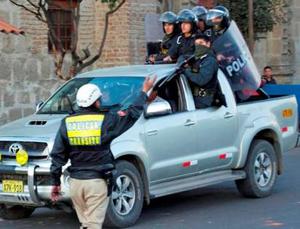
POLICE IN THE PAY OF MINING COMPANIES

A Corporate Mineral-Security Complex in Peru


by Luis Manuel Claps, NACLA

Peru is a mining conflict country. In September of this year, the Defensoría del Pueblo (National Ombudsman Office) reported 223 social conflicts in September alone, with more than two thirds of them linked to minerals. The report also registers 196 dead and 2,369 injured in disputes over natural resources from 2006 to 2011. The database of the Latin American Observatory of Mining Conflicts (OCMAL) registers 34 cases across Peru. Even though the State has increased its presence in some mining areas and has its own Social Conflict Administration Office, the front line often becomes the ugliest side of corporate-community relations.

Continue ReadingPOLICE IN THE PAY OF MINING COMPANIES