

TRANS-ATLANTIC PARTNERSHIP TRADE PACT

Duplicates Secretive Trans-Pacific Trade Pact

by Pete Dolack, Systemic Disorder

Neoliberalism knows no borders, so perhaps it should not come as a bolt out of the blue that the United States and European Union are set to negotiate a "Transatlantic Trade and Investment Partnership."

It might be thought that the Obama administration would have its hands full with the ongoing, top-secret Trans-Pacific Partnership talks, but it seems that much can be done in the absence of any pesky oversight. It might be thought that European Union officials would have their hands full with their series of financial crises, but it appears this is an irresistible opportunity to safeguard austerity.

Continue ReadingTRANS-ATLANTIC PARTNERSHIP TRADE PACT 

PLANET EARTH: NUCLEAR-FREE ZONE

by Karl Grossman, Common Dreams

With the second anniversary of the Fukushima Daiichi nuclear disaster this week, with North Korea having just threatened a “pre-emptive nuclear attack” against the United States and a US senator saying this would result in “suicide” for North Korea, with Iran suspected of moving to build nuclear weapons, with the continuing spread of nuclear technology globally, the future looks precarious as to humankind and the atom.

Can humanity at this rate make it through the 21st Century?

Continue ReadingPLANET EARTH: NUCLEAR-FREE ZONE 

ANARCHISM AND THE ARAB UPRISINGS

An Interview with Mohammed Bamyeh

by Joshua Stephens, Toward Freedom

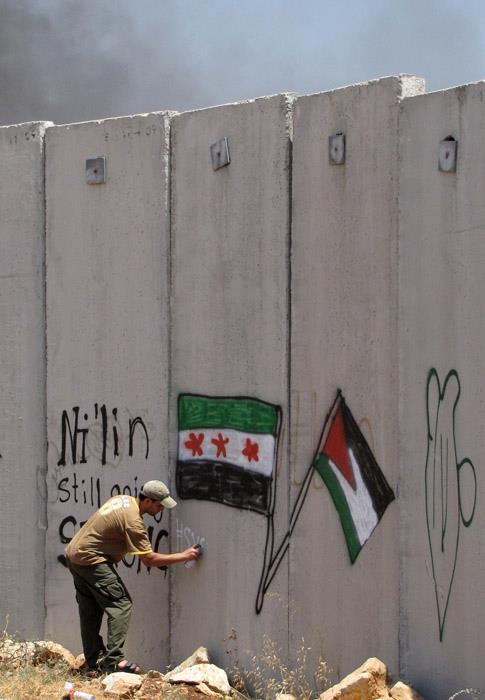
Spontaneity, largely horizontal organization, and a suspicion toward explicit political leadership have all been signature components of what’s referred to as the Arab Spring. This has been the case since the outbreak of the Tunisian revolution—regardless of the regimes that have resulted from the power vacuums left in their wake. Yet very little of the particularities or the historical forces driving these uprisings captured the imagination of or spoke to left anti-authoritarians in the west, until the appearance of a western-style black bloc in Cairo on the two-year anniversary of the Egyptian revolution. That contradiction, and a sudden gaze cast—particularly on Egypt—pose rather unsettling questions about representation, and a slouch toward Orientalism.

Continue ReadingANARCHISM AND THE ARAB UPRISINGS 

MARX AND EXTRACTIVISM IN LATIN AMERICA

by Joan MartĂ­nez Alier, EcoPortal.net

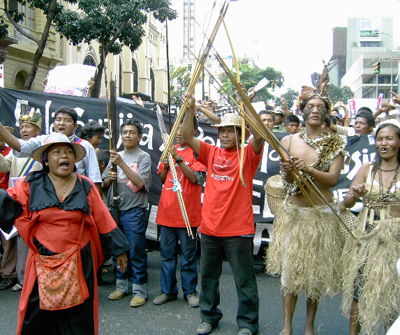
President Rafael Correa of Ecuador asks when and where Marx criticizes mega-mining. In various interviews, Correa, the mouthpiece of mega-mining and the expansion of oil exploitation, has asked, “Let’s see, señores marxistas, where was Marx opposed to the exploitation of non-renewable resources?” The response is easy. Marx and Engels criticized predatory capitalism, even if (in my opinion) we cannot make a proto-ecologist critique a fundamental pillar of their work, which was more focused in an analysis of the exploitation of salaried workers and its consequences for the dynamics of capitalism.

Continue ReadingMARX AND EXTRACTIVISM IN LATIN AMERICA 

CAN VIGILANTE JUSTICE SAVE MEXICO?

by Dudley Althaus, Global Post

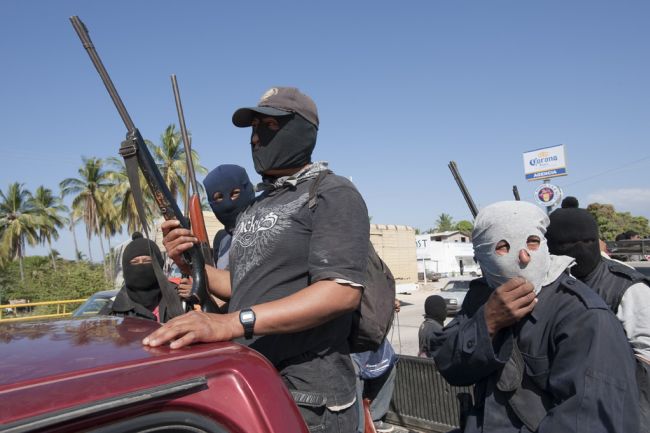
AYUTLA DE LOS LIBRES, Mexico — For almost a month now, hundreds of masked men wielding old shotguns, rifles, revolvers and machetes have claimed to be the law in the rugged mountains outside the faded resort of Acapulco.

Manning roadblocks and patrolling by the truckload, these citizen posses have been rounding up accused drug dealers, rapists, killers and rustlers under the wincing but winking watch of state and federal security forces.

Continue ReadingCAN VIGILANTE JUSTICE SAVE MEXICO? 

TUNISIA ON RAZOR’S EDGE

After the Assassination of Chokri Belaid
by Kevin Anderson, International Marxist-Humanists

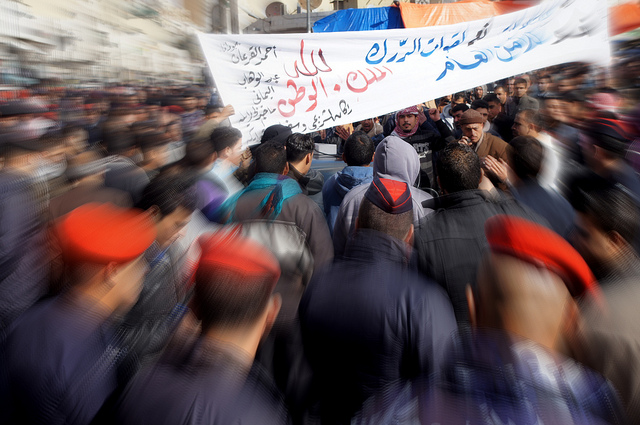
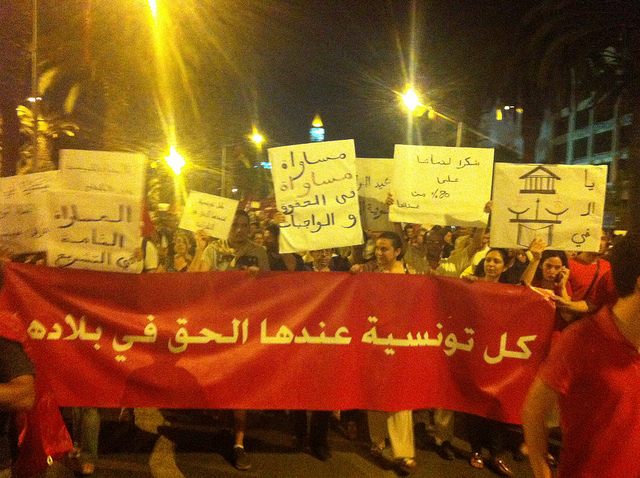
The assassination of leftist leader Chokri Belaid on February 6, apparently by Islamists, has brought into the open the long-simmering conflict that has pitted the ruling Islamist Ennahda Party against progressives, trade unionists, and secularists, who have staged the first general strike in 40 years and the largest street demonstrations since the 2011 revolution.  – Editors

Continue ReadingTUNISIA ON RAZOR’S EDGE 

STRUGGLE FOR LAND AND WATER IN THE ANDES

Campesinos Stand Up to the Mineral Oligarchy

by Bill Weinberg, WIN Magazine

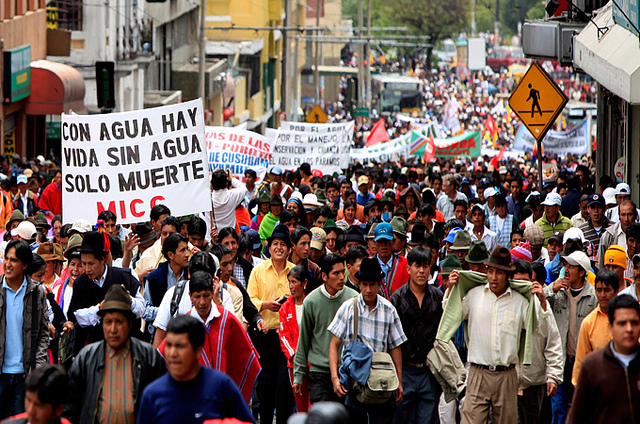
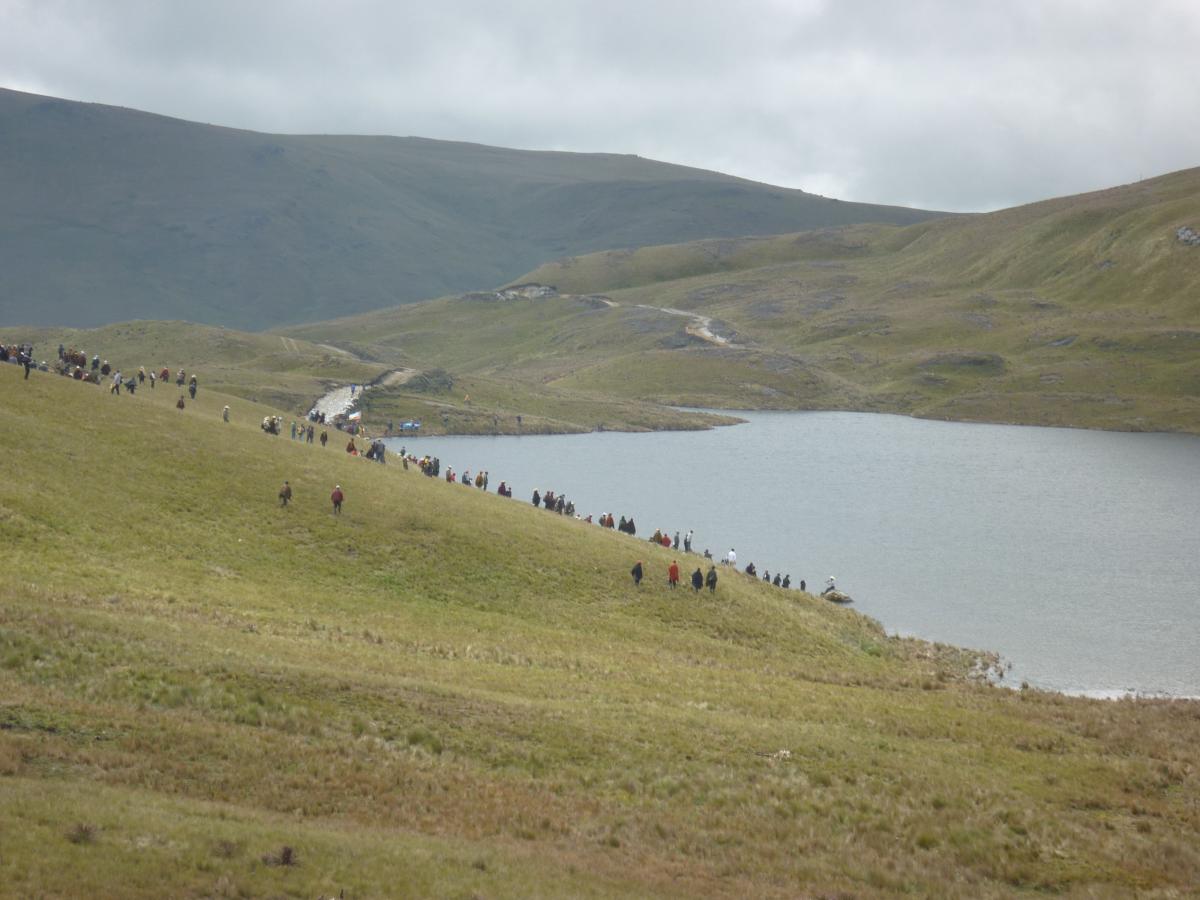
In what has become an emblematic struggle against government plans to open peasant lands to mineral interests throughout the sierras of Peru, local campesinos continue to hold strikes and protests in the northern region of Cajamarca—in defiance of a state of emergency and a heavy presence of army and National Police troops.

The months-long campaign to halt the mega-scale Conga gold mine high in Cajamarca’s alpine zone—which Colorado-based Newmont Mining hopes to develop with Peruvian partners and investment from the World Bank—cost five lives last July 3 and 4, when government troops opened fire on protesters in the rural towns of CelendĂ­n and Bambamarca. The youngest of the fallen was only 17 years old.

Continue ReadingSTRUGGLE FOR LAND AND WATER IN THE ANDES 

STRATEGIES OF A NEW COLD WAR

US Marines and the Drug War in Guatemala

by Dawn Paley, Toward Freedom

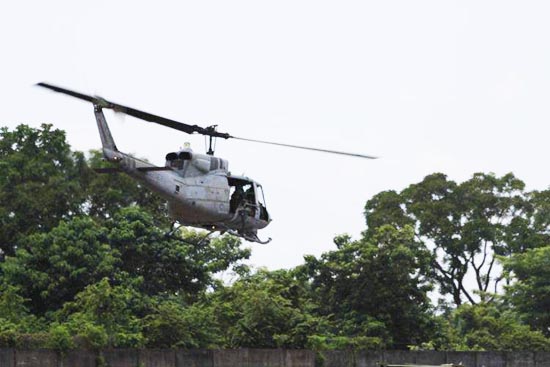
GUATEMALA CITY — The news broke in the United States during the lazy summer days of late August: 200 US Marines were stationed in Guatemala as part of the war on drugs. The deployment of US combat troops to Guatemala was part of Operation Martillo, a military plan meant to disrupt cocaine trafficking routes that pass through Central America on their way from Colombia to the United States.

Continue ReadingSTRATEGIES OF A NEW COLD WAR 

IRAQ: NO FUTURE FOR AL-QAEDA’S CHILDREN

from IRIN

BAQUBA — Near a swamp of sewage in a slum in eastern Iraq, six-year-old Amir plays soccer with friends, unaware of a fact that may continue to affect him for the rest of his life: His father—killed four months before he was born—was a senior leader within al-Qaeda.

Like dozens of other children of insurgents in Diyala province, Amir’s birth was not registered. He has no documentation, no citizenship, no access to government services and, his mother fears, no future.

Continue ReadingIRAQ: NO FUTURE FOR AL-QAEDA’S CHILDREN 
Mali

THE SANDSTORM OF WAR IN NORTHERN MALI

by Andy Morgan, Jan. 11

The situation along the demarcation line that separates Islamist-held northern Mali from the south of the country is agonizingly confusing.  The Malian army claim to have recaptured the strategic town of Douentza, while the Islamist claim the complete opposite. According their spokesperson, the bearded Sanda ould Boumama, the combined forces of AQIM, Ansar ud-Dine and MUJAO have pushed the Malian army back at least as far as the small town of Konna, if not further. Meanwhile France has mobilized some elite troops from a base in Chad and sent them to SevarĂ©, the town on the main east-west highway that serves as a transport hub for the Mopti region. The idea of Islamists capturing Mopti itself, Mali’s second largest city which is now dangerously close to the frontline, would be an A-grade nightmare not only for Mali but also for France and the international community. France has spent the last few months trying to persuade the US and the UN that need for action in northern Mali is urgent, without a great deal of success. There are also reports of an aerial bombardment of Konna although whether it was carried out by France or by Ukranian mercenaries isn’t entirely clear.

Continue ReadingTHE SANDSTORM OF WAR IN NORTHERN MALI 

THE DARK SIDE OF WIKILEAKS: REVISITED

Julian Assange, Ecuador, and the Belarus Connection

by Bill Weinberg, Al Jazeera

Aliaksandr Barankov is breathing easier, after Ecuador’s highest court on August 28 rejected a request for his extradition to Belarus—the country known as “Europe’s last dictatorship,” facing international isolation for its harsh repression. Barankov, a former police investigator from the ex-Soviet republic, was granted asylum by Ecuador in 2010,  after he was charged with fraud and extortion in his homeland—charges he claimed were bogus, and brought in retribution for having exposed a petrol-smuggling ring implicating high officials of President Alexander Lukashenko’s regime. Barankov said he feared for his life should he be sent back home. An extradition request by Belarus was refused last October.

But on June 7, Barankov was arrested at his home in Quito, and imprisoned while Ecuador’s courts reviewed a new extradition request from Lukashenko’s government. Shortly thereafter, probably not coincidentally, Lukashenko visited Quito and signed various cooperation pacts with Ecuador’s President Rafael Correa. “Everything changed after Lukashenko came,” Barankov told the Associated Press by phone from his Quito prison cell.

Barankov should soon be free again, and the high court’s ruling is a testament to the independence of Ecuador’s judiciary. However, his case probably would have received little international attention if it did not come just as Ecuador has granted diplomatic asylum to Julian Assange, the controversial mastermind of WikiLeaks, which has aroused the ire of Washington with its release of thousands of classified US diplomatic cables. And few media reports have noted the special irony in the juxtaposition of the Assange and Barankov cases: a rights group is demanding a full accounting from WikiLeaks on claims that it may have actively collaborated with the Belarus dictatorship.

Continue ReadingTHE DARK SIDE OF WIKILEAKS: REVISITED 

ENVIRONMENTAL DISSONANCE

Global Warming and Bolivia’s Kallawaya Healers

by Dylan Harris, Upside Down World

LA PAZ — As the global climate change discourse heated up in Doha at the COP18, the lived reality of climate change was becoming more apparent in some of the world’s most vulnerable ecosystems.  In Bolivia, a country unfortunately well acquainted with the effects of global warming, the COP discourse is more relevant now than ever.

Villages nested in the craggy peaks of the Cordillera Apolobamba of Northern Bolivia house the centuries-old Kallawaya healing tradition. A few weeks ago, I was conducting field research in the Apolobamba region of Northern Bolivia, walking from village to village and discussing agriculture and climate change with locals.

Continue ReadingENVIRONMENTAL DISSONANCE