


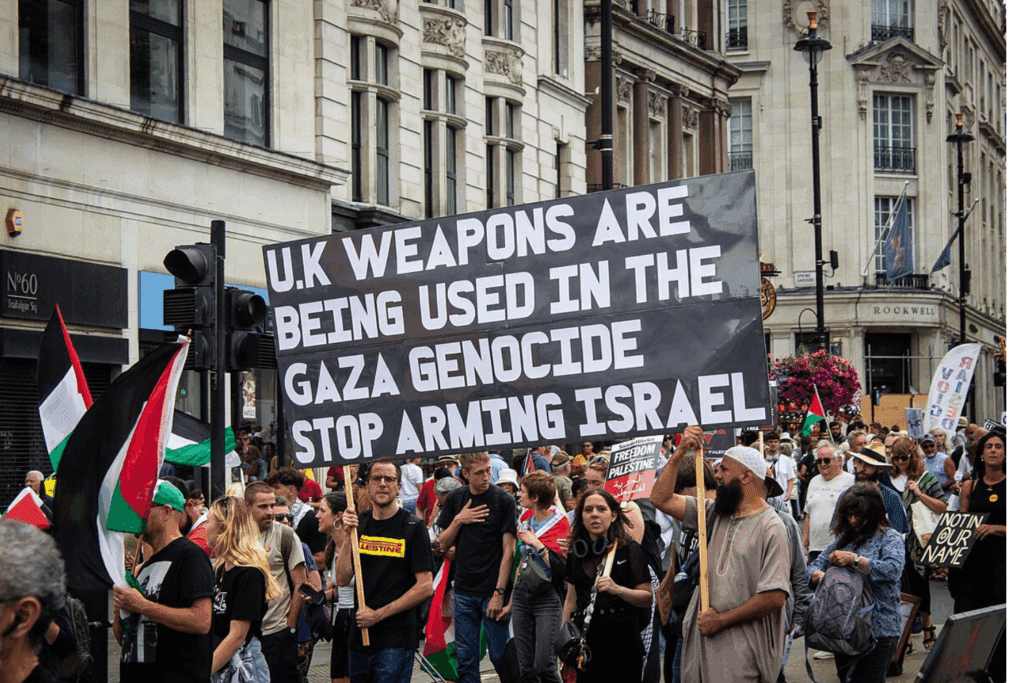
London’s Metropolitan Police Service (MPS) reported that 466 people were arrested on Aug. 9 for displaying support for activist group Palestine Action at a protest in Westminster. The MPS added that an additional eight arrests were conducted, including five for assault on police officers. Police said they invoked Section 60AA of the Criminal Justice & Public Order Act of 1994, which grants police officers the authority to demand the removal of any signs or clothing “expressing support” for a “proscribed group.”
Most of those arrested were holding placards that read: “I oppose genocide. I support Palestine Action.”
The MPS noted that the individuals were sent to “Prisoner Processing Points in the Westminster area,” where they were released on bail, conditional upon their not participating in any protest led by Palestine Action in the future. If the authorities press charges, they may face up to 14 years in prison.
Palestine Action, formed in 2020, was designated a “terrorist organization” by the UK government earlier this year under the Terrorism Act of 2000, following a series of “direct actions” (targeted vandalism) against arms manufacturers believed to be supplying weapons to Israel as well as warplanes and armaments at a Royal Air Force base. The designation was approved by a vote of Parliament last month.
The Terrorism Act of 2000, the UK’s main legislation governing counter-terrorism, stipulates that the government can ban the operation of organizations believed to be involved in acts of terrorism, allowing the government to criminalize membership, support, or the promotion thereof.
In July, UN Human Rights Chief Volker Türk warned that the ban of Palestine Action under the act was an over-extension of counter-terrorism powers to non-terrorist conduct. He stated that the decision to designate the organization as a terrorist group was disproportionate, violating freedom of expression and assembly.
According to the Network for Police Monitoring (NETPOL), the criminalization of support for Palestine Action is a political move aiming to shut down solidarity campaigns for the Palestinians. Particularly, NETPOL noted that the broad and poorly defined anti-terrorism law gives police powers that could be abused in racist and Islamophobic ways.
From JURIST, Aug. 10. Used with permission.
Photo: Cary Bass-Deschênes via Good Law Project


Questions about Palestine Action targets
It appears that Palestine Action targeted an arms plant in Belgium in one of their “direct actions” because it was owned by OIP, a subsidiary of the Israeli firm Elbit Systems. However, a report in Brussels Signal indicates that the plant was not actually producing armaments for Israel—but for Ukraine.
Similarly Ukraine’s Militarny reports that the principal RAF base that Palestine Action targeted, Brize Norton, is not involved in missions in support of Israel—but of Ukraine.
We will assume that these were honest errors on the part of Palestine Action—but they do appear to have been errors (at least). The question is explored, with more cynical assumptions, by vlogger Dylan Burns.
UN experts express concern for activists on hunger strike in UK
UN experts on Dec. 19 called for the protection of eight pro-Palestine activists on hunger strike while imprisoned in the UK. The eight individuals have been on hunger strike since Nov. 2.
The prisoners have five demands: the end of all censorship; immediate bail while awaiting trial; the right to a fair trial, including the release of any documents related to their cases; the immediate dropping of all terrorism-related charges; and that the UK government divests from Elbit Systems, an Israeli defense manufacturing company.
The eight prisoners are independently accused of charges related to two actions damaging the property of Elbit Systems and the Royal Air Force. Their names are Qesser Zuhrah, Amu Gib, Heba Muraisi, Jon Cink, Teuta Hoxha, Kamran Ahmed, Lewie Chiaramello and Umer Khalid. Four of the eight have ended their hunger strikes due to health reasons.
Cink, Khalid, Chiaramello, and Gib are accused of breaking into a Royal Air Force hangar and allegedly causing £7million worth of damage to two military aircraft. Zuhrah, Muraisi, Hoxha and Ahmed are members of the Filton 24, accused of participating in the break-in at Elbit System’s research center.
The experts also expressed concern about the overbreadth of the “terrorism” definition under UK law, and the mass arrests of individuals for alleged support of Palestine Action.
UK Prime Minister Keir Starmer’s government classified Palestine Action as a terrorist organization in July. Section 1(b) of the UK Terrorism Act 2000 defines terrorism as an action that involves serious damage to property. Parliament can classify a group as a terrorist organization under Section 3 of the act for participating in or glorifying acts of terrorism.
Police in the UK have arrested hundreds of anti-genocide protestors for holding signs stating, “I Support Palestine Action.” UK police recently arrested Greta Thunberg for holding a sign that read “I support Palestine Action and the Palestine Action prisoners.” Authorities later released her on bail until March.
In 1981, 10 Irish Republican prisoners died in British custody. The leader of the movement, Bobby Sands, died after 66 days on strike. (Jurist)
UK High Court rules Palestine Action ban unlawful
The UK High Court of Justice ruled on Feb. 13 that the Home Secretary acted unlawfully in designating Palestine Action as a terrorist organization, and ordered the decision to be quashed.
The ruling found that the Home Secretary is empowered to exercise discretion when deciding to designate a group as a terrorist organization, and the proscription of Palestine Action failed to take into account “other factors,” aside from the group’s actions meeting the threshold for proscription, an error that the Court deemed “significant.”
While the judgment noted that “[r]eal weight must attach to the fact that Palestine Action has organised and undertaken actions amounting to terrorism,” it ruled that the “nature and scale of Palestine Action’s activities had not yet reached the level, scale and persistence to warrant proscription.” On this point, the judgment stated:
The High Court concluded that the ban on the group’s activities should be lifted “pending the possibility of an appeal.”
Palestine Action’s co-founder, Huda Ammori, celebrated the victory in a post on X (formerly Twitter), announcing that the ban was found “disproportionate to free speech.”
The Metropolitan Police responded to the decision in a press release posted on X, stating that, as the quashing order is pending appeal, “expressing support is still a criminal offence.” The response also warned that the police focus will now be on “gathering evidence of those offences” as opposed to “making arrests at the time.”
Ammori brought the legal challenge following the group’s proscription as a terrorist organization last year. Ammori’s challenge was made under the Human Rights Act 1998and Articles 10 and 11 of the European Convention on Human Rights. UK Secretary of State Yvette Cooper announced the categorization following the group’s vandalism of military planes, in protest of the conflict in Gaza. The categorization was made under the Terrorism Act 2000, making any affiliation or expressed support of the group an illegal offense.
A UK Home Office statistic shows that 1,630 terrorism-related arrests made in 2025 were linked to the Palestine Action ban. This statistic demonstrates a “rise of 660% compared with the previous year.” In August 2025, 466 demonstrators were arrested at a protest at Westminster, drawing concern from rights groups. Some critics charge that the proscription, which was rushed through Parliament, was a political move.
In late January, the last of eights imprisoned activists who had been on hunger strike in protest of the criminalization of Palestine Action ended his fast. (Jurist)