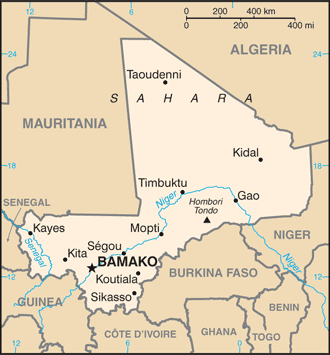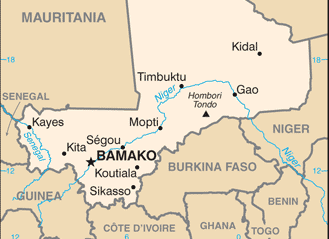
Human Rights Watch (HRW) confirmed March 10 that an al-Qaeda-linked armed group summarily executed 10 long-haul truck drivers and two teenage apprentices in late January in southwestern Mali as part of the group’s attack on a fuel convoy, and deemed the acts “apparent war crimes.”
HRW called on the Malian government to “seek assistance from the African Commission on Human and Peoples’ Rights” for the effort to “protect civilians and hold those responsible for abuses to account.”
Witnesses to the attack on the road to the the city of Kayes said assailants opened fire on the front of the 40-truck convoy, followed by a shift towards the middle and back. A military escort accompanied the convoy, and soldiers advised drivers not to panic or stop. Some drivers abandoned their trucks and fled; however, attackers captured many fleeing drivers, later executing 10 and releasing others. Attackers burned multiple trucks, creating large clouds of smoke.
Bodies were abandoned by the side of the road and found on Feb. 11 “with their hands tied behind their backs and their throats slit.” One surviving truck driver said, “No one dared recovering them out of fear of another attack.”
Mali’s truck driver union staged a nationwide strike in response to the attack, demanding recovery of victims’ bodies to ensure their families can have proper funerals.
The group believed responsible for the attack was Jama’a Nusrat ul-Islam wa al-Muslimin(JNIM), which has described itself as the official branch of al-Qaeda in Mali. The group has claimed responsibility for numerous attacks against Malian security forces, the UN Multidimensional Integrated Stabilization Mission for the country (MINUSMA), and others.
The trucks had been transporting fuel to a region that hosts several military bases. Whether attackers knew the fuel was slated for military use would partially determine whether the attack on the trucks constituted oppositional military action under the laws of war. HRW explained, however, that the treatment of the drivers was criminal in any case, stating:
The legality of the attack on the fuel convoy would depend on whether the attackers took all feasible steps to verify that the fuel was intended for armed forces use. Whether the attack on the trucks was lawful or not, the cruel treatment and execution of the truck drivers was clearly unlawful.
HRW stated that the acts violated customary laws of war and Article 3 to the Geneva Conventions. Under the former, attacking forces are required to distinguish between civilians and combatants, and any intentional attack on civilians is strictly prohibited. The latter states that this principle applies to “conflicts not of an international character,” such as that in Mali.
From JURIST, March 10. Used with permission. Internal links added.
Map: PCL