


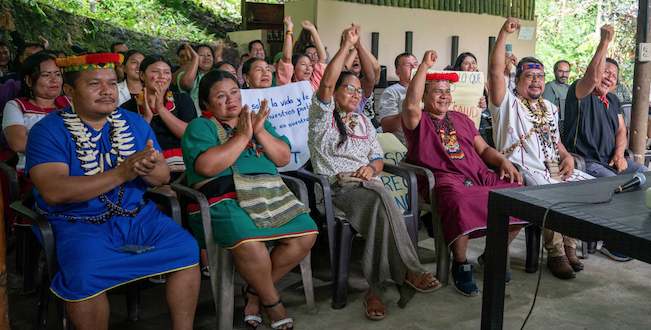
The Ecuadoran government’s financial crimes agency froze the bank accounts of several indigenous and environmental groups, using secret intelligence information in an apparent effort to silence protests, Human Rights Watch said on Dec. 9. Juanita Goebertus, Americas director at Human Rights Watch, commented that the measures in question constitute a misuse of anti-money laundering mechanisms, which “should be used to fight crime and not environmental groups.”
The government’s Unidad de Análisis Financiero y Económico (UAFE) cited secret intelligence reports to justify the freezing of the funds. Among the groups affected was the indigenous organization Alianza Ceibo, representing the Waorani, Siekopai, A’i Cofán and Siona peoples, which has defended the economic, social, cultural and collective rights of these peoples for 10 years.
The groups were not notified of the decision beforehand. Furthermore, authorities did not disclose reasons for the freezes. UAFE officials cited the June 2025 Intelligence Law to argue that this information was confidential. After the cases were challenged in court, judges liftedsome of the freezes, finding that the agency did not provide sufficient substantial evidence for the bans.
In freezing the accounts, the UAFE applied a provision in Ecuador’s new Social Transparency Law. The law, passed in August, enables the agency to freeze accounts without a court order when it claims to have “objective, serious, and verifiable evidence” of suspicious activity, with any review only coming post factum. The law only limits the measure by stating its application should be “exceptional,” “proportionate to risk,” and “limited exclusively to the amount of the [suspicious] transaction.”
Both the Intelligence Law and the Social Transparency Law are incompatible with the Ecuadoran constitution, rights groups say, and have challenged them both in court. They say the actions by the agency interfere manifestly with the right to property, codified in the International Convention on Civil & Political Rights. The Inter-American Court of Human Rights has ruled that limitations to the right to property must be necessary and proportionate to reach a legitimate goal.
Ecuadoran President Daniel Noboa defended the measures publicly, saying that the funds were intended to “destabilize” his administration with demonstrations. The financial measures were implemented over the past two months, as indigenous groups protested against the government’s decision to cut diesel subsidies. Environmental groups meanwhile protested the decision to approve a mining project in the southern province of Azuay, which threatens the fragile ecosystems in the region. To curb the protests in October, authorities used what rights groups assailed as massive and indiscriminate force, resulting in injuries and deaths.
From JURIST, Dec. 11. Used with permission. Internal links added.
See our last reports on the crackdown in Ecuador, and the October protests.
Photo: Alianza Ceibo

